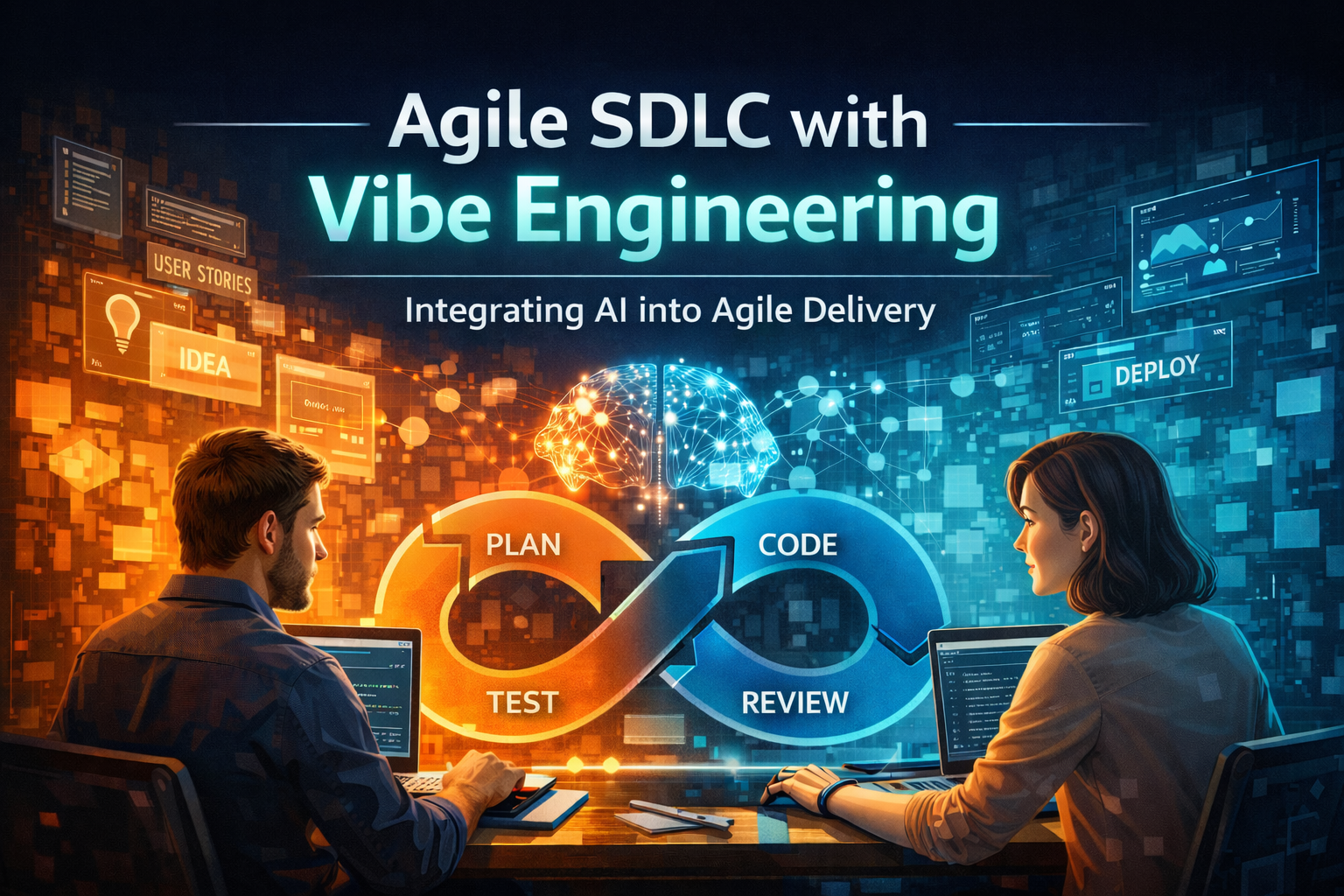
Agile optimized human collaboration and iterative delivery. Vibe Engineering adds AI as a first-class execution layer while preserving Agile’s core principles.
This is not “Agile vs AI.” It’s Agile + AI = human-AI delivery pipelines.
Below is what industry leaders and research already confirm — and what is still evolving.
AI Is Already Inside Enterprise SDLC
Enterprise adoption is no longer experimental. According to PwC’s GenAI enterprise survey, most organizations now use generative AI across multiple SDLC phases, including requirements, design, coding, and testing.
McKinsey’s research on AI in software development further shows that meaningful impact appears only when companies change workflows, operating models, and team behaviors, not when AI tools are simply layered onto existing processes.
This aligns directly with the Vibe Engineering premise: extending Agile from human-only execution into human + AI orchestration.
What Agile Keeps
Vibe Engineering strengthens Agile principles rather than replacing them.
Frequent Delivery
AI accelerates iteration cycles, enabling more frequent delivery of working software — a direct reinforcement of Agile’s “working software first” principle, as highlighted in PwC’s enterprise SDLC adoption data.
Fast Feedback Loops
Enterprise AI adoption playbooks emphasize frequent validation checkpoints to prevent quality regressions and review backlogs when AI output scales, as described in Faros’ Enterprise AI Coding Assistant Scaling Guide.
This reinforces Agile’s core feedback-driven delivery loop.
What Changes in Practice
The SDLC phases remain. The execution mechanics shift.
Planning: From Tasks to Intent
| Classic Agile | Vibe Engineering |
|---|---|
| Break stories into implementation tasks | Define specs and constraints |
| Estimate coding effort | Clarify acceptance criteria |
| Assign validation ownership |
Structured AI-assisted SDLC workflows emphasize using spec artifacts to stabilize AI output and preserve engineering discipline, as described in AI-Enabled SDLC: A Structured Human-Centered Workflow.
Planning becomes less about “who writes code” and more about who validates intent and quality.
Development: Humans Become Directors
Enterprise data shows AI coding assistants improve throughput and developer efficiency when integrated systematically, according to Faros’ enterprise adoption analysis.
Large organizations such as JPMorgan Chase have publicly reported 10-20% efficiency gains using internal AI coding assistants, as covered by Reuters in this case study.
At the same time, recent academic research — including the SAFE-AI framework for AI-driven software engineering (Aug 2025) — confirms that human oversight, runtime verification, and human-in-the-loop checkpoints remain essential for complex reasoning, system integration, and architectural correctness.
In Agile terms, engineers shift from “typing code” to directing system behavior and validating outcomes.
Testing & Reviews: The New Bottleneck
As AI output scales, review bandwidth becomes the dominant constraint.
Enterprise telemetry shows productivity gains plateau when review and validation workflows fail to evolve alongside AI generation, according to Faros’ scaling guidance.
Vibe Engineering adapts Agile quality gates into layered validation:
- Automated AI and static analysis
- Policy and architecture checks
- Human judgment pass
Quality control remains central — it simply becomes more automated and structured.
Ceremonies: Agile Meetings Evolve
Standups → Alignment Checkpoints
Instead of “what did I code?”, teams focus on:
- What outputs need review
- What decisions are blocking progress
- Where intent is unclear
Planning → Spec Calibration
Teams align on:
- Risk
- Integration impact
- Validation complexity
Retrospectives → Pipeline Optimization
Leadership research from McKinsey’s AI delivery transformation analysis highlights that teams gain the most value when retrospectives focus on workflow efficiency, feedback loops, and organizational friction, not just tool usage.
Sprint Cadence: What’s Actually Known
Important reality check:
There is no standardized AI-native Agile framework yet defining optimal sprint length, ceremonies, or team topology.
Most industry guidance today focuses on:
- Tool adoption
- Governance models
- Leadership enablement
- Measurement systems
—not full SDLC redesign, as reflected in both McKinsey’s enterprise guidance and Faros’ scaling playbook.
This means Vibe Engineering-style SDLC patterns are still emerging practice, not finalized doctrine.
Practical View: Two-Speed Agile
Many AI-enabled teams are converging on a hybrid operating model.
Strategic Horizon (Bi-weekly or Monthly)
- Roadmap alignment
- Architecture direction
- Stakeholder coordination
Execution Rhythm (Weekly or Continuous)
- Spec updates
- Output validation
- Rapid iteration cycles
This preserves Agile stability while matching AI execution speed.
Final Thought
Agile optimized how humans collaborate.
Vibe Engineering optimizes how intent flows into production through human-AI systems.
The SDLC doesn’t disappear. It becomes:
- Faster
- More automated
- More leverage-driven
- More dependent on human judgment than raw execution
Agile isn’t being replaced.
It’s being lifted into a new abstraction layer — and the industry is only beginning to define what that future really looks like.