Most writing about AI in software engineering is about output. Faster code, faster reviews, faster tickets closed. That framing is not wrong, but it is small. It measures the same activity as before and asks how to do more of it per hour.
This book takes a different position. Where implementation becomes cheaper, code production may cease to be the primary constraint. It is a well-designed organization that turns work into durable understanding faster than its competitors. My argument is that advantage then depends increasingly on organizations that turn execution into reliable outcomes and retained learning.
That single shift is the spine of everything here. The rest of the book is what follows from taking it seriously.
This is not a linear book
A traditional book assumes a reading order. Chapter 2 depends on Chapter 1. You start at the front and arrive at the back.
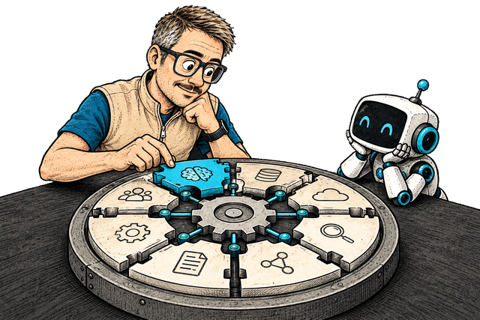
This book does not work that way, because the thing it describes does not work that way. An AI-native engineering organization is not a sequence of steps. It is a set of interacting systems: how people communicate, where knowledge lives, how judgment is learned, how leadership is exercised, how work gets executed, and how the organization itself evolves.
So the book is organized as dimensions, not parts. Each dimension is a facet of the same operating model, viewed from a different angle. You can enter from any of them. A chapter on Async by Default will point you toward Hierarchical Context when it needs to; a chapter on the Engineering Leadership Stack will point you back to both. The connections are the content.
The delivery and learning loop
- Define the outcomeA problem worth solving, with evidence and boundaries.
- Resolve the contextOwned sources, accepted decisions, and explicit authority.
- Execute within limitsObservable work, isolated changes, and a way to stop.
- Challenge the resultIndependent evidence and accountable review.
- Deliver and observeBounded release, recovery, and an outcome to inspect.
- Retain what helpsA correction that improves the next decision or check.
The eight dimensions
Each dimension answers one question. Read them as a wheel, not a ladder.
| Dimension | The question it answers |
|---|---|
| I. Foundations | What actually changes when AI enters software engineering? |
| II. Communication | How do teams coordinate when execution outruns the calendar? |
| III. Knowledge | Where does organizational knowledge live, and who governs it? |
| IV. Learning | How do engineers still learn when agents do the routine work? |
| V. Leadership | What does each leadership layer design in an AI-native org? |
| VI. Execution | How does work actually get built with agents in the loop? |
| VII. Organizations | How do you design an organization that continuously learns? |
| VIII. Future | What is still unresolved, and where is this heading? |
None of these stands alone. Communication fails without Knowledge to route. Learning collapses without Leadership that designs for it. Execution at machine speed exposes every weakness in the other seven. The point of the book is to hold them as one model.
A further reading path is Recursive Self-Improvement and Organizational Change: how the delivery system can improve the machinery of its next improvement, and where organizational adoption makes the analogy incomplete.
Mental models are the connective tissue
Some ideas recur across many dimensions. Rather than re-explaining them each time, the book gives each one a canonical home and references it everywhere else. These are the mental models: The AI SDLC, Async by Default, Hierarchical Context, Context as Infrastructure, Thinking Out Loud, Learning Streams, The Engineering Leadership Stack, Administrative Gravity, Span of Improvement, and Organization as a Product.
When you see one of these terms, it means the idea has a precise definition elsewhere and is being used deliberately, not casually. Over time these models become the vocabulary of the operating manual. If you only remember the models and how they connect, you will have the book.
How to read this
Start wherever the question you have today lives. If you lead an organization, Leadership and Organizations will feel most urgent. If you are rebuilding how your teams coordinate, start in Communication and Knowledge. If you want the argument from first principles, read Foundations first.
The blog is the research layer: individual arguments, published as snapshots in time. This book is the textbook: the integrated, continuously revised version. Where a blog post expands an idea, it gets folded back into the relevant chapter. Nothing here is final, which is the point. It is a living operating manual, not an edition.
Who this is for, and what it does not assume
This book is for engineers and leaders responsible for a delivery system, from a small product team to a multi-team organization. It assumes that some work can be delegated to agents, not that every task benefits from delegation. Where implementation remains difficult or verification is weak, the right response may be a narrower experiment.
The operating model is a proposal to test against evidence. It is not a validated maturity scale, a staffing prescription, or a promise of productivity gains. The goal is reliable customer and organizational outcomes, including the decision not to build something.
Choose a reading path
| Your question | Start here | Then follow |
|---|---|---|
| How does this fit together? | One Change Through the System | AI SDLC, then Organizational Operating Systems. |
| How do I delegate a change responsibly? | The AI-Executable Ticket | Agentic Development, Evaluation, Human in the Loop. |
| Why is coordination still slow? | Async by Default | Decision Records, Hierarchical Context, Context over Meetings. |
| How do people keep developing? | What Async Can’t Teach You | Thinking Out Loud, Mentorship. |
| Where should my company invest? | Engineering Economics | The Organization as a Product, Applying the Book. |
The running case is fictional and explicitly labeled. It demonstrates the method without pretending to be evidence of business impact. Research citations support narrower claims; the design choices that connect them remain the author’s argument.
Keep the vocabulary precise
A decision record preserves a choice and its rationale. A context contract requests and tracks cross-team action. A context bundle supplies selected, versioned sources to one run. An executable ticket defines the work and its boundaries. They may live in the same tool, but they answer different questions.
Likewise, human learning, a new regression test, and an updated agent instruction are different outcomes. None should be claimed merely because a summary was saved.
The dependencies run both ways. Execution needs context and authority; its failures reveal weaknesses in them. Learning needs evidence and protected attention; it changes the next execution. Leadership owns the conditions under which those loops can work. Read the dimensions separately, but assess a proposed improvement across their boundaries.