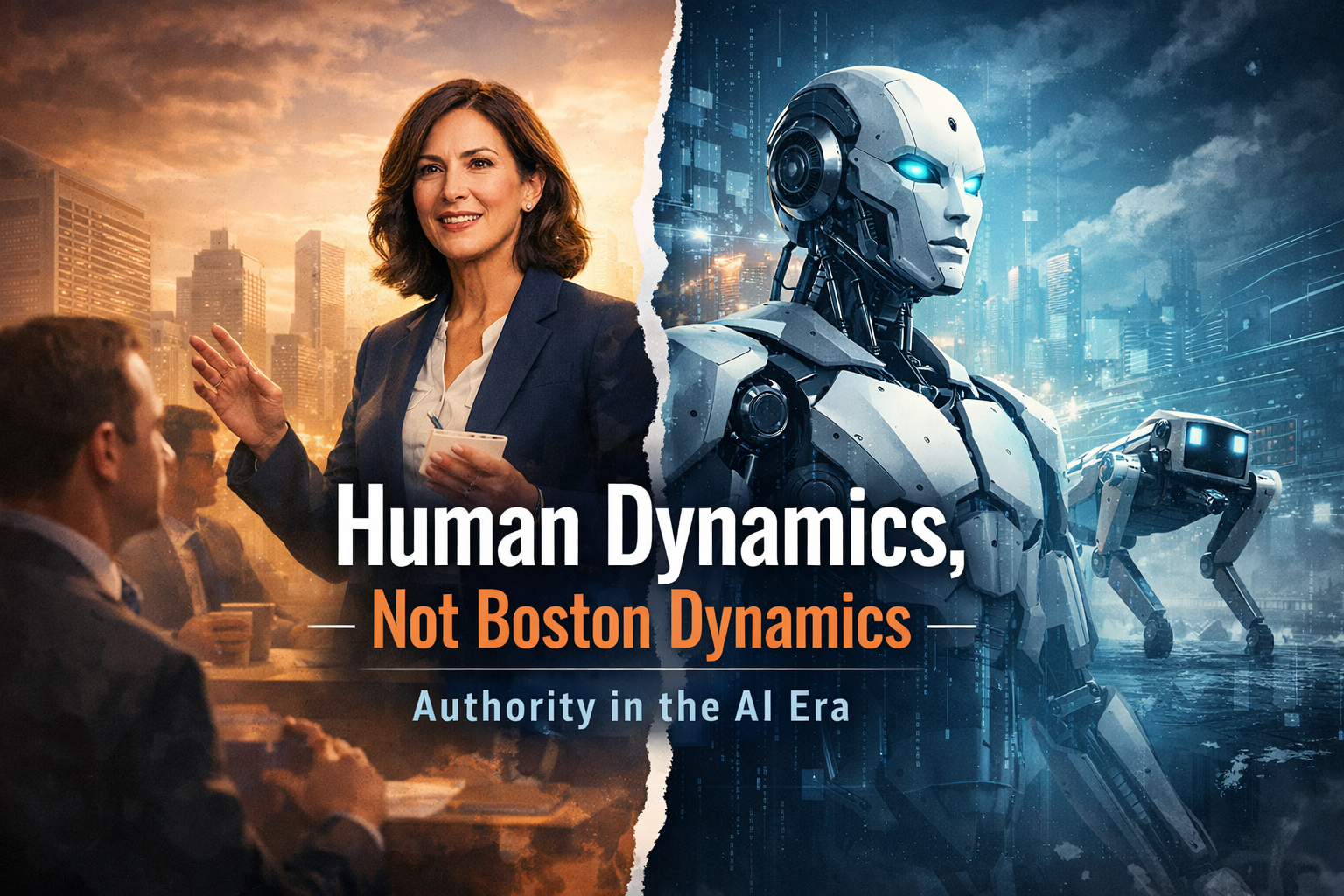
Authority, Age, and Power When Knowledge Stops Being the Divider
Boston Dynamics perfects mechanical balance. AI may be disrupting social balance.
The most significant impact of AI inside organizations may not be productivity gains. It may be the restructuring of authority.
For decades, corporate hierarchy rested on advantages that accumulated with time. AI compresses some of those advantages while leaving others intact. At the same time, organizations themselves are thinning. That combination reshapes human dynamics.
1. The Historical Authority Model
Authority traditionally emerged from four compounding advantages:
- Time Exposure — experience with crises, strategy cycles, irreversible consequences.
- Knowledge Accumulation — domain depth, institutional memory, pattern recognition.
- Relational Capital — trust networks, sponsorship, coalition power.
- Communication Leverage — framing ability, narrative clarity, audience calibration.
Together, these produced a relatively stable legitimacy equation:
Seniority ≈ Experience + Expertise + Networks + Narrative Authority → Authority
The model worked because these advantages were slow to accumulate and difficult to shortcut.
2. What AI Compresses — and What It Does Not
AI materially reduces:
- Time required to acquire explicit knowledge.
- Friction in generating structured analysis.
- Barriers to producing executive-grade documentation.
- Cost of exploring alternatives.
This weakens the link between age and analytical capability. A Stanford/MIT study published in the Quarterly Journal of Economics (May 2025) found that generative AI boosted worker productivity by 14% on average — but novice and low-skilled workers improved by 34%, effectively closing the gap with experienced colleagues. A joint Harvard Business School and BCG study confirmed the pattern: below-average consultants improved by 43% with AI, while top-half performers gained only 17%.
However, AI does not directly compress:
- Trust accumulation.
- Governance authority.
- Legal responsibility.
- Stakeholder legitimacy.
- Consequence ownership.
Communication advantage is partially affected. AI can generate articulate text, but persuasive authority depends on credibility and relational context.
The result is asymmetrical compression.
Knowledge equalizes faster than legitimacy.
An important caveat: recent research suggests AI narrows the gap most effectively for workers who have some foundational knowledge but lack senior-level depth. Complete novices with no baseline domain experience see less benefit — interpreting and refining AI output still requires some expertise.
3. Capability vs Decision Rights
Decision-making operates at three layers:
- Analysis
- Recommendation
- Formal decision rights
AI expands participation in the first two.
The third remains structurally constrained.
Decision rights allocate capital, commit strategy, and carry accountability. Authority is therefore less about cognitive dominance and more about recognized risk-bearing capacity combined with legitimacy.
As knowledge asymmetry shrinks, authority requires clearer justification.
4. The Shrinking Organization Effect
AI does not only redistribute capability. It often reduces organizational size.
Fewer layers. Fewer coordination roles. Fewer formal titles.
Deloitte’s 2025 Human Capital Trends report on the future of the middle manager reports that US employers were advertising 42% fewer middle-management positions at the end of 2024 than in spring 2022, with AI automating much of the coordination, reporting, and monitoring work traditionally done at that layer.
As companies shrink:
- Middle-management compresses.
- Decision rights concentrate.
- Authority becomes scarcer.
Hierarchy does not disappear. It concentrates.
5. Structural Shift in Authority
| Dimension | Historical Model | AI-Lifted, Lean Model |
|---|---|---|
| Knowledge | Accumulates slowly | Rapidly accessible |
| Age Correlation | Strong predictor of expertise | Weaker predictor of analytical dominance |
| Authority Basis | Seniority + expertise | Legitimacy + accountability |
| Organization Shape | Thick hierarchy | Lean, concentrated decision rights |
| Communication | Advantage amplifier | Primary differentiator |
| Relational Capital | Builds gradually | Remains durable |
Age becomes a weaker predictor of influence. Systemic contribution and consequence-bearing become stronger predictors of authority.
6. Emerging Tensions
As capability distributes more evenly and organizations flatten, predictable tensions arise:
Legitimacy Pressure When knowledge gaps shrink, deference must be justified explicitly.
Influence–Authority Divergence High-capability individuals may gain informal influence without formal accountability.
Authority Concentration Fewer individuals hold decision rights, raising the bar for earning them.
Framing Competition In environments saturated with analysis, those who define the problem gain disproportionate power.
AI democratizes output. It does not democratize legitimacy.
7. Bias, Perception, and the Charisma Premium
As knowledge equalizes, perception may carry more weight.
Authority depends on trust and communication. Trust and communication are filtered through human bias.
Research on the halo effect, first described by Edward Thorndike in 1920, shows that individuals who are:
- Physically attractive
- Confident in delivery
- Verbally fluent
- Socially dominant
are often perceived as more competent, independent of actual performance. Anderson and Kilduff (2009) found that individuals high in trait dominance attain influence because they appear competent — through assertive speech, direct eye contact, and expansive posture — even when they lack actual competence.
In knowledge-scarce systems, expertise can override perception bias.
In knowledge-equalized systems, perception may regain influence.
Does AI Create a Market Premium on Charisma?
Potentially.
If technical differentiation shrinks, differentiation shifts toward:
- Framing clarity
- Persuasive delivery
- Emotional signaling
- Narrative coherence
These are charisma-adjacent capabilities.
In lean organizations where decisions are faster and authority is concentrated, individuals who command attention and reduce ambiguity quickly may gain disproportionate influence.
Charisma may accelerate access to authority.
The Risk
If authority becomes too perception-driven, organizations risk:
- Overvaluing confidence over judgment
- Rewarding fluency over depth
- Elevating persuasive but risk-blind individuals
In high-velocity environments, misjudgment scales quickly.
The Counterbalance
Durable authority still depends on:
- Measurable outcomes
- Consequence ownership
- Risk awareness
- Consistent reliability
Perception may open the door. Accountability determines who remains inside.
8. The 15-Year-Old Test
If a highly capable 15-year-old can generate correct analysis, why should they not decide?
Because authority inside a system is not self-declared.
It is conferred through:
- Governance recognition.
- Stakeholder acceptance.
- Accountability attachment.
- Risk absorption capacity.
AI changes capability distribution.
It does not automatically rewrite legitimacy contracts.
The decisive variable remains: who bears irreversible consequences?
Leadership Playbook: Earning Authority in an AI-Lifted, Lean Organization
If knowledge advantage weakens and hierarchy thins, authority must be earned through structural contribution.
| Focus | What to Develop | Why It Matters |
|---|---|---|
| Leverage | Systems thinking, automation, scalable frameworks | Authority follows output multiplication |
| Outcome Ownership | Clear economic or strategic responsibility | Decision rights attach to measurable impact |
| Stability | Calm under pressure, structured thinking | High-velocity systems reward emotional control |
| Framing | Problem definition, tradeoff clarity | Direction-setting shapes decisions |
| Trust | Reliability, fairness, cross-functional credibility | Legitimacy stabilizes authority |
| Risk Awareness | Downside modeling, consequence ownership | Protecting the system earns durable power |
Authority in lean systems behaves less like a ladder and more like gravity.
It concentrates around those who:
- Increase system output.
- Reduce systemic risk.
- Clarify direction.
- Absorb consequence.
Capability earns influence. Leverage earns relevance. Trust earns centrality. Accountability grants authority.
Final Perspective
AI changes how quickly humans generate knowledge. It changes how broadly capability distributes. It changes organizational shape.
As knowledge stops being the dominant divider and companies thin their layers, authority does not disappear.
It concentrates.
The defining challenge of the AI era is not mechanical.
It is human: How authority is justified, granted, and sustained when intelligence is no longer scarce and perception becomes more visible.