Something feels off lately.
Not just faster — harder to absorb.
The pace of change in software and AI is obvious. What’s less obvious is what it’s doing to my ability to keep up in a healthy way.
I can still learn, still understand, still connect ideas.
But after a certain amount of input, I start feeling resistance. Not confusion exactly — more like saturation.
Which raises a question I don’t have a good answer to:
Am I just tired — or is there an actual cognitive limit I’m running into?
What It Feels Like
This isn’t binary. It’s more like gradual overload:
- I jump between topics faster than I used to
- new inputs start feeling heavier after a while
- at some point in the day, taking in more information becomes noticeably less effective
- the pace of incoming change starts feeling higher than my pace of real absorption
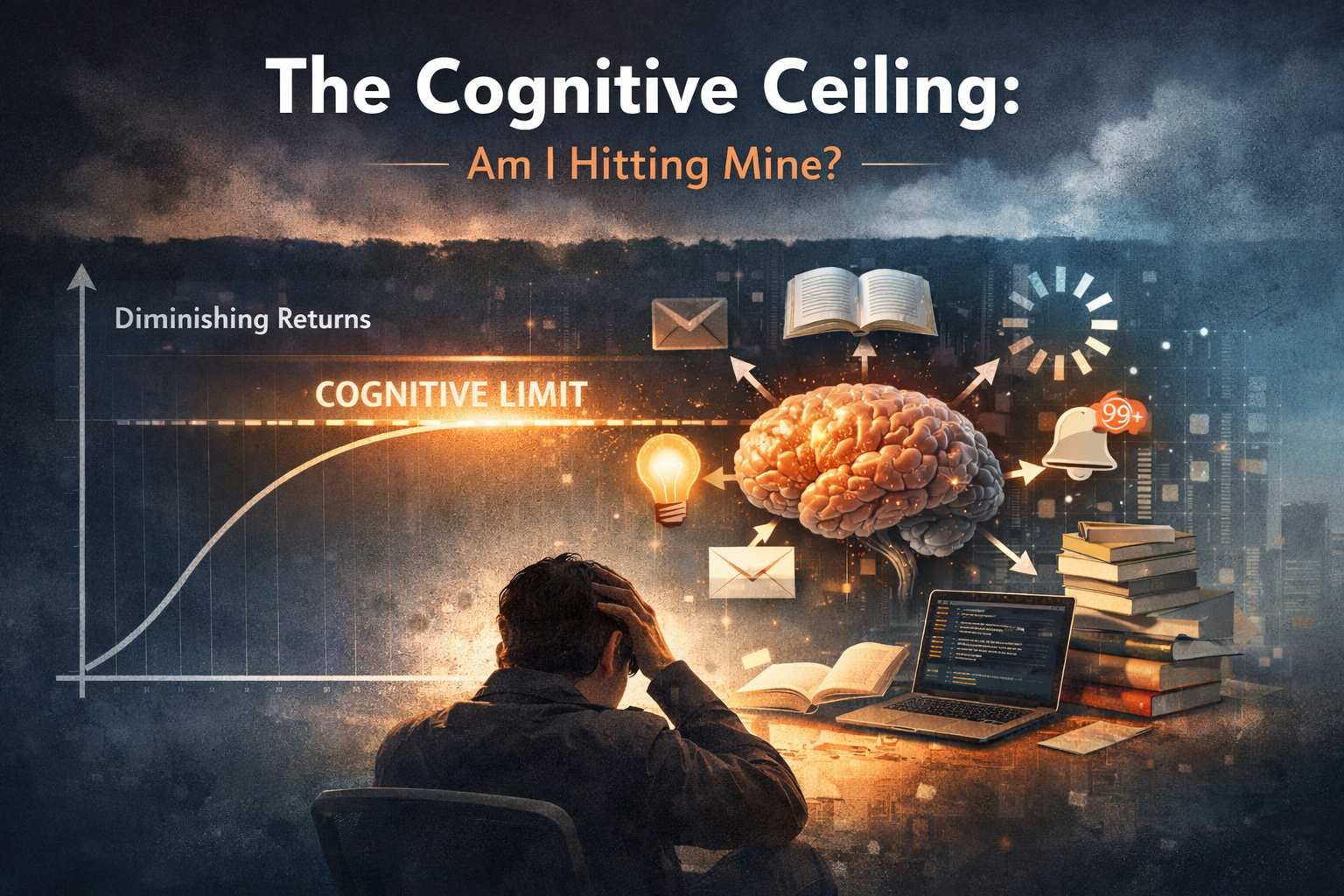
Almost like there’s a cap — and once it’s reached, additional input has much less value.
That’s roughly how it feels — diminishing returns rather than a hard stop.

There Is a Concept of Cognitive Limits
I haven’t gone deep into academic literature — this is mostly summaries and high-level reading.
But a few ideas keep showing up, and they seem consistent.
Working Memory Capacity
George Miller’s 1956 paper proposed the famous “7 ± 2” rule for short-term memory. Later, Nelson Cowan’s 2001 review revised that number downward — closer to 4 chunks when rehearsal strategies are controlled for.
From what I understand, this is the “in-progress” space in your brain.
And it’s small — just a few chunks at a time.
My interpretation:
Once too many new ideas stack up, the system doesn’t fail — it just becomes less effective. You can still follow along, but the marginal value of additional input drops.

Cognitive Load Theory
Usually associated with John Sweller’s framework from the late 1980s, which breaks cognitive load into three types:
| Type | What It Means |
|---|---|
| Intrinsic | Inherent complexity of the material |
| Extraneous | Unnecessary difficulty from poor presentation |
| Germane | Effort spent building mental schemas |
From the summaries I’ve read, learning depends on total load — complexity, presentation, and effort combined.
If that exceeds capacity, learning quality drops sharply.
Information Overload
When input exceeds processing capacity, performance degrades. Alvin Toffler popularized the idea in Future Shock (1970), and later research — like Iyengar and Lepper’s choice overload study (2000) — showed that too many options can reduce both satisfaction and motivation to decide.
What’s interesting is how it feels:
- distraction
- avoidance
- fragmented attention
Not “too much information” in an obvious way — which makes it easy to misread.
Memory Consolidation
Understanding something is not the same as fully learning it.
It still has to be consolidated — which seems to require time, pauses, and especially sleep. Matthew Walker’s research suggests that sleep deprivation can reduce memory encoding capacity significantly — during slow-wave sleep, the hippocampus replays recently encoded experiences, strengthening them for long-term storage.
My takeaway:
Continuous consumption is not the same as effective learning.

The Environment Changed — The Brain Didn’t
This feels like the core mismatch.
Brains evolved for:
- slower information flow
- repetition
- stability
Now we operate in:
- constant novelty
- high context switching
- pressure to stay current
That seems fundamentally misaligned.
Learning Through Practice Feels Different
One thing that does seem consistent:
Doing feels different from reading.
If I apply an idea, test it, build with it, or explain it, it tends to become much clearer and more usable.
Research on active recall supports this. Roediger and Karpicke’s 2006 study found that students who practiced retrieval retained significantly more material after one week than those who simply re-read. Spaced repetition — scheduling reviews at increasing intervals — builds on the same principle, tracing back to Ebbinghaus’s forgetting curve (1885).
My interpretation:
Practice forces compression.
Instead of juggling loose ideas, you are forced to structure them — which likely reduces load.

First Principles — But What Actually Stays Constant?
A lot of advice points to first-principles thinking — reasoning from fundamental truths rather than analogy, an approach traced back to Aristotle and popularized in modern discourse by Elon Musk.
The idea sounds simple:
Focus on fundamentals instead of surface-level details.
But in a world where everything seems to change quickly, that raises a harder question:
What are the actual “fundamentals” that don’t change?
From what I’ve been reading and observing, a few patterns seem consistent.
1. Things driven by constraints, not tools
Tools change fast. Constraints don’t.
- latency still matters
- human attention is still limited
- systems still need to scale predictably
If something is driven by a constraint, it’s more likely to stay relevant.
2. Ideas that show up across domains
Some concepts keep reappearing — in different forms, but with the same core.
This is similar to what Charlie Munger describes as a “latticework of mental models” — building understanding from multiple disciplines rather than one narrow lens.
If an idea shows up in:
- engineering
- product decisions
- business strategy
…it’s probably not tied to a single trend.
3. Things that reduce complexity, not add to it
Some knowledge expands the number of things you need to track. Some reduces it.
People like Jeff Bezos often emphasize focusing on things that don’t change — customer obsession, speed of delivery, selection. His famous framing: “I very frequently get the question: ‘What’s going to change in the next 10 years?’ I almost never get the question: ‘What’s not going to change?’”
If something simplifies future decisions, it’s likely higher leverage.
4. Things that hold up in practice
There’s a difference between something that sounds right and something that survives real use.
Ideas that hold up when you:
- build
- debug
- make decisions under constraints
tend to stick.
This connects to active recall — the finding that retrieving knowledge under real conditions strengthens it far more than passive review, a principle rooted in Ebbinghaus’s work on spaced repetition.
A Rough Filter
Instead of trying to keep up with everything, I’m starting to think in terms of:
- Is this tied to a constraint or just a tool?
- Does this show up across domains?
- Does it reduce complexity?
- Does it hold up in practice?
If it checks a few of these, it’s probably worth deeper focus.
If not, it might just be noise.
The Polymath Question
This is where it gets confusing.
People like Elon Musk appear to operate across multiple domains at high speed.
David Epstein’s Range (2019) synthesizes research suggesting that broad experience often outperforms narrow specialization for complex problems. Root-Bernstein’s research found that Nobel laureates are significantly more likely to have serious creative hobbies compared to typical scientists.
My guess:
- stronger filtering
- more compression
- less need for completeness
- heavy delegation
Not necessarily more input — better selection.
In Conclusion
I don’t have this figured out.
Some days I still scroll through too many tabs, read too many threads, and end up feeling like I learned nothing. The pull to consume more is strong — it feels productive even when it isn’t.
But one thing has become harder to ignore:
The problem is not finding information. That part is solved. The problem is what happens after — whether any of it actually lands, sticks, and changes how I work.
Most of it doesn’t.
And I’m starting to think that’s not a failure of discipline. It’s just how the system works. There’s a ceiling, and pretending it doesn’t exist leads to a lot of wasted hours disguised as learning.
So the skill I’m trying to build isn’t learning more. It’s learning what to ignore, what to practice, and when to close the laptop.