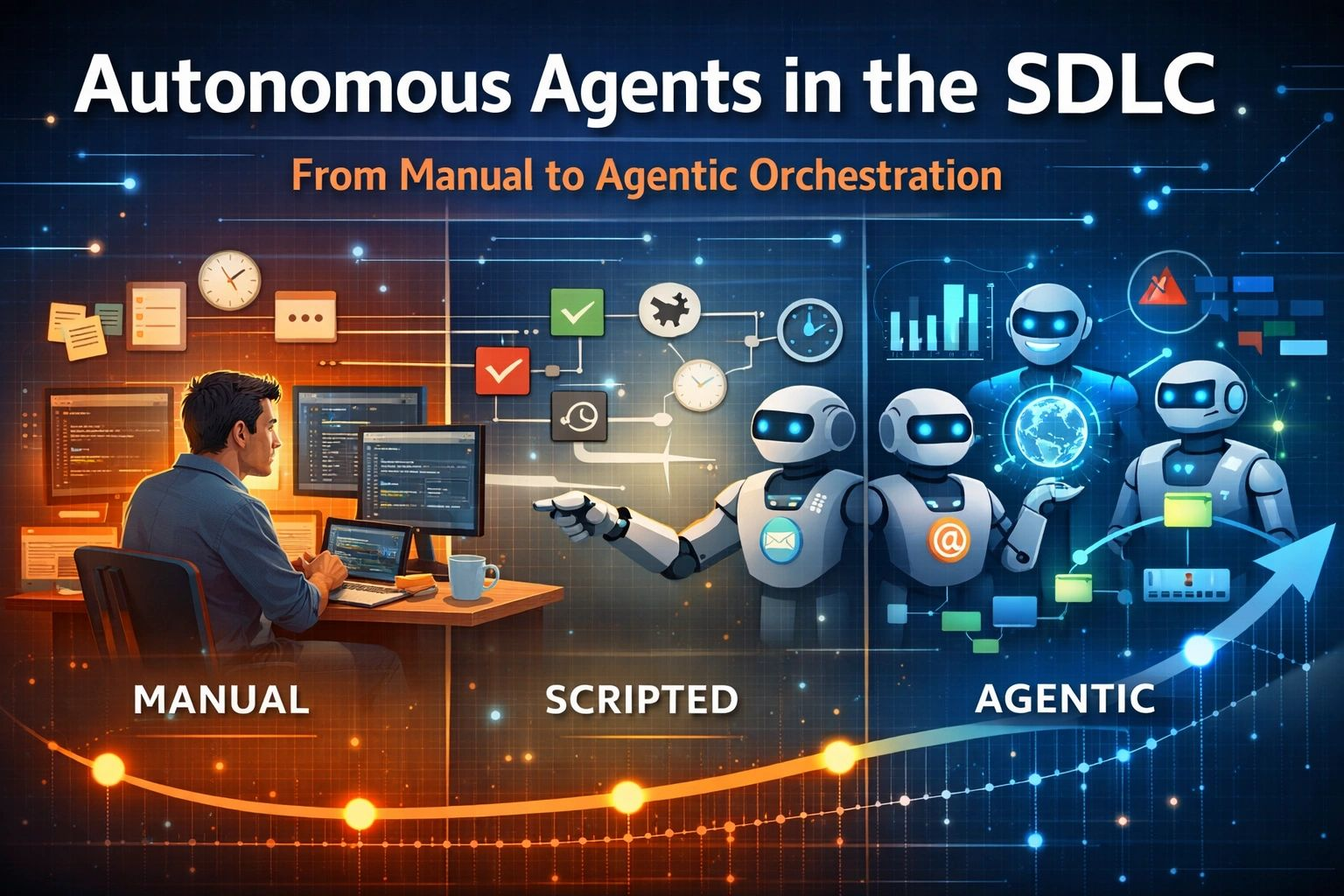
Here is my current view of how efficiency gains emerge along the path to an agentic approach.
Autonomous agents don’t deliver value all at once. The real gains only begin to accumulate once orchestration itself changes.
Manual Orchestration: No Accumulation
When humans orchestrate everything:
- agents help locally
- outcomes improve in isolation
- but nothing compounds
Every task still:
- waits for attention
- depends on context switching
- and resets between steps
Useful, but flat.
Scripted Orchestration: Local Gains, No Momentum
Automation removes repetition, but not coordination. Observable improvements:
- fewer obvious mistakes
- more consistency
- slightly faster feedback
What remains absent:
- sustained momentum
- fewer interrupts
- or work finishing itself
Gains exist — they just don’t stack.
Assisted Orchestration: Cognitive Relief, Still Linear
When agents propose plans:
- humans think less about mechanics
- decisions get easier
- quality improves
However, progress still pauses:
- for approvals
- for clarification
- for someone to say “yes”
Improvements remain linear.
Supervised Agentic Orchestration: Accumulation Begins
This is the first meaningful inflection point. Once policies replace per-step approvals:
- agents act immediately
- retries happen without delay
- work continues while humans are elsewhere
Results include:
- backlogs thin naturally
- interruptions drop
- progress feels steadier
The system starts carrying its own weight.
Agentic Orchestration: Flow Replaces Coordination
At maturity, work stops moving in batches. Agents:
- notice issues early
- address them while they’re small
- keep things aligned continuously
Humans don’t work faster. They work less reactively.
The Key Insight
Most teams expect autonomy to pay off immediately—it doesn’t. Value accumulates only when:
- orchestration is delegated
- decision latency disappears
- work no longer waits by default
Until then, autonomy is just assistance.
Why This Matters for the SDLC
Improvement comes not from agent intelligence but because:
- fewer things wait
- fewer handoffs are needed
- fewer decisions block progress
That’s the quiet advantage of agentic orchestration—and why it’s worth doing deliberately.