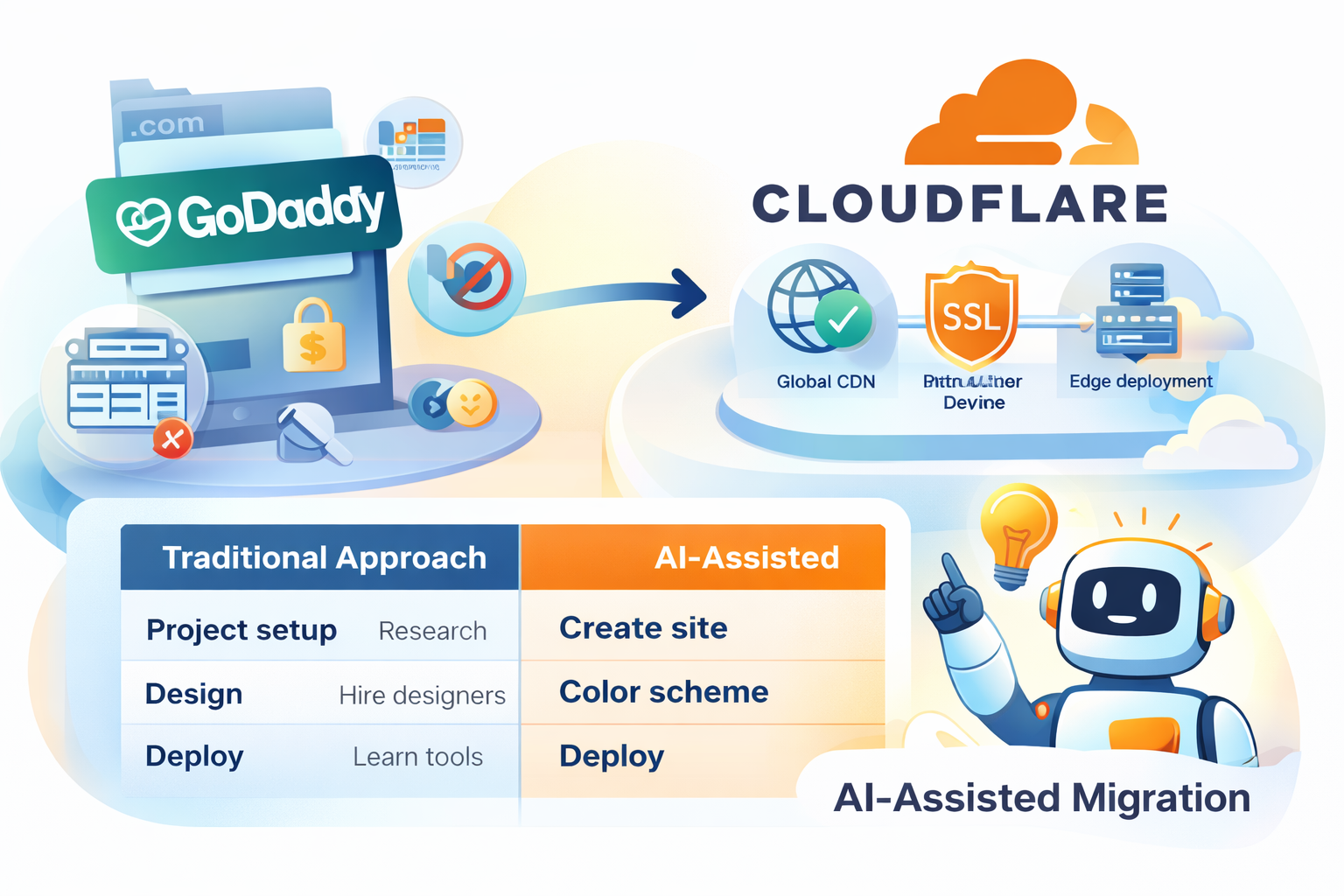
Last week I migrated this website from GoDaddy to Cloudflare. The process took an afternoon with Claude Code handling most of the work. What struck me wasn’t just the technical simplicity—it was realizing how fundamentally AI-assisted development changes the economics of web presence.
The GoDaddy Problem
GoDaddy charged me roughly $25/month for what amounted to a glorified WordPress installation with a website builder. For that price, I got:
- Limited markdown support (tables had to be screenshots)
- A clunky editor that fought against any customization
- Upsells at every turn
- Zero control over my deployment pipeline
The platform was designed for a world where building a website required either coding skills or expensive agencies. The business model assumed technical complexity as a barrier to entry.
The Migration
With Claude Code, migrating to a modern Astro site on Cloudflare took one conversation:
| Task | Traditional Approach | AI-Assisted |
|---|---|---|
| Project setup | Research frameworks, read docs, configure build | “Create an Astro site with blog support” |
| Design implementation | Hire designer or struggle with CSS | “Match this color scheme with modern spacing” |
| Deployment | Learn Cloudflare Workers, configure wrangler | “Deploy this to Cloudflare” |
| Security headers | Research OWASP, write configs | “Add security protections” |
| Content migration | Manual copy-paste | “Import these blog posts” |
The table above? I just typed it in markdown. No screenshots required.
Cloudflare’s free tier gives me global CDN distribution, automatic SSL, DDoS protection, and edge deployment. My monthly cost went from $25 to $0.
The Disruption Pattern
This isn’t about GoDaddy specifically—it’s about an entire category of businesses built on the assumption that technical complexity creates value.
Consider what AI-assisted development eliminates:
No-code website builders charged premiums because coding was hard. When an AI can scaffold a complete site from a conversation, the “no-code” value proposition evaporates. The code exists—you just didn’t have to write it.
CMS platforms emerged because content creators needed separation from developers. But when the same tool that writes your content can also modify your templates, why maintain that separation? My blog posts are MDX files. When I want to change the layout, I describe what I want. There’s no CMS to configure or plugin to install.
Managed hosting bundled technical operations into monthly fees. Cloudflare, Vercel, and similar platforms commoditized deployment. AI handles the configuration complexity that used to justify managed services.
Do You Even Need a CMS?
The honest answer: probably not.
CMS platforms solve two problems:
- Non-technical users need to publish content
- Content needs to be separate from presentation
For problem one, AI-assisted editing might be simpler than learning a CMS interface. Tell the AI what you want to write, where it should appear, and what it should look like. No admin panels, no WYSIWYG editors fighting your formatting.
For problem two, modern static site generators already solved this with frontmatter and templates. The “separation of concerns” that justified enterprise CMS installations is built into tools like Astro, Next.js, and Hugo.
The CMS becomes necessary only when:
- Multiple non-technical editors need simultaneous access
- Complex approval workflows exist
- Content must integrate with external systems programmatically
- You’re managing thousands of pages with structured metadata
For a personal site, a small business, or even a medium-sized publication? A git repository with AI assistance handles it.
The Economics of AI-First Web Development
Here’s what changes when AI handles the technical implementation:
Time cost shifts from building to deciding. The hard part isn’t making the website—it’s knowing what you want. AI can implement any reasonable design in minutes. The bottleneck is clarity of intent.
Maintenance becomes conversation. “Add a contact form.” “Change the color scheme.” “Optimize for mobile.” No context-switching between admin panels, code editors, and documentation.
Technical debt becomes optional. When you can rebuild from scratch in an afternoon, there’s less pressure to maintain legacy systems. Migration isn’t a six-month project—it’s a Tuesday.
Customization is free. The premium that page builders charge for “custom” features loses meaning when everything is custom by default.
Who Gets Disrupted?
Every business model that extracts value from technical complexity faces pressure:
- Website builders (Wix, Squarespace, GoDaddy) lose the “easy” positioning
- WordPress hosting loses the ecosystem lock-in
- Low-code platforms lose the “faster than coding” advantage
- Template marketplaces lose to AI-generated designs
- Basic web agencies lose the implementation revenue
What remains valuable:
- Strategic thinking about web presence
- Brand and visual design expertise
- Complex integrations and enterprise requirements
- Ongoing optimization and growth
The implementation layer compresses. The strategy layer expands.
Building This Site
This entire website was built through conversation with Claude Code:
- Astro framework with MDX blog support
- Custom design matching my personal brand
- Cloudflare deployment with edge caching
- Security headers and best practices
- Git-based workflow for content
No templates purchased. No plugins installed. No CMS configured. Just described what I wanted and iterated until it worked.
The real cost: I burned through roughly $150 in Claude Code tokens building this site. That’s not nothing—but compare it to hiring a developer or agency for a custom site. The tokens bought me a fully customized website, CI/CD pipeline, test suite, and the ability to modify anything through conversation. Six months of GoDaddy fees would have cost the same, with none of the flexibility.
The tools that made this possible—Claude Code, Astro, Cloudflare—are available to anyone. The barrier isn’t technical skill anymore. It’s knowing what you want to build.
What This Means
If you’re paying monthly fees for website hosting with a builder interface, ask yourself: what am I actually paying for?
If the answer is “convenience” or “not having to code,” that value proposition has an expiration date. AI-assisted development offers more convenience with more flexibility at lower cost.
If the answer is “I need specific integrations” or “my team requires approval workflows,” you might still need traditional tooling. But even enterprise use cases should expect disruption as AI capabilities expand.
The website builder industry grew on the assumption that most people can’t code. That assumption no longer holds when AI can code for them.
This post was written in markdown, deployed via Cloudflare Workers, and built with Claude Code. Monthly hosting cost: $0. One-time AI development cost: ~$150.