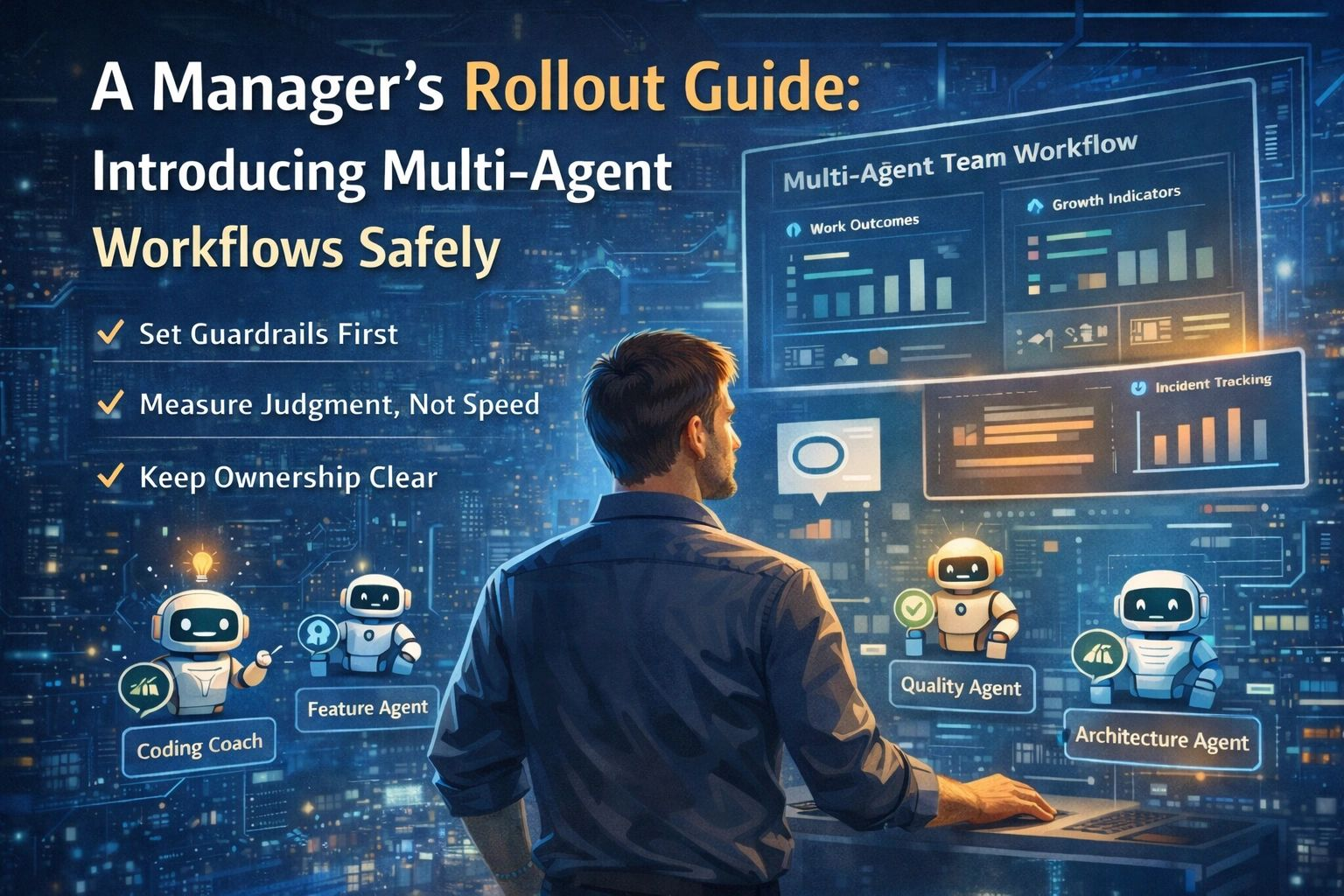
Rolling out AI agents is not a tooling change — it’s a capability change.
Successful implementation raises quality, leverage, and team learning. Poor execution creates skill gaps, brittle systems, and false confidence. This guide helps engineering managers introduce multi-agent workflows while preserving ownership, judgment, and professional growth.
1. Start with Principles, Not Tools
Before introducing agents, align on non-negotiables:
- Humans own decisions and outcomes
- Agents augment thinking, not replace it
- Code review and accountability remain essential
- Learning is a first-class goal
Without explicit principles, teams optimize for speed at the expense of long-term capability.
2. Roll Out by Level, Not by Team
Introduce agents based on judgment maturity, not organizational structure:
- Junior–Mid: Coding Coach Agent only
- Senior: Feature Implementation + Quality Control
- Staff: Architecture, CI/CD, and Observability
- Principal: Ideation and systemic optimization agents
This alignment prevents accidental over-delegation and matches execution power to experience.
3. Introduce One Agent at a Time
Multiple simultaneous agent introductions obscure causality around velocity gains, quality shifts, and judgment erosion. The practical approach: add one agent → wait several sprints → review outcomes → decide next steps.
4. Define Clear Rules of Engagement per Agent
For each agent, teams should clarify:
- What decisions can this agent make?
- What must always be reviewed by humans?
- What signals should the agent surface versus act upon?
- When should the agent be ignored?
Examples include: Coding Coach never merges code; Quality Agent can block merges; Architecture Agent remains advisory only.
5. Redefine Code Review (Don’t Remove It)
Code review shifts focus rather than disappearing.
Review less for:
- Syntax
- Formatting
- Trivial correctness
Review more for:
- Intent alignment
- Trade-offs
- Architectural impact
- Test sufficiency
- Production risk
Managers should explicitly reset review expectations to reflect this change.
6. Measure the Right Signals and Reframe Growth Conversations
Traditional productivity metrics fail in multi-agent environments. Output becomes cheap; judgment, clarity, and system impact matter most.
Evaluate growth using observable work artifacts, not intuition or raw velocity.
What Not to Measure
Avoid:
- Lines of code
- PR count
- Raw speed
- Visual polish
These inflate easily with AI and reveal little about maturity.
What to Measure Instead
Track three states for each signal: Emerging, Consistent, and Multiplying others. No scoring, no math. Consistency matters more than snapshots.
| Signal | What to Look At | Objective Indicators | Growth Progression |
|---|---|---|---|
| Quality of Intent | PR descriptions, task breakdowns, agent instructions | Clear success criteria, explicit constraints, fewer mid-PR reversals | Junior: describes tasks → Senior: defines intent → Staff: frames problems |
| Decision Transparency | Comments, PR discussions, design notes | Trade-offs explained, alternatives rejected, risks acknowledged | Junior: explains what → Senior: explains why → Staff: explains why now |
| Delegation Skill (Human + Agent) | Agent prompts, iteration count, corrections | Faster convergence, fewer rework cycles, early error detection | Mid: executes → Senior: directs → Staff: designs workflows |
| System Impact Awareness | Post-deploy checks, observability updates, incidents | Proactive metric checks, preventive fixes, fewer repeat failures | Senior: reacts → Staff: anticipates → Principal: designs issues out |
Using This in 1:1s
Replace vague feedback like: “You’re productive, but I want more impact.”
With specific observation: “Your intent is clear. Next, I want trade-offs documented so others execute without you.”
This makes growth actionable and fair.
7. Normalize Saying “The Agent Was Wrong”
Psychological safety matters more with AI than without it. Managers should model:
- Challenging agent output
- Rejecting confident-but-wrong suggestions
- Treating agent mistakes as learning data
If engineers feel pressure to accept AI recommendations, quality decays quietly.
8. How to Monitor and Support Adoption (Without Micromanaging)
Adoption should be observable, not surveilled.
Watch Decision Ownership
Healthy teams justify decisions clearly. Warning signs emerge when rationale becomes “the agent suggested it.”
Use PRs as the Primary Signal
PR quality reveals intent clarity, review depth, and architectural awareness. No AI-specific metrics required.
Hold Lightweight Calibration Check-Ins
Every few weeks, ask:
- Where did agents help your thinking?
- Where did they get in the way?
- What decisions do you keep human-only?
These questions surface issues early.
Track Lagging Indicators
Monitor escaped defects, rollbacks, MTTR, and onboarding speed. Velocity without stability is debt.
Pair Adoption with Explicit Skill Goals
Help engineers articulate what skills they’re building, where agents should not be used yet, and what feedback they want. Growth must stay intentional.
Create Safe Agent-Free Zones
Normalize turning agents off for early design thinking, deep debugging, and learning new domains. Over-reliance dulls intuition.
Rotate Responsibility and Literacy
Encourage engineers to explain their agent setup, review work produced with different agent mixes, and critique prompts and constraints. This prevents knowledge silos.
Intervene Early and Publicly
When patterns drift, correct the practice, not the person. Explain the risks and document learning. Small corrections beat hard resets.
The Manager’s North Star
A successful rollout demonstrates:
- Juniors learn faster without skipping fundamentals
- Seniors ship faster without cutting corners
- Staff engineers reduce chaos, not add tools
- Principals multiply impact without becoming bottlenecks
If agents make the team faster and calmer, implementation is succeeding.
Bottom Line
Good management makes judgment visible. This work defines the manager’s role now.