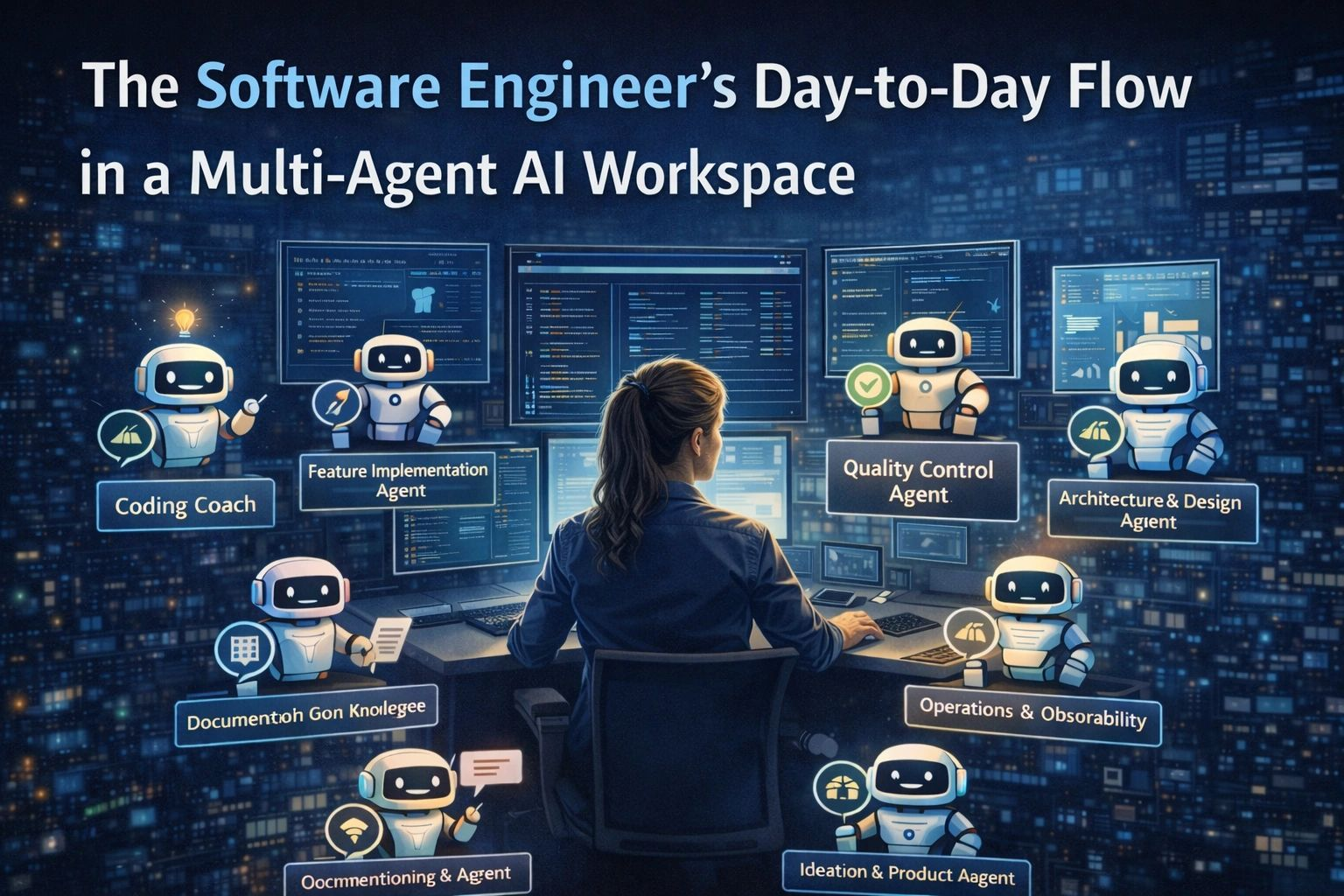
Hopefully 2026 will be the year text-in-images finally functions properly. This article explores next-generation engineering concepts I’ve been developing.
Core Thesis
Traditionally, productivity improvements came through better languages, faster hardware, and enhanced tooling. AI represents a fundamental shift—it doesn’t merely accelerate coding speed but restructures how work itself is organized. Modern engineers now “orchestrate a set of specialized AI agents” with distinct responsibilities operating in parallel, with the engineer serving as the decision-maker and integration point.
From Solo to Multi-Agent
Solo Engineer Phase
One person manages everything end-to-end: coding, testing, debugging, documentation, and production analysis. This builds strong fundamentals but doesn’t scale.
Do-Everything Assistant Phase
A single AI assistant handles all tasks. Initial productivity surges, but responsibilities blur, quality becomes inconsistent, context leaks between tasks, and review overhead increases significantly.
True Multi-Agent Flow
Work distributes across agents with explicit, narrow mandates—implementation, quality assurance, architecture, documentation, operations. Agents run parallel, outcomes become transparent, and the engineer evolves into a director providing intent, judgment, and accountability.
Successful adoption requires incremental steps: introduce one agent at a time, maintain narrow responsibilities, treat errors as calibration opportunities, and operate at higher abstraction without surrendering control.
Agent Roles and Timing
Core Engineer-Focused Agents: Directly involved in building and validating software. Form the backbone of the workflow.
Auxiliary/Scaling Agents: Don’t build features directly. Reduce friction, decrease risk, and increase leverage as systems grow.
Important caveat: This represents options, not requirements. Alignment between execution capability and judgment maturity matters more than adopting every role.
Typical Daily Workflow
Engineers begin by defining intent, constraints, and success measures. Multiple agents then execute in parallel: feature development progresses, tests run continuously, architectural implications undergo review, documentation updates automatically, and operational signals get monitored. Engineers receive synthesized insights rather than raw data, then review, decide, and adjust course accordingly. This reduces context switching, minimizes interruptions, and increases effective focus time.
Supporting Practices
Explicit agent contracts outweigh sophisticated prompts. Parallel execution surpasses sequential perfection. Humans remain intentionally embedded in decision-making. Agents form systems where feedback mechanisms must be deliberately designed or they’ll emerge uncontrolled.
The objective isn’t maximum automation but “sustainable, high-quality velocity.”
For Junior-Mid Career Engineers
Early careers benefit when agents teach rather than execute. A dedicated Coding Coach Agent prevents learning gaps by explaining reasoning, comparing approaches, reviewing junior-written code rather than replacing it. As engineers develop, coaching influence decreases while execution agents enter the workflow. Growth remains continuous rather than reset.
Ownership and Human Judgment
Code may be delegated; thinking cannot. Comments, pull request descriptions, and reviews must demonstrate human judgment regarding approach rationale, rejected alternatives, and existing risks. AI may help draft language, but human intent ownership remains essential.
Outcomes and Impact
This working style doesn’t just accelerate delivery. It makes engineers calmer under pressure, more consistent in quality, and more strategic in impact. Engineers spend less time executing individual steps and more time deciding what merits building. They become “calmer under load, more consistent in quality, more strategic in impact.”
Conclusion
Multi-agent workflows don’t replace engineers; they reveal what kind of engineer someone is becoming “by making judgment, clarity, and system thinking visible.” This represents the genuine opportunity within AI-augmented development.