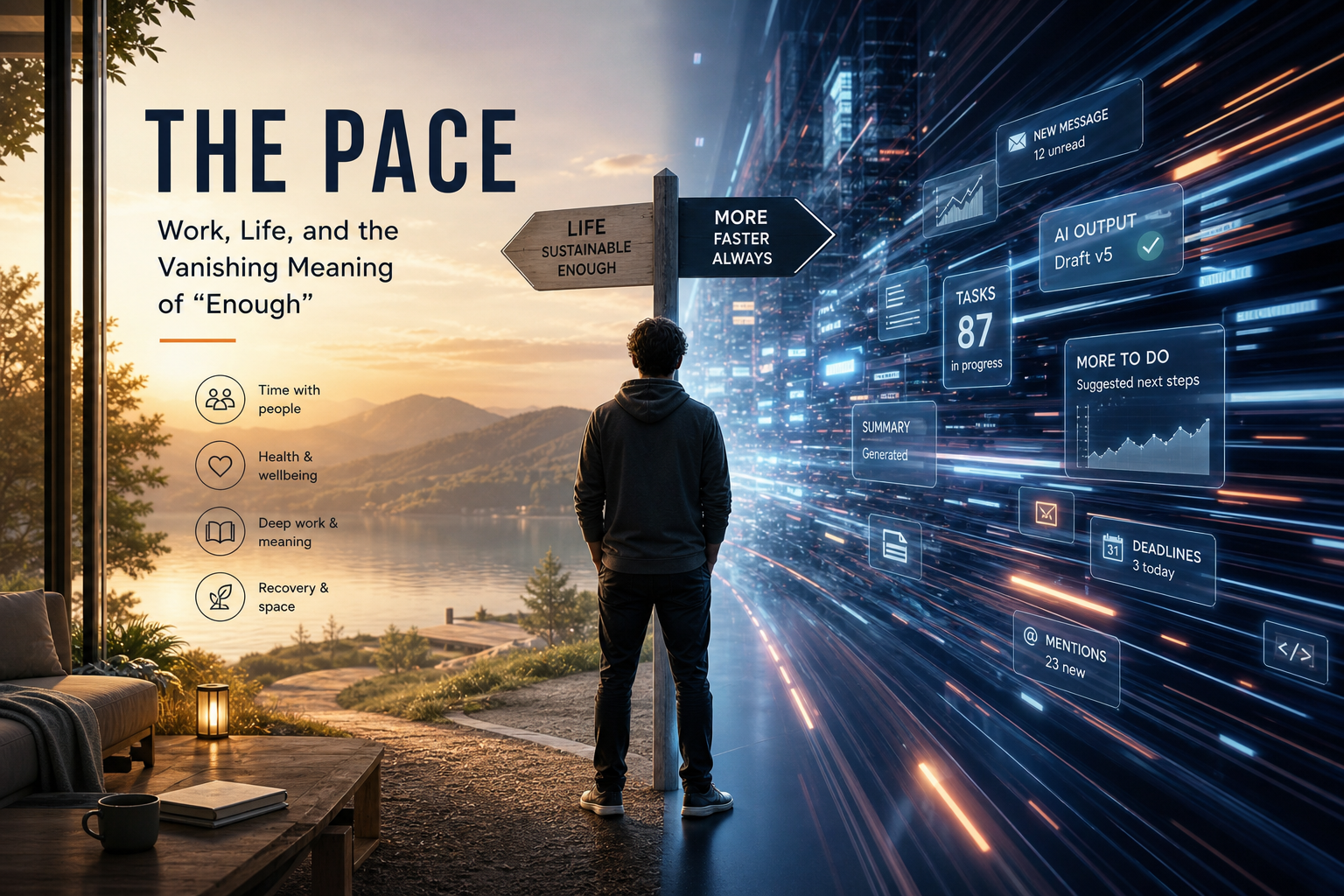
Before AI, work had a rough human speed limit. Not a perfect one. Not a fair one. But most organizations had some shared intuition for what a reasonable day looked like.
An engineer could ship a feature, review a PR, sit through meetings, debug a production issue, and call it a productive day. A manager could spend the day in 1:1s, planning, and alignment and still be doing real work, even if the artifact was mostly invisible. The shape of a workday was constrained by human limits: typing speed, meeting time, attention, context switching, review cycles, fatigue, and the simple fact that most people eventually needed to stop.
Then AI entered the workflow and quietly removed part of the speed limit. Not all of it — not judgment, trust, taste, or responsibility. But enough to destabilize the old agreement.
What is a reasonable pace of work when the ceiling keeps moving?
The old baseline was invisible, but real
A senior engineer was not expected to produce code every minute of the day. A staff engineer might spend days clarifying a system design before writing anything visible. A director might spend a week aligning teams or absorbing organizational tension. That work was not easy to measure, but it was socially legible — people understood that humans needed to think, read, ask questions, sit with ambiguity, and recover after deep concentration or a messy production issue.
The old model was shaped by constraints.
| Constraint | What it quietly regulated |
|---|---|
| Typing and implementation speed | How much code, documentation, or analysis one person could produce |
| Meeting schedules | How much collaboration could fit into a day |
| Review cycles | How quickly changes could safely move through the system |
| Cognitive load | How much complexity one person could hold |
| Context switching | How many parallel efforts could be handled well |
| Coordination cost | How much work a team could realistically absorb |
| Fatigue | Where the day usually had to end |
These constraints were frustrating, but they did something useful: they made pace understandable. You could argue about whether someone was productive enough, but the argument happened within a shared human frame. AI weakens that frame.
AI makes output elastic
A draft that used to take a morning can now appear in minutes. A prototype that once required multiple days can be built in an afternoon. A design document, test plan, migration outline, and implementation sketch can all be generated before lunch. At first, this feels like pure leverage — and in many cases, it is. The boring parts get compressed. The blank page gets less intimidating. Junior people get support; senior people delegate mechanical work; teams move through early ambiguity more quickly.
The evidence is real. Nielsen Norman Group summarized studies showing a 66% productivity improvement across three studies. Microsoft’s 2025 Work Trend Index reports that 75% of global knowledge workers are now using AI at work, with usage roughly doubling over six months.
The productivity story is not imaginary. But nobody knows where the new normal is.
If something can be done five times faster, should five times more become expected?
If one person can now generate the artifacts of three people, does the job description change?
If a motivated employee uses AI late into the evening and produces a mountain of useful-looking work, does that raise the bar for everyone else?
If the tool never gets tired, does the human still have permission to?
This is where the word “enough” begins to vanish.
The collapse of “reasonable”
The old workday had stopping points. The calendar ended. The sprint had capacity. The ticket had scope. The pull request was enough for today.
AI makes stopping harder because every completed step reveals five more steps that are suddenly cheap to attempt. You finished the spec — why not ask AI to write the test cases? Then the implementation. Then the rollout plan. Then the stakeholder summary. Then three alternative strategies. Each step feels reasonable; together they create an infinite workday. The problem is not that AI makes more work possible — it is that possibility starts pretending to be obligation.
This is showing up in research. In a 2026 Harvard Business Review piece, Berkeley Haas researchers Aruna Ranganathan and Xingqi Maggie Ye argued that AI does not necessarily reduce work; it can intensify it. Berkeley’s own summary describes how AI dissolves natural stopping points, encouraging employees to take on broader scopes and extend work into times that used to be protected by default.
Before AI, “I did not have time” was often a valid explanation. After AI, the silent reply becomes:
But did you ask the model?
That question may be useful. It may also become toxic.
Possible is not the same as sustainable
AI expands possible output, but possible is not the same as sustainable — or valuable. A person can now generate more code than they can deeply understand, more documentation than the team can absorb, more proposals than leadership can evaluate, more analysis than anyone has time to challenge.
In the AI era, the easiest thing to scale is artifacts. The hardest thing to scale is meaning.
| AI can increase | But the organization still needs |
|---|---|
| Code volume | Maintainability, ownership, and trust |
| Documentation volume | Shared understanding |
| Idea volume | Prioritization |
| Prototype volume | Product judgment |
| Analysis volume | Decision quality |
| Communication volume | Alignment |
| Speed of change | Operational safety |
More is better when it increases learning, reduces friction, or compresses low-value work. More is worse when it creates noise, review burden, or pressure to keep moving without understanding what changed. The bottleneck moves from production to judgment.
The new bottleneck is judgment
In the old model, work was constrained by production capacity. AI helps with all of that. But once production gets cheaper, the scarce resources become different: attention, taste, prioritization, review, context, trust, courage to say no, and recovery. The work does not disappear — it moves.
The real question becomes not “Can we produce this?” but “Should we?” Should we ship this change? Should we trust this generated implementation? Should we explore five more options or commit to one? Should we use the extra capacity to improve quality, reduce load, or simply increase expectations? That last question is the heart of the pace problem.
Ethan Mollick has written about a related organizational gap: individual AI productivity gains do not automatically translate into organizational performance. A person may become faster. A team may generate more. But unless the organization changes incentives, workflows, and review models, the extra speed becomes more work moving through the same old pipes.
The danger of permanent sprint mode
A hackathon pace can be energizing because it is temporary — it suspends normal constraints, accepts rough edges, and runs on adrenaline. But if every week becomes hackathon week, the company does not become more innovative. It becomes more exhausted.
AI can accidentally turn work into a permanent sprint because the machine is always ready for another iteration. One more prompt, one more version, one more refinement, one more experiment. It feels good at first: fast feedback, visible output, the employee feels powerful, the manager sees progress.
Until the hidden costs arrive. The codebase gets harder to reason about. The documents multiply. The decision history becomes muddy. The team loses shared context. The best employees quietly stretch their evenings because they can always do “just one more thing.” The system looks faster, but the humans inside it become more fragile.
Cal Newport has been writing about this through the lens of digital productivity traps and asking why AI has not made work easier. The trap is not “AI does nothing.” It is something more complicated:
AI can make people busier at a higher speed.
Personal life becomes the boundary layer
If the organization does not define pace, personal life becomes the only remaining boundary. That is a lot to put on the individual. The employee now has to decide:
- Am I stopping because the work is done — or because I am tired?
- Am I stopping because this is good enough — or because I have a family, a body, a life?
- Am I stopping too early because I am underusing AI?
- Am I falling behind someone who is prompting until midnight?
This is not just a productivity question. It is an identity question. Many ambitious people do not want to do the minimum — they want to grow, contribute, learn, and be seen as effective. AI gives those people an extremely powerful lever. But without a clear definition of enough, the lever becomes a trap. The workday no longer ends because the work is exhausted; it ends because the person chooses to stop. That sounds empowering. It can also be cruel.
Upwork’s 2025 follow-up research on the AI-human work dynamic found the gap persisted: a majority of C-suite leaders observed AI productivity gains, while employees reported substantial productivity boosts paired with rising burnout. Leadership sees the productivity dividend. Employees experience the workload expansion. Both can be true.
The comparison problem
AI makes performance comparison more confusing. Two people may appear dramatically different in output, but the surface signal is often misleading.
| What it looks like | What might actually be happening |
|---|---|
| High output | Strong AI leverage and good judgment |
| High output | Shallow artifact generation |
| Fast delivery | Real acceleration |
| Fast delivery | Hidden quality debt |
| Slower delivery | Weak AI adoption |
| Slower delivery | Better reasoning and risk control |
| Many documents | Strong communication |
| Many documents | More noise for everyone else |
| Constant availability | High commitment |
| Constant availability | Burnout in progress |
If managers reward only visible output, they push people toward artifact generation. But the best AI-assisted employees may not produce the most artifacts. They use AI to think through options faster, then choose not to create unnecessary work. They delete more than they generate. They compress a week of confusion into one clear decision. That kind of work is extremely valuable — and extremely hard to count.
Artifact velocity is not value velocity
Artifact velocity is easy to see: more code, more documents, more slides, more tickets, more Slack updates. Value velocity is harder: did the customer experience improve, did the system become more reliable, did we make a better decision, did we avoid a bad path, did we create durable leverage?
AI dramatically increases artifact velocity. But if the organization cannot distinguish artifacts from value, it just creates faster noise. This is the new version of performative productivity. Before AI, a person could look busy by attending meetings. After AI, a person can look busy by generating impressive artifacts. The costume changed. The problem did not.
Microsoft and LinkedIn’s Work Trend Index captures this organizational confusion: leaders see AI as critical but struggle to quantify gains, while employees bring their own AI tools into work in a bottom-up adoption pattern that moves faster than governance. AI at work arrived before many companies had a real operating model for it. Some people accelerate, some teams hesitate, some employees quietly automate parts of their job while worrying that admitting it may make them look replaceable. The technology moves faster than the shared agreement.
The manager’s job gets harder
There is a tempting story that AI will make management easier because everyone becomes more measurable. Maybe eventually. In the transition period, management gets harder. Managers need to understand not just what people produced but how they produced it, whether they understood it, and whether the pace is sustainable.
The useful question is no longer “How much did you produce?” but “What changed because of your work?” A generated document matters if it creates alignment. Code matters if it solves a real problem without unacceptable debt. A prototype matters if it teaches the team something useful. The output is evidence — not the outcome.
The World Economic Forum and PwC frame this as a workforce design problem, not just a tooling problem. Their report on generative AI for job augmentation and workforce productivity argues that organizations need to align AI deployment with people’s needs, job quality, and meaningful work — not only productivity targets. AI adoption is not about giving everyone a tool. It is about renegotiating the work system around the tool.
Three paces
AI work now operates across three different paces.
| Pace | Description | Risk |
|---|---|---|
| Human pace | The rate at which people can think, communicate, decide, and recover | Too slow if it ignores AI leverage |
| Machine pace | The rate at which AI can generate, revise, summarize, and automate | Too fast for judgment, trust, and integration |
| Organizational pace | The rate at which a company can safely absorb change and turn it into value | Hard to measure, but probably the real target |

The sustainable pace is not pure human pace — that would ignore the leverage AI gives us. It is also not machine pace — that treats humans as the slow part of the system and turns work into a treadmill. The real target is organizational pace: how fast the team can understand the work, how fast customers can benefit from it, how fast systems can absorb it, how fast leaders can make good decisions, and how fast people can recover and still come back with judgment intact.
That is the pace that matters.
The new social contract
Every major productivity shift eventually forces a new social contract. The old one was roughly: we know what a reasonable workday looks like, even if we argue about the details. The new contract cannot simply be produce as much as AI makes possible — that is not a strategy, it is a burnout engine. A healthier version might be: use AI to increase leverage, reduce waste, improve quality, and accelerate learning, but do not confuse maximum output with sustainable contribution.
This requires companies to be explicit about expectations. What does good AI usage look like for this role? Where should it increase output, where should it increase quality, where should it reduce hours? When is burst mode appropriate, and when is slower thinking required? What does “enough” mean now?
Without those answers, the most anxious and ambitious people will set the pace for everyone else — not because leadership asked them to, but because social comparison fills every vacuum.
The future may belong to companies that learn the right pace
There is a simplistic version of the AI future where the winning companies are just the fastest. Speed will matter — it usually does. But raw speed is not enough. A company can move fast in circles, generate more than it can integrate, and burn out its best people while producing a beautiful trail of demos and half-finished transformations.
The more interesting advantage may belong to companies that learn the right pace:
- Fast enough to benefit from AI.
- Slow enough to preserve judgment.
- Explicit enough that people understand what good looks like.
- Disciplined enough not to confuse output with value.
- Human enough that life outside work is not treated as a productivity bug.
AI did not just make us faster. It made speed negotiable, uneven, and socially confusing. That is why “the pace” matters — not because people should work less by default, and not because the old world was better, but because the old baseline is gone and the new one has not been negotiated yet.
Until it is, the question will sit quietly behind every AI-assisted workday:
How much is enough when more is always possible?