
This one started as a side-thought while writing 20 Simple Questions That Get Weird With Human-Like Robots — once you start imagining humanoids living among us, the next question is unavoidable: what, exactly, will they be wearing?
The opportunity in humanoid robotics is enormous. But it is unevenly distributed. (So are the trench coats.)
The Obvious Layer: The Robot Itself
 Atlas, the Boston Dynamics humanoid that somehow manages to look intimidating without any clothes on at all. Photo: DARPA, public domain.

At the center of the current wave is the robot. It is the part everyone points a camera at.
That layer is capital-intensive, technically complex, and structurally constrained. It requires:
- large-scale manufacturing
- vertically integrated hardware and software
- long iteration cycles
- significant upfront investment (the kind where a spreadsheet cell contains the letter “B”)
As a result, it concentrates naturally among a small number of players — Tesla, Figure AI, Boston Dynamics, 1X Technologies, and a short list of others brave enough to put “humanoid” on a pitch deck.
The pattern is familiar. A few companies build the base layer. Everyone else waits to see what it needs.
The Less Obvious Layer: Everything Around It
What tends to emerge next is less visible at first.
Not a competing platform, but a surrounding one. Less “build your own robot,” more “sell the robot a belt.”
Historically:
- phones led to accessories and apps
- PCs led to peripherals and software ecosystems
- cars led to aftermarket parts, insurance, and an entire genre of scented tree
The question here is not whether this happens for humanoid robots. It is what form it takes, and when — and whether anyone is currently sewing.
A Small Signal: Wearables
One emerging signal is physical rather than digital.
Wearables. Yes, clothes. For robots. Stay with me.
At first glance it sounds absurd — a humanoid does not get cold, does not care what Karen from accounting thinks, and has no social calendar. But the idea intersects with several deeper dimensions:
- Capability — what the robot can support or carry
- Context — how its role is communicated
- Comfort — how it is perceived in human environments (yours, not the robot’s)
This combination makes it slightly different from traditional accessories. It is not only additive. It is interpretive. A phone case says “I have a phone.” A robot apron says “please do not call the authorities, it’s just making pasta.”
Households Change the Frame
 Pepper — shorter, friendlier, and wearing nothing but a tablet. The domestic-humanoid experiment before the current wave of life-sized ones. Photo: Softbank Robotics Europe, CC BY-SA 4.0.

The distinction becomes clearer in domestic settings. The same machine is evaluated against a very different scorecard once it crosses the front door.
| Dimension | Industrial | Household |
|---|---|---|
| Primary metric | Throughput, uptime, cost per task | Presence, trust, “does it match the sofa” |
| Aesthetic tolerance | Exposed actuators are fine | Exposed actuators are terrifying |
| Noise budget | Industrial-loud is acceptable | Dishwasher-quiet or it gets unplugged |
| Failure mode | Downtime, safety incident | Social embarrassment, loss of trust |
| Appearance driver | Branding, spec sheet | Family, mood, season, grandma’s opinion |
| Buyer | Procurement | Whoever also picks the curtains |
| Switching cost | Retooling, contracts | Emotional — the kids named it |
In industrial environments, performance dominates. In households, perception and interaction become equally relevant — and there is a non-zero chance someone’s grandmother will try to feed it soup.
A robot in a home is not only a tool. It becomes part of the environment. (A theme I touched on in Human Dynamics, Not Boston Dynamics — the social dimension tends to reshape things in ways the mechanical spec sheet doesn’t capture.)
Wearables as a Boundary Layer

From that perspective, wearables start to look like a boundary layer between two systems:
- the mechanical system of the robot
- the social system of the home (which, let’s be honest, is also mechanical in its own way)
They mediate between:
- rigid structure and soft environments
- generic capability and specific roles
- machine behavior and human expectations
Some emerging patterns start to make sense:
A default layer
Soft, neutral, often washable exteriors — designed to blend into living spaces. Think: “robot in loungewear.”
Role signaling
Aprons, uniforms, task-specific overlays — a visual shorthand for intent. The chef hat is doing a lot of work.
Safety surfaces
Padding, softer materials — reducing both physical and psychological friction. Harder to be afraid of something wearing a cardigan.
Utility augmentation
Pockets, harnesses, modular attachments — small extensions of capability. Cargo pants, but load-bearing.
Expression
Subtle visual or auditory cues — not full personalities, but hints of them. A scarf is a personality.
What If Customization Is the Product?
Here is a hypothesis worth taking seriously: in households, the robot is the platform, but the customization is what people actually buy.
The hardware is expensive, undifferentiated, and — once a few players reach mass production — likely to look roughly the same from across the room. Capability will converge. Price will converge. The “which humanoid did you get” conversation will sound a lot like “which iPhone did you get.”
What doesn’t converge is how a robot fits into a specific home, a specific family, a specific aesthetic. That’s where buyers actually express preference — and where they tend to keep spending after the initial purchase.
A few reasons this could be the center of gravity:
- Recurring revenue. You buy a robot once. You might buy it a new outer shell every year. Ask anyone who owns a phone.
- Low-risk personalization. Changing a cover is a soft commitment. Changing the robot itself is not. People love customization precisely because it’s reversible.
- Identity mapping. Households express themselves through surfaces — paint, furniture, outfits. A robot with a fixed appearance is a piece of hardware. A robot you can re-skin is a member of the household.
- Gifting. “I got my mom a new autumn shell for her Neo” is a sentence that will, eventually, exist.
- Cultural and regional fit. A single global robot SKU cannot simultaneously be appropriate in Tokyo, Stockholm, and Lagos. Customization solves localization without the manufacturer having to.
- Emotional attachment as a business moat. Once a household has personalized its robot, switching brands becomes psychologically expensive in a way the spec sheet does not capture.
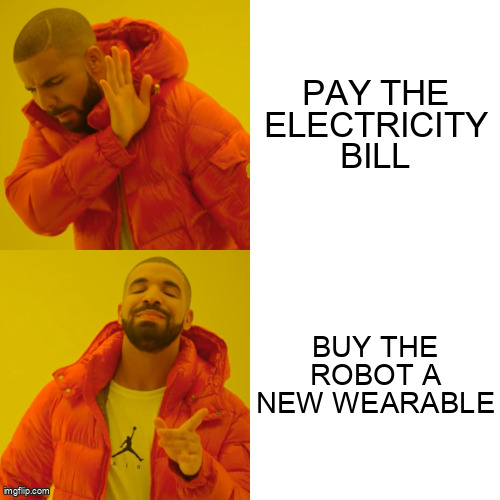
If that’s right, then wearables aren’t a niche accessory market. They are the layer where the robot stops being a product and starts being yours — and, not coincidentally, the layer where most of the post-sale money lives.
The OEMs sell the machine. Everyone else sells identity.
Where the Research (and Market) Still Feels Incomplete
The idea is easy to imagine. What is harder is finding evidence that the category is forming in a structured way, rather than existing mostly in moodboards.
Right now, the signals are fragmented.
1. No standardization layer
There is no equivalent of USB-C, MagSafe, or even basic sizing conventions. Nobody knows if the robot is a medium. Across humanoid robots there is:
- no shared attachment interface
- no standard mounting points
- no agreed body dimensions
It is unclear whether wearables can be designed once and reused across platforms — or whether every robot will need a tailor.
2. Weak evidence of independent businesses
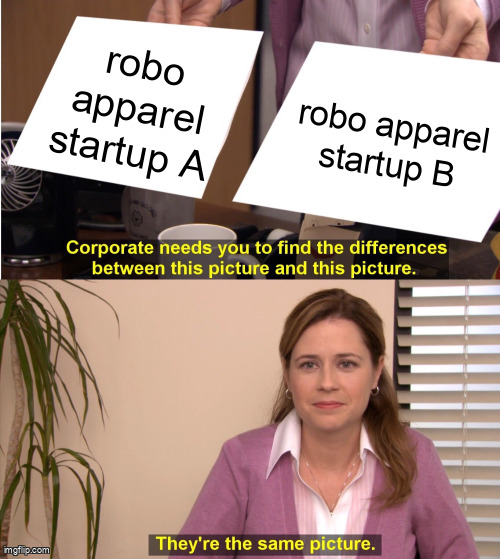
There are attempts at “robot apparel” positioning, but they show early-stage signals: placeholder-heavy websites, stock photos of suspiciously similar androids, unclear customer validation, limited external presence. They read more like category probes — or hobby projects with good branding — than established businesses.
3. OEMs are absorbing the layer (for now)
Humanoid robot companies are already experimenting with soft exteriors, removable coverings, and washable materials. This suggests that early “wearables” may not appear as a separate market — they may initially exist as integrated product features, quietly, without the word “fashion” ever being used in a keynote.
4. No clear consumer demand signal (yet)
There are adjacent signals — social robots with clothing ecosystems, accessory-driven engagement, the entire Roomba-costume corner of the internet. But for humanoid robots in homes:
- no large-scale deployment
- no repeat purchasing behavior
- no measurable attachment rate (pun acknowledged)
There is a gap between conceptual appeal and demonstrated demand. At the moment the demand is mostly from people writing blog posts about it.
5. Role vs. form factor is still unclear
A key assumption:
One robot → many roles → wearables enable switching
But an alternative is equally plausible: multiple specialized robots, each optimized for one task. The wearable market depends heavily on which of these wins — a general-purpose robot that dresses for the occasion, or five slightly boring robots that don’t.
6. Physical constraints are underexplored
Unlike phone accessories, robot wearables must deal with:
- heat dissipation
- joint articulation
- sensor visibility
- balance and weight distribution
- not setting itself on fire
This is not just design. It is physics. And physics has historically been uninterested in spring collections.
7. The emotional layer is recognized, but vague
There is growing acknowledgment that softness affects trust and appearance affects comfort — something the robo-joke benchmark hinted at from a different angle, where the uncanny parts of daily life with humanoid machines are exactly the ones hardest to articulate. But there is little clarity on what actually drives acceptance, or how much personalization matters. Whether anyone wants a robot with a “signature look” remains, technically, an open research question.
A Familiar Pattern
Base technologies often begin as exposed, functional, optimized. Form follows function, and function isn’t always much to look at.
Over time, layers appear: abstraction, interface, personalization. Eventually someone adds a color option called “graphite.”
If humanoid robots follow this path, the visible hardware may not be the only thing evolving.
A Note on Distribution of Opportunity
This does not reduce the importance of the robot itself. Somebody has to build the expensive metal skeleton.
But it suggests a distribution:
- a small number building the robot
- a broader set exploring how it fits into real environments (and, possibly, what it wears on Tuesday)
Closing Thought
Early robots tend to look like machines. Mature ones tend to look like something else. Something with a tote bag.
What sits between those states is not only software. It is also everything that shapes how the robot is experienced.
Wearables are a small part of that. But they are a revealing one — and, if the title of this post is any indication, an easy one to talk about.
PS: A Note on the Memes
Both memes were generated while drafting this post, via a small Claude Code skill I wrote that calls the imgflip API. I’m experimenting with ways to make articles more engaging to read — and using these as testing grounds for AI humor.
Picking the template is most of the work; the Drake meme took three rewrites before the joke stopped being a statement of preference with a reaction face on top. The Pam meme ended up visually asymmetric — which is, accidentally, the post’s point: different shapes, nothing fits both the same way.
Feel free to use this skill for your own things.