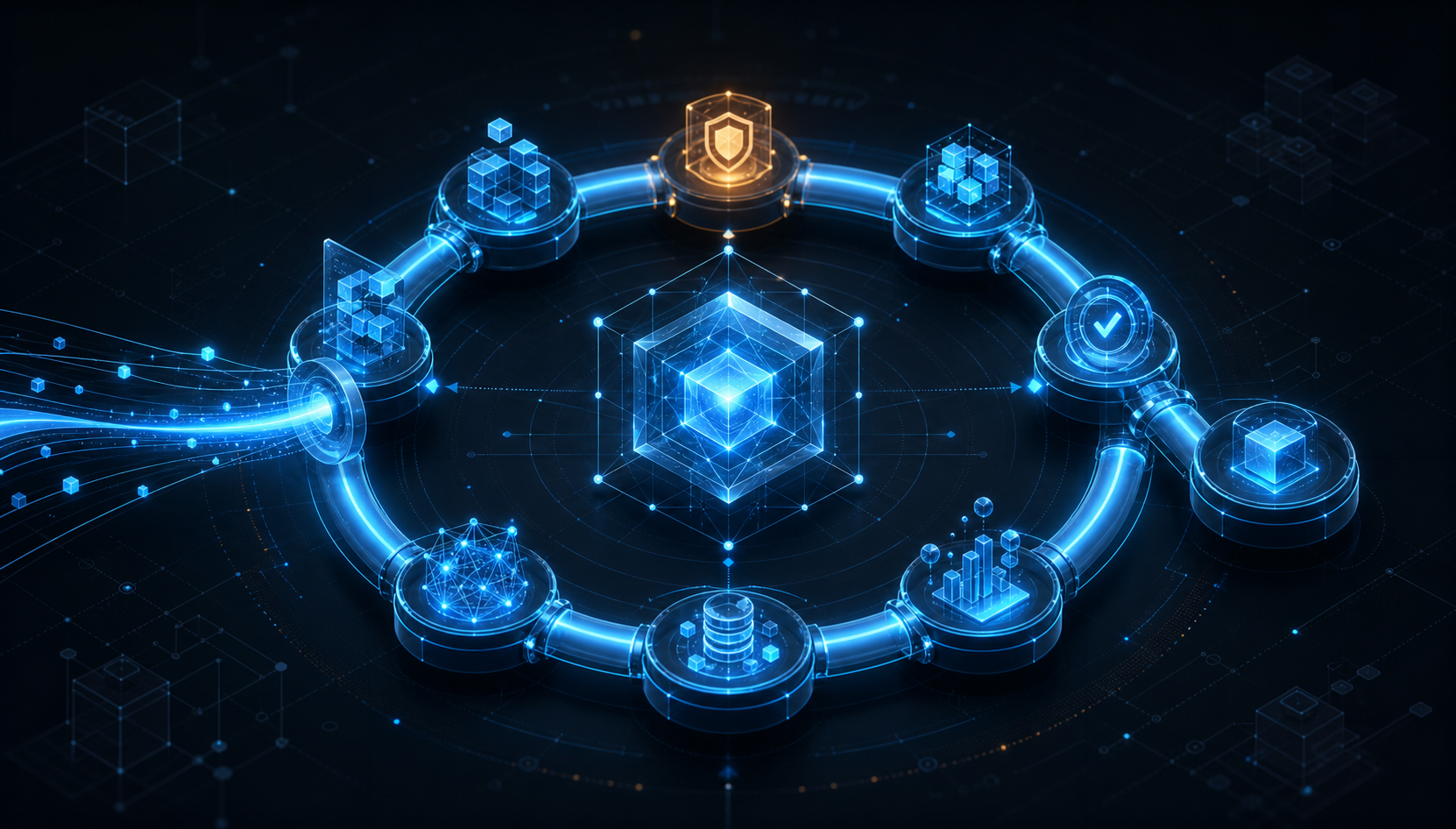
AI-assisted software development usually begins with a task.
A human defines the work. An agent inspects the repository, proposes a plan, changes code, runs tests, and prepares a pull request. The execution may be impressively autonomous, but the development loop still belongs to the human.
The human noticed the problem.
The human decided it mattered.
The human started the agent.
The next limit of the AI SDLC is not simply an agent that can complete a larger task. It is a development system that can remain active between tasks, observe results, retain operational memory, initiate bounded work, and improve how the next cycle is performed.
That is the difference between agentic execution, an autonomous SDLC, and a self-learning pipeline.
The distinction matters because all three are frequently described as autonomous coding. Coding is only one step. The more consequential question is who controls the loop.
Three different systems
| System | How the work runs | What changes |
|---|---|---|
| Agentic execution | A person defines a task. An agent plans, implements, tests, and presents the result for review. | Already useful and increasingly common. It can compress implementation without changing who selects the work or how the organization learns from it. |
| Autonomous SDLC | A system receives or discovers a signal, interprets whether software work is required, plans a bounded response, implements it, validates it, releases it within policy, and observes the result. | Not better code generation. The system now controls more of the delivery loop. |
| Self-learning SDLC | The system uses evidence from previous cycles to change how later work is performed. | It may update repository guidance, add an evaluation, change model routing, strengthen a test, revise a decomposition strategy, reduce permissions, or promote a lesson into a broader organizational standard. |
Self-learning does not require continuously retraining the foundation model. In practical engineering systems, the first meaningful learning happens around the model: memory, context, prompts, skills, tests, policies, routing, and workflow configuration.
The components are already visible
It would be inaccurate to describe this entire direction as hypothetical. Anthropic, OpenAI, Google DeepMind, and open-source projects such as OpenClaw have published working pieces of the system.
None of these examples, based on the public material reviewed for this article, describes a complete production-wide lifecycle that independently chooses product priorities, deploys changes, measures business outcomes, and modifies its own governance.
They do show that several previously difficult components are operating today.
Anthropic: persistent execution across sessions
Long-running engineering work exposes a basic limitation of coding agents: a substantial project outlives one context window.
Anthropic’s long-running agent harness addresses this with an initializer agent, a progress file, incremental implementation, Git checkpoints, and explicit instructions to leave the repository in a clean state for the next session.
The important artifact is not the progress file itself, but the pattern it encodes:
Inspect durable state
  -> choose the next bounded step
  -> execute and verify
  -> record progress
  -> leave a clean handoff
Each session can begin without conversational memory and still continue the same engineering process.
Anthropic later demonstrated a much larger form of sustained execution. In its C compiler experiment, 16 Claude agents worked across nearly 2,000 Claude Code sessions to produce a roughly 100,000-line Rust compiler that could build Linux 6.9 for x86, ARM, and RISC-V. The reported API cost was approximately $20,000.
The experiment combined repeated execution, parallel agents, shared tests, incremental commits, autonomous task selection, and limited active human supervision.
It also had a property that makes autonomy easier: success could be expressed through executable evidence. Compiling known programs and eventually the Linux kernel provides a much stronger evaluator than “make the product better.”
Autonomous execution becomes tractable first where correctness is measurable.
Anthropic: evaluation as an improvement loop
Anthropic’s guidance on evaluating AI agents distinguishes capability evaluations from regression evaluations.
| Evaluation | What it does |
|---|---|
| Capability | Asks whether an agent can perform a new class of work |
| Regression | Protects behavior that already works |
Successful capability tests can graduate into a continuously running regression suite.
That creates a disciplined learning loop:
Define a capability
  -> evaluate repeated trials
  -> inspect transcripts and outcomes
  -> improve model, harness, context, or tools
  -> convert stable capability into regression protection
Anthropic also emphasizes that an agent evaluation measures the model and harness together. That is crucial. The unit being improved is the complete execution system, not the model in isolation.
Anthropic: context and bounded authority
Persistent execution requires selective memory, not an ever-growing prompt. Anthropic’s context-engineering guidance describes just-in-time retrieval using lightweight references such as file paths, stored queries, and links. Agents load relevant material when the task requires it.
This resembles the practical purpose of Hierarchical Context: organization, team, service, and task knowledge should remain addressable at the scope where it applies.
More autonomy also requires a different safety model. Anthropic reports that Claude Code sandboxing reduced permission prompts by 84% in internal usage by enforcing filesystem and network boundaries. Its later description of auto mode says users approved 93% of permission prompts and explains the use of classifiers and injection probes to automate some decisions.
The lesson is not that approvals should disappear. Repeated approval prompts can become ceremonial, while unrestricted execution is unsafe. A usable autonomous system needs bounded environments, policy-mediated actions, escalation, and observable interventions.
OpenAI: the repository learns
OpenAI’s description of harness engineering provides a concrete example of learning being encoded into the engineering environment.
The reported practices include repository-local knowledge, versioned execution plans, structural tests, custom linters, dependency boundaries, naming conventions, file-size limits, and remediation instructions embedded in lint failures.
The most relevant part is the feedback loop. OpenAI describes review comments, refactoring pull requests, and user-facing defects being converted into documentation or tooling. When written guidance is insufficient, the rule is promoted into code.
That is operational self-learning:
- A human or production signal reveals an undesirable result.
- The lesson is captured as context.
- Later agents receive the guidance.
- Repeated or critical guidance becomes an executable constraint.
- Future changes receive immediate deterministic feedback.
The repository accumulates judgment without requiring every reviewer to remember and repeat the same correction.
Google DeepMind: evolutionary optimization
Google DeepMind’s AlphaEvolve combines model-generated programs with automated evaluators and evolutionary selection.
Candidate programs are generated, evaluated, retained, selected, and modified through repeated cycles. DeepMind reports applications in data-center scheduling, chip design, AI training, matrix multiplication, and mathematical discovery.
A one-year impact update published in May 2026 moves several of those results from demonstration into production. DeepMind reports:
| Application | Reported result |
|---|---|
| Spanner, after AlphaEvolve reworked its log-structured merge-tree compaction heuristics | 20% reduction in write amplification |
| DeepConsensus genomics model | 30% reduction in variant detection errors |
| AC Optimal Power Flow | Feasible-solution rates rising from 14% to over 88% |
Generate
  -> evaluate
  -> retain
  -> select
  -> mutate
  -> re-evaluate
AlphaEvolve works in domains where results can be scored repeatedly and objectively. That gives us an important boundary:
A pipeline can improve only as reliably as it can evaluate the result.
If the evaluator is incomplete, the system can become better at satisfying the evaluator rather than improving the software or product.
DeepMind’s CodeMender demonstrates a narrower but more recognizable development loop. It investigates vulnerabilities, identifies root causes, generates patches, and validates them with static analysis, dynamic analysis, differential testing, fuzzing, and SMT solvers. DeepMind reported 72 upstreamed security fixes during the first six months of development, with generated patches reviewed by human researchers before submission.
This is not a fully autonomous product lifecycle, but it is a strong example of autonomy in a bounded work category with specialized verification and human authority at the release boundary.
OpenClaw: a persistent control-plane pattern
OpenClaw is not an autonomous SDLC platform. It earns a place here because it demonstrates a persistent agent runtime that connects models, workspaces, skills, sessions, channels, and a background Gateway.
Its built-in memory engine indexes MEMORY.md and memory/*.md into a per-agent SQLite database. Its Gateway manages channels, nodes, sessions, and hooks. Its channel configuration supports communication systems including Slack, Discord, Telegram, WhatsApp, Matrix, Teams, and others.
These capabilities suggest a control plane that remains active between coding sessions, receives signals, retrieves memory, and delegates work to specialized tools or coding agents.
They also widen the security surface. OpenClaw’s own security documentation states that it is not a hostile multi-tenant security boundary and describes sandbox, workspace, and per-agent tool-policy controls. Persistence plus tools plus external communication is useful precisely because it carries authority. That authority must be constrained.
OpenClaw demonstrates that an always-on coordination layer is technically practical. It does not establish that connecting one to production systems creates a trustworthy development lifecycle.
Generation is not the bottleneck
The components above make agentic execution look close to solved. The delivery numbers say something narrower.
Demirer, Musolff, and Yang tracked more than 500,000 GitHub developers across three generations of tooling, from autocomplete through interactive agents to autonomous ones, in Writing Code vs. Shipping Code (NBER working paper, May 2026, revised September 2026). For autonomous agents the cumulative effect attenuates sharply as work moves closer to something a user can actually run:
| Stage of the production hierarchy | Cumulative effect |
|---|---|
| Commits | +240% |
| Projects | +80% |
| Releases | +30% |
The authors estimate an elasticity of substitution of 0.23 between AI and human effort, which points to complementarity rather than replacement. Across four software marketplaces they found more new app launches and no matching rise in total usage.
Commit growth outrunning release growth by a factor of eight is what an open loop looks like from the outside. The expensive step is no longer writing the change but qualifying it: review, testing, security analysis, release, and the human attention all of those consume. This is the attenuation described in From Execution Speed to Adoption Limits, observed at the level of the commit rather than the organization.
Happy Bhati’s Beyond Code Generation, published in September 2026, supplies the accounting such a gap requires. A production-qualified change counts as output only once it clears the review, test, security, deployment, and operational gates that apply to it. The verification tax is the ratio of assurance and rework cost to generation cost, which puts the downstream burden on the same ledger as the tokens. The paper converges on a control plane that allocates autonomy against cost, reliability, and human-attention budgets.
Reaching a control plane from cost economics, when the architecture below reaches one from governance, is a useful corroboration. It also frames the measurement problem the way Stop Measuring Motion does: a pipeline that cannot price what it costs to qualify a change will keep optimizing the step that was already cheap.
The closed loop
A self-learning AI SDLC can be described as nine connected stages:
- 01 · ObserveCollect incidents, telemetry, support cases, security findings, dependency events, roadmap changes, and explicit human requests.
- 02 · InterpretConnect signals to product behavior, architecture, ownership, operational history, and previous decisions.
- 03 · PrioritizeApply organizational intent, risk, urgency, customer impact, cost, and authority.Human-governed unless the relevant policy is explicit and bounded.
- 04 · PlanDefine acceptance evidence, context, implementation boundaries, rollout strategy, permissions, and stop conditions.
- 05 · ImplementAssign isolated agents or agent teams to bounded work.
- 06 · VerifyCombine deterministic tests, static analysis, security checks, simulations, model-based evaluation, and human judgment.
- 07 · ReleaseUse progressive delivery, explicit approval boundaries, and reversible changes.
- 08 · MeasureCompare the intended result with production behavior, customer outcomes, operational effects, review effort, and maintenance cost.
- 09 · LearnUpdate context, evaluations, routing, skills, policies, tests, and planning heuristics at the correct organizational scope.
Closed loopLearn improves how the next cycle is performed, starting again from Observe.
The loop is only as strong as its transitions. A pipeline that implements and tests but cannot connect the result to the original intent is automated execution, not organizational learning.
Five layers of learning
| Layer | What it learns |
|---|---|
| Execution learning | Asks which models, tools, prompts, and workflows reliably solve a task category |
| Repository learning | Captures architectural conventions, hidden dependencies, recurring defects, and validation requirements |
| Product learning | Examines whether a change produced the customer or business outcome it was intended to affect |
| Organizational learning | Records where ownership, communication, or authority repeatedly created friction |
| Governance learning | Identifies where the system requested too much authority, missed risk, produced excessive review burden, or required human correction |
The last layer prevents self-learning from becoming a synonym for expanding automation. A legitimate learning system must be able to conclude that it should do less, request stronger evidence, or return authority to a human.
Autonomy should be earned
Autonomy is not one switch for the entire pipeline.
| Level | Authority |
|---|---|
| Observe | Gather signals and propose work |
| Prepare | Produce plans, patches, and validation evidence |
| Execute safely | Merge or release low-risk, reversible changes within policy |
| Operate conditionally | Respond to production conditions within defined limits |
| Adapt | Modify bounded workflow configuration and routing |
| Governed improvement | Propose changes to policies, evaluations, or permissions for independent approval |
Reliability should be tracked by repository, task category, environment, workflow, and model combination. Evidence that an agent safely updates documentation says little about whether it should autonomously migrate customer data.
A reference architecture
A closed-loop engineering system needs several planes with explicit boundaries:
- Signal plane: telemetry, incidents, customer feedback, dependency events, security findings, and roadmap inputs.
- Context and memory plane: hierarchical context, repositories, architecture records, operating history, and decision provenance.
- Goal and policy plane: product intent, priorities, constraints, permissions, risk classes, and approval boundaries.
- Orchestration plane: persistent supervisors plus specialized implementation, test, review, and operations agents.
- Execution plane: isolated worktrees, ephemeral environments, CI, delivery systems, and observability tools.
- Evaluation plane: deterministic checks, model-based evaluation, security analysis, outcome comparison, and regression detection.
- Learning plane: memory updates, workflow tuning, model routing, new evaluations, and knowledge promotion.
- Governance plane: identity, authorization, audit trails, cost controls, provenance, rollback, and human escalation.
The learning plane should not have unrestricted authority to rewrite the governance plane. A system that can relax its own controls in order to improve its score does not have a learning architecture. It has a conflict of interest.
What remains incomplete
The public examples establish substantial capabilities. They do not resolve several organizational problems:
- discovering the right work from noisy production and customer signals;
- connecting implementation to product and business outcomes, which the marketplace result above shows is still largely unsolved;
- resolving conflicting goals across teams;
- deciding when an evaluator is wrong;
- promoting learning without spreading a local exception as global policy;
- managing architectural consequences over long periods;
- changing governance without weakening independent control;
- assigning accountability for autonomously initiated work.
These are not small integration details. They are the parts of the lifecycle where organizational judgment lives.
The limit worth stretching
The useful endpoint is not a software factory that produces the maximum amount of code without people.
It is a continuously operating development system that can convert signals into bounded work, gather evidence, improve its execution strategy, and expand authority only where repeated outcomes justify it.
The most valuable pipeline is not the one that removes humans from the greatest number of steps. It is the one that learns where human judgment is necessary, where deterministic machinery is sufficient, and where previous assumptions no longer match observed reality.
The building blocks are already in use.
The hard work is connecting them into a closed engineering system without confusing persistent activity with learning, or technical autonomy with organizational authority.