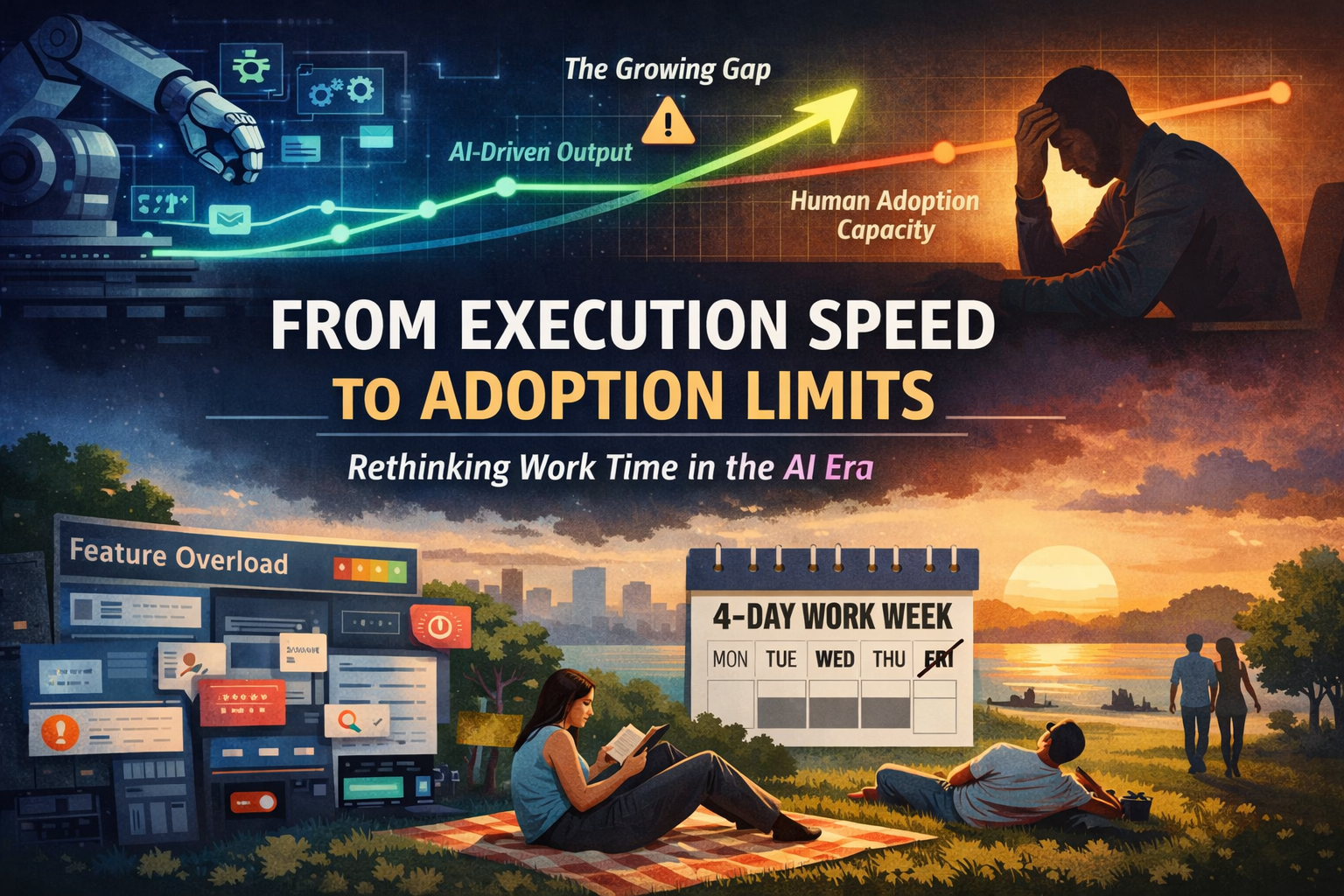
This is not a prediction. It’s a hypothesis about how organizations may be forced to adapt as AI reshapes the pace of software creation.
The Hypothesis
As AI makes routine execution cheap and abundant, human adoption capacity becomes the binding constraint. Organizations that recognize this will eventually convert productivity gains into time optimization — not to be generous, but because sustainable performance outperforms raw speed. Shorter workweeks may emerge not as a perk, but as a system-level balancing mechanism between machine speed and human limits.
AI tooling is dramatically accelerating how fast teams can build, test, and ship software. Agentic workflows, automated pipelines, and AI-assisted development are compressing weeks of work into hours.
The 2025 reality (Index.dev, Faros AI):
- 84% of developers now use AI tools
- 41% of all code is AI-generated
- 21% more tasks completed on high-AI-adoption teams
- 98% more pull requests merged
- 91% longer PR review times — the human bottleneck
75% of engineers use AI tools, yet most organizations see no measurable performance gains.
A growing asymmetry is emerging:
Execution speed is scaling faster than human adoption capacity.
Software can now be created at near-machine speed. But value is still created at human speed.
People must learn new tools. Teams must change behavior. Organizations must build trust in new systems. Stakeholders must approve change.
No amount of compute can eliminate these constraints.
This creates a structural tension most companies are only beginning to feel:
- Shipping faster does not guarantee value faster
- Feature velocity can exceed organizational absorption capacity
- Productivity gains risk converting into burnout instead of leverage
This raises a provocative question:
Instead of endlessly increasing output, will organizations eventually optimize time itself?
The New Bottleneck: Adoption Bandwidth
Modern AI tools — from IDE copilots to autonomous deployment agents — have shifted the bottleneck away from execution.
Teams can now:
- Generate features rapidly
- Automate infrastructure creation
- Produce tests and documentation automatically
- Deploy continuously
But software only creates value when humans:
- Understand it
- Trust it
- Integrate it into daily workflows
- Change habits
- Adjust mental models
This creates a fundamental mismatch:
Production capacity grows exponentially. Human adaptation capacity grows linearly.
Even with simplified UX, better onboarding, and automation, human attention remains finite. Despite years of effort, 70% of digital transformation initiatives still fail to meet their objectives in 2025, with employee resistance cited as a factor in approximately 70% of these failures (Gartner/Meltingspot, 2025). AI is accelerating the pace of change faster than organizations can absorb it.
When Feature Velocity Becomes a Liability
As AI accelerates delivery, a subtle shift occurs.
At first, faster shipping feels like progress.
Then symptoms appear:
- Feature overload in products
- Users ignoring new releases
- Training backlogs growing
- Documentation debt accumulating
- Adoption metrics lagging behind deployment metrics
The paradox becomes visible:
Faster engineering teams may reduce real-world impact if adoption cannot keep up.
Velocity without absorption creates noise, not value.
This suggests that raw output must eventually be synchronized with organizational learning speed.
What Agentic Systems Fix — And What They Don’t
Agentic AI changes the dynamics, but not the core constraint. I explored the progression from manual to autonomous workflows in From Manual to Agentic Orchestration — efficiency gains compound as orchestration matures, but human attention remains the limiting factor.
| Agents can | Agents cannot replace |
|---|---|
| Run automated testing | Human judgment |
| Simulate user behavior | Accountability |
| Pre-validate rollouts | Strategic decision-making |
| Generate onboarding content | Organizational trust-building |
| Handle basic support |
They compress effort — not cognition. They scale operations — not attention.
As a result, adoption bottlenecks are delayed, not eliminated.
The Hypothesis: Time Reduction as Structural Rebalancing
If output keeps rising while adoption remains capped, organizations face a choice.
| Option 1: Push harder | Option 2: Time stability |
|---|---|
| Increase burnout | Maintain output |
| Increase cognitive overload | Reduce calendar load |
| Inflate feature backlogs | Improve sustainability |
| Create fragile high-output systems | Protect long-term performance |
This is where the idea of time optimization emerges.
Not as a benefit.
As a capacity alignment mechanism.
Instead of creating a loop of:
AI increases output, which increases pressure,
organizations may move toward:
AI maintains output, while time pressure decreases.
Why This Likely Happens After Layoffs and Hard Optimization
If this hypothesis holds, the sequence matters.
Most organizations will not reduce time first.
They will start with:
- Headcount compression
- Cost optimization
- Team consolidation
These are the fastest visible financial levers — and the pattern is already playing out. I explored the dynamics of AI-driven organizational restructuring in After AI Becomes Standard, and why four engineers may be the sustainable team size in The Fantastic 4.
Only after:
- AI workflows mature
- Productivity rises significantly
- Adoption bottlenecks become obvious
- Sustainability risks appear
does time rebalancing become strategically attractive.
In other words:
Shorter workweeks are more likely to appear as a second-order correction, not the first response.
Why Four Days Is Structurally Different Than Shorter Days
Reducing time can be done in multiple ways. The structure matters.
| 4 days × 8 hours | 5 days × 6 hours | |
|---|---|---|
| Recovery | Real boundary, full day off | Weaker recovery effect |
| Meetings | Forced discipline | Meeting creep continues |
| Deep work | Better focus blocks | Fragmented focus |
| Behavior change | Hard boundary forces adaptation | No forcing function |
| Global teams | Preserves timezone overlap | Shrinks collaboration windows |
The four-day model aligns with AI-assisted execution: machines handle background tasks while humans focus on high-leverage decisions during concentrated work periods.
For globally distributed teams, four full days preserve meaningful timezone overlap windows. Teams across continents may have only 1-2 hours of overlap — reducing daily hours makes synchronous work nearly impossible. Full eight-hour days maintain the overlap needed for real-time decisions while agents handle async execution.
Without a hard boundary, organizations rarely change behavior.
Two Models, Different Intent
Not all four-day implementations are equal. The calendar outcome looks the same, but the strategic intent differs.
| 100:80:100 Model | 80:80 Model | |
|---|---|---|
| Pay | 100% salary maintained | 80% salary (20% cut) |
| Time | 80% (4 days) | 80% (4 days) |
| Output expectation | 100% (efficiency gains assumed) | Reduced proportionally |
| Strategic intent | Sustainability, talent retention | Cost reduction, layoff alternative |
| Signal to employees | “We’re investing in your wellbeing” | “This or layoffs” |
The 100:80:100 model is a bet on productivity — that focused time plus AI-assisted execution can maintain output. This is the model most four-day workweek research validates.
The 80:80 model is a cost-reduction tactic — essentially a softer form of layoffs. Some companies have used it successfully to avoid cuts during downturns, then restored full pay once they stabilized (Yahoo Finance / Procurify, 2025). Others frame it as “4 days at 80% pay or be let go” — which may preserve headcount but risks talent flight.
The distinction matters for long-term outcomes:
- 100:80:100 tends to improve retention and engagement
- 80:80 may trigger top performers to leave for full-pay competitors
If the goal is sustainable performance, the model choice signals whether time optimization is a genuine investment or a cost-cutting measure with better optics.
Outcome-Based Scheduling and the Agentic Future
Long-term, AI-native teams may abandon fixed hours entirely.
Instead:
- Teams commit to outcomes
- Agents handle execution
- Humans focus on decisions and strategy
- Work becomes burst-based and adaptive
This model requires maturity, trust, and strong observability.
Most organizations are not ready for this yet, but it represents a logical destination once agentic infrastructure becomes reliable.
Adoption Bottleneck as Strategic Advantage
If execution becomes cheap, the real competitive advantage shifts toward:
- Learning speed
- Adoption velocity
- Organizational enablement
- Change management capability
Teams that absorb change faster will outperform teams that simply ship faster.
Shorter workweeks can indirectly support this by:
- Creating reflection time
- Improving training absorption
- Reducing cognitive overload
- Improving decision quality
Evidence Signals (Early but Suggestive)
Organizations experimenting with shorter workweeks have reported:
- Stable or improved productivity
- Reduced burnout
- Lower attrition
- Higher engagement
The UK’s 2025 four-day workweek pilot ended with a 100% success rate — all 17 participating companies decided to continue the shorter working week after the six-month trial (4 Day Week Foundation, Jul 2025). Across pilots in six countries, workers reported better physical and mental health, with two-thirds experiencing reduced burnout (Euronews Health, Jul 2025). By 2025, more than 2.7 million UK workers — almost 11% of the workforce — now report working a four-day week (World Economic Forum, Oct 2025).
Not because people worked less — but because inefficiencies were removed and focus improved.
AI amplifies this dynamic by removing low-value execution work at scale.
Risks If Implemented Incorrectly
This model fails quickly if companies:
- Keep the same meeting load
- Preserve synchronous-heavy culture
- Maintain unclear ownership
- Add AI without redesigning workflows
Time compression without organizational change produces:
- Hidden overtime
- Stress spikes
- Burnout acceleration
AI must be used to remove coordination overhead — not just accelerate delivery. See Engineering Management Evolution in Agentic Engineering for how management practices must adapt when execution accelerates.
The Larger Pattern
This hypothesis builds on the organizational shifts I explored in After AI Becomes Standard: What’s Next for Software Engineering?. If this hypothesis plays out, the transformation arc may look like this:
- AI adoption → 2. Hard optimization (layoffs, cost compression) → 3. Agentic acceleration → 4. Adoption saturation → 5. Sustainability pressure → 6. Time optimization experiments
This mirrors the Industrial Revolution pattern. The shift from 80-100 hour weeks to the 40-hour standard took over a century — from Robert Owen’s “eight hours labor, eight hours recreation, eight hours rest” in 1817, through Ford’s adoption of the five-day week in 1926 (after discovering 48-hour weeks yielded only marginal productivity gains), to the Fair Labor Standards Act in 1938 (History.com).
Automation displaced labor first. Labor movements restructured working conditions. Economic optimization eventually aligned incentives.
Final Thought
AI does not make work free.
It makes routine execution cheap and abundant — while intelligent execution and human attention remain scarce.
If organizations continue accelerating output without addressing adoption limits, the system becomes unstable.
Shorter workweeks are not guaranteed.
They are not universal.
But they may become increasingly rational as a way to rebalance:
- Machine speed
- Human limits
- Organizational sustainability
In the AI era, time itself becomes a design decision.
Not because companies want to be generous.
But because sustainable performance eventually outperforms raw speed.