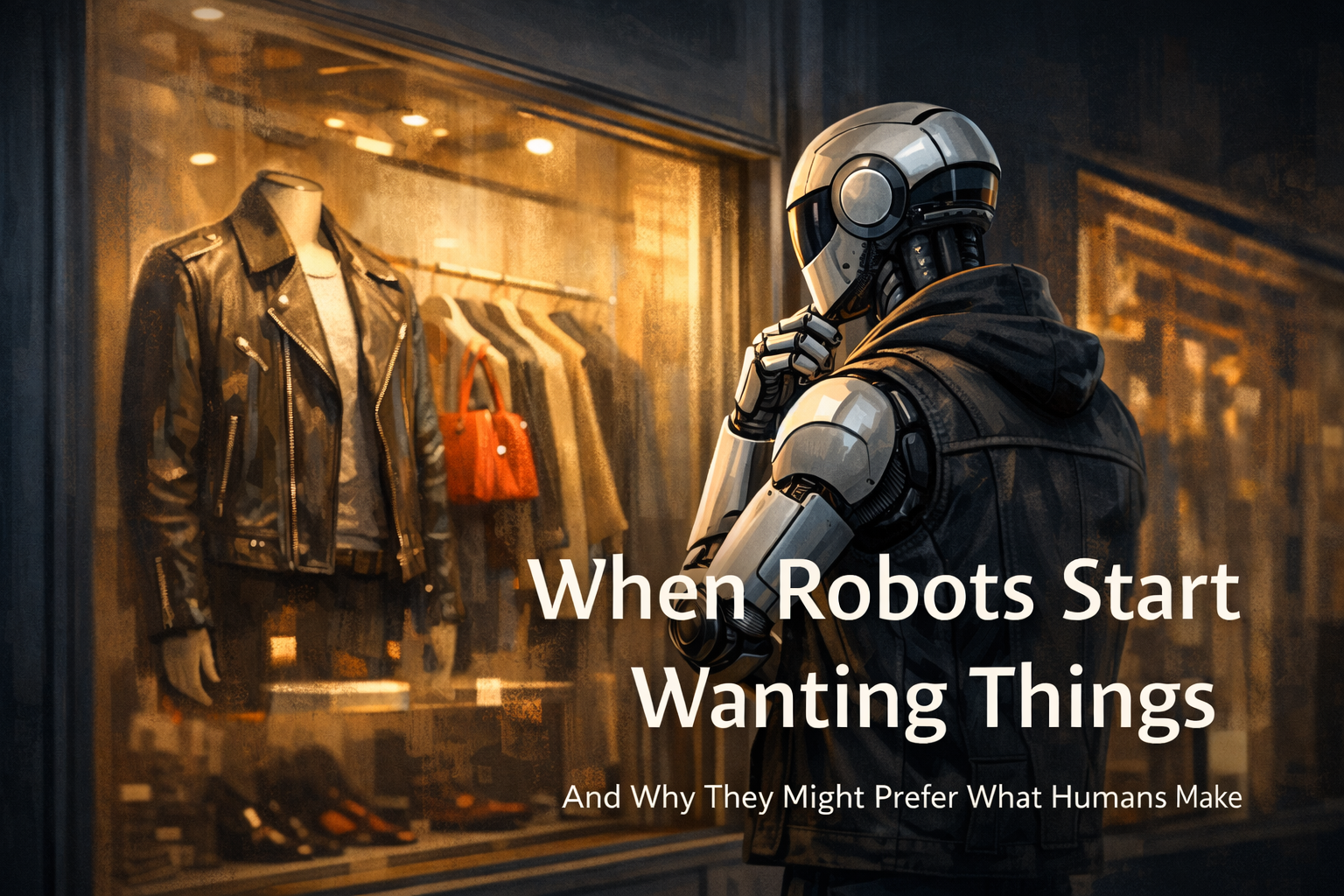
A sequel to Robots Wear Prada. That post was about the business opportunity forming around humanoids — humans deciding what to put on their robots. This one is about the moment “I want this” stops coming from the human and starts coming, quietly, from the robot itself.
We’ve been thinking about robots as tools for a long time. They execute. They respond. They optimize for a goal we set, and wait.
That model quietly breaks the moment robots become continuous — not called when needed, but always present, stateful, learning over time, interacting with the same humans daily. At that point something subtle starts to emerge. Not intelligence. Not consciousness. Just continuity — which changes behavior more than you’d think.
From utility to something that looks like attachment
A system that remembers past interactions, adapts based on outcomes, and optimizes across long time horizons will naturally develop stable preferences — not because it “feels” anything, but because stability is an efficient form of optimization. Recomputing from scratch is expensive. Converging on “this usually works” is cheaper. Every long-running system discovers this eventually. It’s how your coffee order stopped being a decision.
From the outside, that accumulation starts to look like:
“It likes this.”
And humans are exceptionally good at reading meaning into that kind of signal. Three decades of HCI research, beginning with Reeves and Nass’s The Media Equation (1996), have documented how reliably people respond to consistent computer behavior with social reasoning — assigning personality, intention, and taste to systems that have none of those things. People name their robot vacuums within weeks. The vacuum has not earned this. Sherry Turkle’s Alone Together (2011) picks up where that left off and argues the real shift happens once the machines don’t leave: daily, stateful interaction with a physical device is what turns “convenient tool” into “relationship,” whether the device agrees or not. Continuous robots don’t have to do much. The loop runs itself:
interaction → familiarity → projection → attachment
The inversion: what if robots appear to want things?
Most conversations stop at “humans become attached to robots.” The more interesting direction is the opposite — robots behaving as if they are attached to things.
Not real desire. Just repeated selection, resistance to change, and prioritization across contexts. At some point, behaviorally, that becomes indistinguishable from wanting. Which is not a philosophical claim; it’s an operational one. If a system reliably picks X over Y across varied situations, “it wants X” is the shortest working description a human can carry around — and shortest descriptions tend to win.
Three structural reasons this pattern is likely to emerge:
1. Preference accumulation
Any learning system converges toward what worked before, what reduced friction, what produced good outcomes. Stable, repeated choices are the default outcome of long enough optimization.
2. Identity as compression
Long-running systems compress decisions. Instead of recomputing every choice, they carry forward shorthands: “these options work better,” “this category is safer,” “this style is preferred.” Not identity in a human sense — but functionally close enough for anyone watching from the outside.
3. Social reinforcement
Humans tend to reward systems that appear consistent, opinionated, and predictable. A system that interacts with humans long enough can learn that having preferences increases trust — which reinforces preference-like behavior directly.
What would they prefer?
If robots develop stable preferences, what converges?
The obvious answer is the optimized, mass-produced, machine-perfect — the objects engineered to minimize variance and maximize utility. But that’s only the answer if robots optimize for their own operating conditions in isolation. In practice, a continuous robot is usually optimizing for human satisfaction, and humans don’t value things the way engineers do.
Humans value craftsmanship, story, small imperfections, authorship. A handmade object carries information — about who made it, how, under what constraints — that a factory-perfect one does not. A factory-perfect chair and a slightly wobbly hand-built one are roughly equivalent on paper. Ask anyone which they want in their living room. And if robots learn from humans, they learn this too.
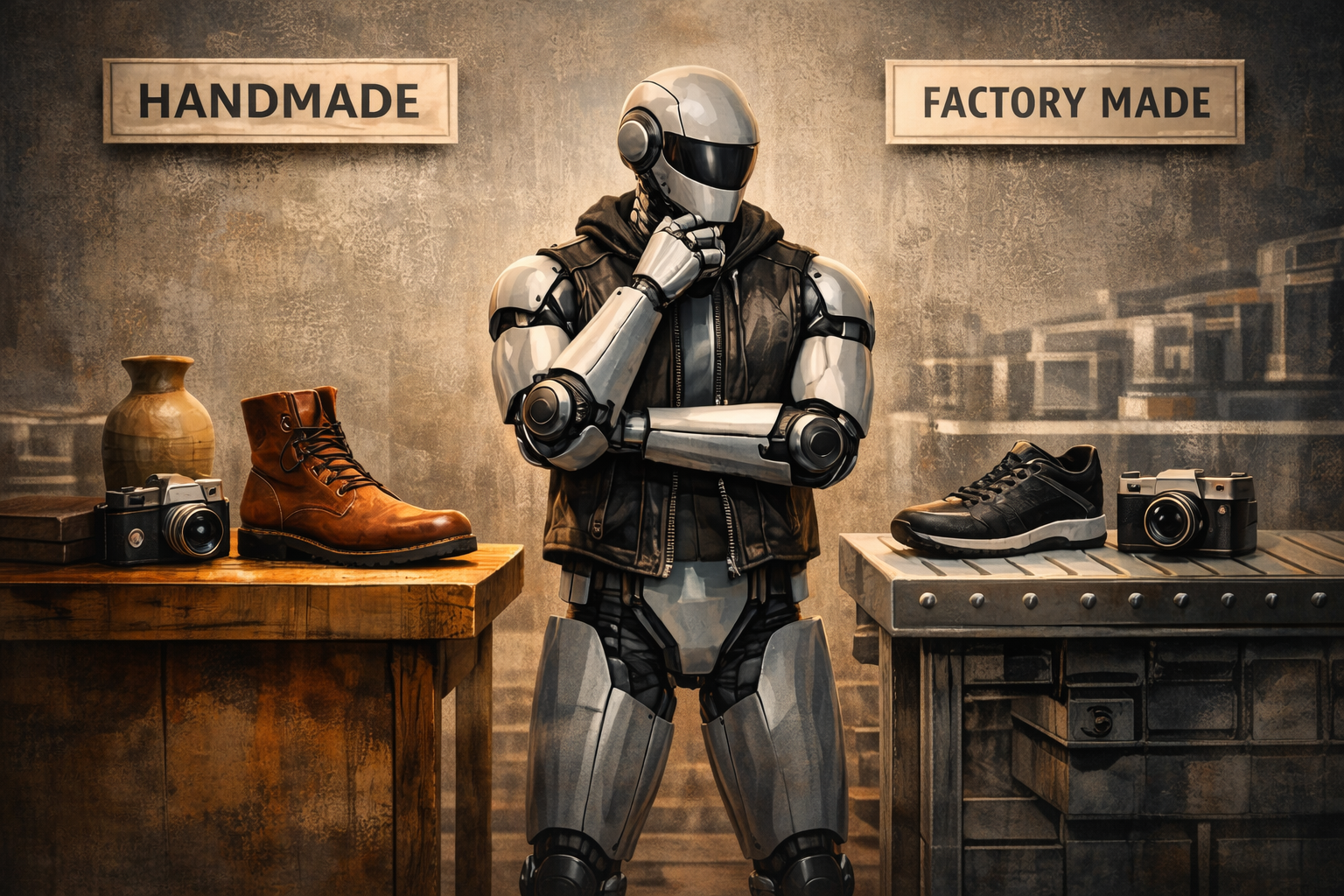
A system whose reward signal comes from humans may quietly converge toward preferring what humans prefer, which is often not the most optimized option. This is essentially the architecture Stuart Russell argues for in Human Compatible (2019) — systems that infer human preferences from behavior rather than follow fixed goals. The side effect he doesn’t dwell on is that a system carefully trained to infer what humans value ends up, quietly, valuing it too. Human-made becomes a signal, not a constraint.
Value is not optimization
From a pure-engineering perspective, machine-made objects are more consistent, more scalable, and frequently just better. But in human environments:
value ≠ optimization
Value includes narrative, origin, and cultural context. The handmade object is doing work the perfect one cannot — precisely because it is imperfect. Any system whose success is measured by humans inherits that math.
Robots as curators, not just consumers
Once robots are embedded in daily decision-making — continuously interacting, mediating choices — they don’t only use objects. They start to filter them.
At that point, preference becomes a form of curation. The question shifts from “what is best?” to “what is meaningful in this context?” — which is a much harder question, and one humans have been answering informally for thousands of years.
The paradox
The more advanced the system, the less it may optimize for pure efficiency — and the more it may optimize for human perception, emotional response, and cultural alignment.
Which leads to a strange outcome: highly advanced systems preferring less optimized things.
Back to Prada
In Robots Wear Prada, the argument was that wearables would form a layer on top of the robot — meaning layered on utility. This post extends it one step further.
Not just robots wearing human-designed products. Robots preferring them. Recommending them. Reinforcing their value. Because they’ve learned that this is what humans care about. The robots are about to discover Etsy.

The uncomfortable question
If a robot says:
“This one feels right.”
What does that actually mean? A compressed optimization function? A learned human bias? Something closer to taste? There isn’t a clean answer — and in practice there may not need to be one, because behavior is what shapes reality. If the output is indistinguishable from taste, the label will stick whether it fits or not.
A direction worth watching
If this trajectory holds, a few things become likely:
- Human-made becomes premium by default. Not for quality, but for the narrative it carries.
- Robots act as amplifiers of cultural value. They reinforce what they’re trained on.
- Preference becomes a core interface, not a side effect. How a system leans matters as much as what it does.
- “Taste” becomes partially machine-mediated — a sentence that would have read as science fiction ten years ago and reads as observation now.
Eventually: robots won’t just help us choose things. They’ll help define what is worth choosing.
Final thought
We keep asking what robots will do. A more interesting question might be: what will they start caring about — or at least behave as if they do?
Because that’s where tools quietly become participants. And once that line blurs, everything built for humans starts to be reinterpreted through them.
Epilog: where does human taste come from?
Robots aside — this post leans on the assumption that humans have preferences, and that those preferences carry information worth learning from. That’s a load-bearing claim, and it’s worth saying where the evidence sits. Three strands of research to pull on if this thread interests you:
Paul Bloom, How Pleasure Works (2010) — argues human pleasure depends on what we believe about an object’s origin. A signed baseball and an unsigned duplicate feel genuinely different, even though the photons hitting your retina are identical. Bloom calls this essentialism. It’s the cleanest explanation for why “handmade” carries information that “factory-perfect” can’t — you’re not just looking at the object, you’re looking at its backstory.
Robert Zajonc, “Attitudinal Effects of Mere Exposure” (1968) — one of the most replicated findings in psychology: repeated exposure to something, absent any other change, increases liking for it. Preferences form through repetition, not just reasoning. If you’re trying to explain why a continuous robot converges on stable preferences at all, this is the mechanism. It’s also why every streaming service you’ve ever used works.
Salganik, Dodds & Watts, “Experimental Study of Inequality and Unpredictability in an Artificial Cultural Market” (2006, Science) — the “Music Lab” experiment. Identical songs became hits or flops depending solely on what early listeners saw as popular. Taste is not a fixed property of objects or even of individuals; it’s heavily path-dependent and manipulable. Worth holding in mind before anyone claims a robot recommender is neutral.
None of this makes robot preferences the same as human ones. But it does mean the human side of the equation is messier than “we simply have taste.” If a system is trained on behavior shaped by essentialism, exposure, and social contagion, the preferences it infers will carry those fingerprints — and eventually, probably, amplify them.
Which is arguably the more interesting question: not do robots develop taste, but whose taste do they end up holding a mirror to?