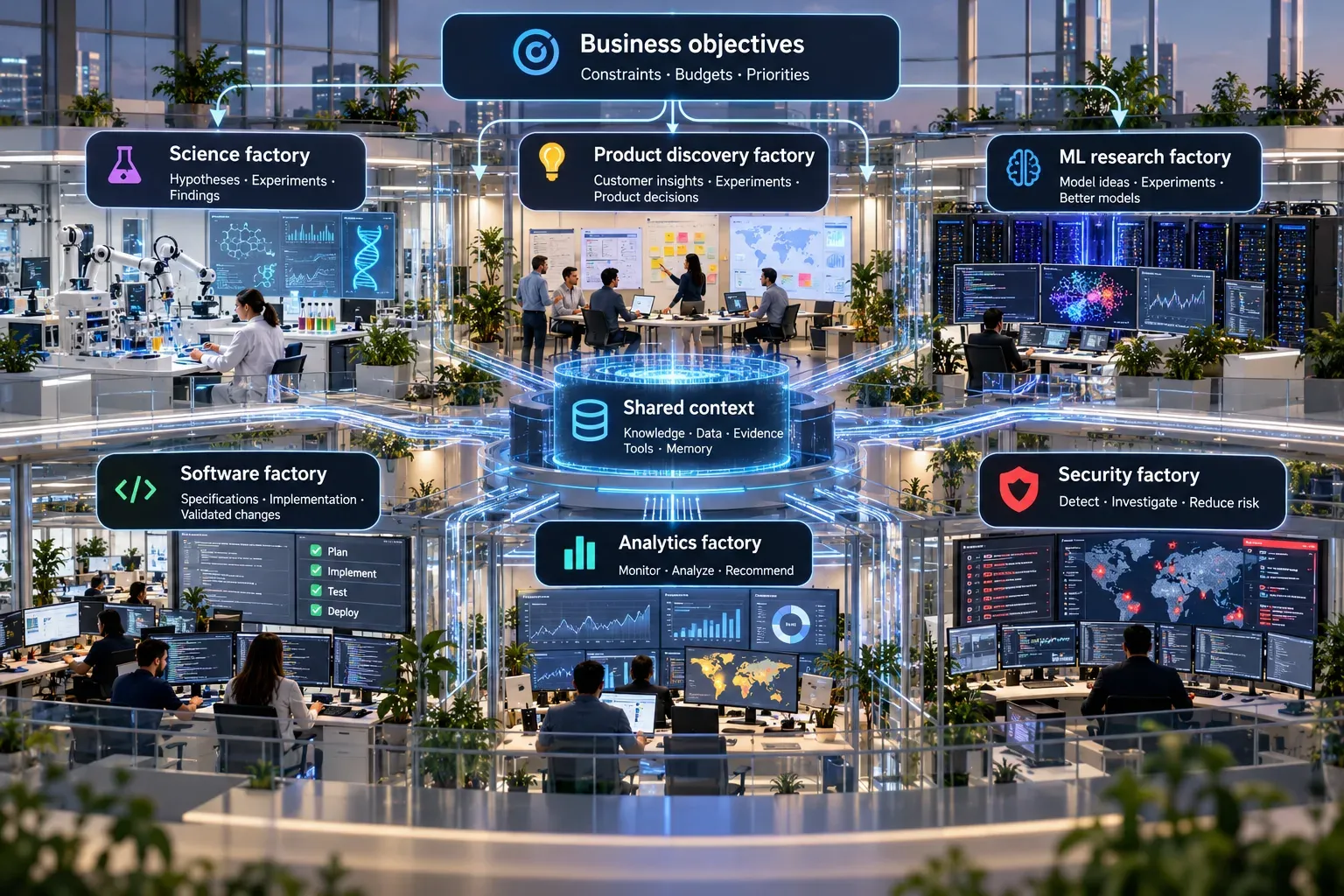
Software factories are only the beginning. AI-powered science, product discovery, ML research, analytics, and security factories could transform how organizations create knowledge and value.
In short
- The software factory may be only the first widely accessible example of a broader pattern: autonomous systems that run whole discovery loops, not isolated tasks.
- The same pattern could power science, product discovery, ML research, analytics, and security factories, each extending what specialists can investigate rather than replacing their disciplines.
- Autonomy without economic discipline is just automated resource consumption. Factories need budgets, stopping criteria, and quality gates, and should be measured by reliable progress per unit of cost.
- The more autonomy a factory receives, the more its evaluation system matters, because a factory without trustworthy feedback can grow more confident without growing more correct.
- The human role shifts toward designing and supervising the exploration system, and the stable organizational unit may become a capability rather than a team.
The next evolution of AI-driven organizations may not be about building more software. It may be about building factories that continuously produce knowledge, experiments, insights, and decisions.
In my previous exploration of the software factory, I argued that engineers should increasingly focus on building autonomous systems that extend their capacity, potentially operating 24/7 while maintaining or improving quality.
But why limit this idea to software engineering?
Software development is just one example of a broader pattern: a complex intellectual process that can be decomposed into smaller tasks, supported by tools, evaluated against objectives, and improved through feedback.
The same pattern exists in scientific research, product discovery, machine learning, business analysis, security, and many other disciplines.
Perhaps the software factory is not the destination. It is simply the first widely accessible example of a much larger transformation.
1. From Automating Tasks to Automating Discovery Loops
Much of today’s AI adoption focuses on making individual activities faster.
An engineer asks AI to implement a feature. A product manager asks it to summarize customer feedback. A scientist uses it to review papers. An ML researcher uses it to generate experiment code.
These are useful improvements, but they still depend on a human to initiate, coordinate, and advance each step.
The factory model is different.
Instead of automating an isolated task, we build a system that can continuously move through a complete cycle:
The next iteration does not always wait for a human
- 01 · ObjectiveThe factory receives an objective
- 02 · Generate ideasIt generates candidate actions
- 03 · Execute / testIt executes those it can safely perform
- 04 · EvaluateIt evaluates outcomes
- 05 · Learn / adaptIt determines the next useful step
Back to step 01
The factory receives an objective, generates candidate actions, executes those it can safely perform, evaluates outcomes, and determines the next useful step.
Humans remain involved where judgment, responsibility, risk, or strategic direction require them.
The critical shift is that the next iteration does not always have to wait for a human to initiate it.
2. The Emerging Family of AI Factories
Science Factory
Continuously explores scientific questions, generates hypotheses, designs experiments, interprets evidence, and identifies promising research directions.
Output: Validated findings, rejected hypotheses, and new knowledge.
Product Discovery Factory
Continuously analyzes customer needs, behavioral data, market signals, and product opportunities, proposing and testing potential improvements.
Output: Prioritized opportunities, experiments, and evidence-backed product decisions.
ML Research Factory
Generates hypotheses about models, architectures, data, and training strategies; runs controlled experiments; evaluates results; and designs subsequent investigations.
Output: Reproducible experiments, evaluated models, and research findings.
Business Intelligence Factory
Continuously monitors operating metrics, investigates anomalies, models scenarios, and identifies risks or growth opportunities.
Output: Actionable insights, forecasts, and recommendations.
Security Factory
Continuously examines vulnerabilities, evaluates defensive controls, proposes remediations, and validates security improvements in authorized environments.
Output: Verified findings, tested remediations, and reduced exposure.
These factories should not be understood as necessarily replacing entire professional disciplines. They are autonomous or semi-autonomous capacity systems that extend what specialists can investigate and accomplish.
3. The Science Factory: From Experiments as Projects to Experiments as a Continuous Process
Scientific research is particularly interesting because it already follows a structured cycle:
Question → Hypothesis → Experiment → Observation → Conclusion → New question
Much of the time between these stages is consumed by searching literature, preparing experiments, coordinating equipment, analyzing results, and planning the next attempt.
AI offers the possibility of reducing this coordination overhead dramatically.
And this is not purely theoretical.
Google Research introduced its AI co-scientist in 2025 to help generate and refine scientific hypotheses, and the peer-reviewed paper on it appeared in Nature in May 2026.
The U.S. National Science Foundation announced a $400 million public-private investment in a network of AI-programmable cloud laboratories in August 2026, while national laboratories are pursuing systems connecting AI, robotics, and physical experiments.
Consider a materials scientist trying to identify a better battery material.
Instead of manually deciding which combination to test next, a science factory could analyze existing findings, propose candidates, run simulations, queue approved physical experiments, compare outcomes, and update its hypothesis space.
When the researcher returns the following morning, the system might present not simply completed tasks but a refined understanding of the problem.
However, scientific productivity is not measured by the number of experiments performed. A factory generating thousands of poorly controlled experiments might produce less knowledge than a careful researcher performing five.
The objective must be reliable knowledge gained per unit of time and cost, not maximum experiment volume.
4. The Product Discovery Factory: An Organization That Never Stops Learning from Customers
Today, product discovery is often organized around periodic research, planning meetings, roadmap reviews, and customer interviews.
But customer behavior and market conditions do not wait for these meetings.
A product discovery factory could continuously observe authorized customer feedback, aggregate product telemetry, detect friction, and investigate emerging opportunities.
Imagine an organization operating such a system overnight:
- It discovers that conversion has declined for a particular customer segment.
- It correlates the change with a recently introduced product behavior.
- It evaluates competing explanations rather than assuming causation.
- It proposes experiments and estimates their potential business impact.
- It prepares a decision package for the product team.
The product manager starts the day with investigated opportunities rather than an unprocessed backlog of signals.
Importantly, the factory should not simply propose more features. It should also discover when existing features should be simplified, fixed, or removed.
Its fundamental output is not a roadmap. It is reduced uncertainty about what the organization should build and why.
5. The ML Research Factory: From Occasional Experiments to Continuous Exploration
Machine learning research is an especially natural environment for factories because many experiments can be implemented, executed, and evaluated entirely within computational infrastructure.
Research from Sakana AI and its academic collaborators, published in Nature in 2026, has already demonstrated automated workflows that generate research ideas, implement code, execute experiments, and prepare scientific manuscripts. Its Agentic Scientist work also discusses limitations such as implementation errors and underdeveloped ideas.
Imagine an ML team investigating how to improve prediction quality while reducing inference costs.
Its factory could continuously test model architectures, feature sets, training configurations, and distillation strategies within a defined computational budget.
The best candidates would be independently evaluated against fixed benchmarks, with multiple runs where needed to measure variation.
The next day, researchers could review not just a leaderboard, but explanations of what was tried, what failed, and what remains uncertain.
This is where factory design becomes essential.
Without experiment tracking, budget enforcement, reproducibility, strong baselines, and independent evaluation, an automated ML researcher risks becoming an expensive generator of misleading results.
A good ML research factory needs the discipline of a scientific laboratory combined with the reliability engineering of a production system.
6. Factories Working Together: From Isolated Intelligence to Organizational Intelligence
This is where the idea becomes even more interesting.
A software factory, product discovery factory, and ML research factory should not necessarily operate in isolation.
Consider a company working on an AI-powered customer support product.
Business objectives and constraints guide the collaborating factories:
- The product factory identifies a customer problem.
- The ML research factory explores whether a new approach could solve it.
- The software factory implements a validated candidate.
- The analytics factory measures whether the customer actually benefits.
- Findings flow back into shared context and the next iteration.
Instead of departments passing documents and tickets between disconnected processes, the organization gains a network of continuously collaborating capabilities.
This also connects to the concept of shared team and organizational context: repositories of knowledge, decisions, constraints, and historical learning that both humans and autonomous agents can access.
A multi-factory organization needs more than agents communicating with each other. It needs a reliable shared understanding of the business.
Without this foundation, every factory may optimize its own metrics while making the overall organization less effective.
7. The Economics of Factories: Not Everything Should Run 24/7
The phrase 24/7 factory is appealing, but constant activity is not necessarily valuable.
Every factory consumes resources: model inference, compute, laboratory equipment, data access, infrastructure, and human review.
The relevant question is not how many agents can run concurrently.
It is how much meaningful progress they produce relative to their cost.
| Factory | Primary value metric |
|---|---|
| Software | Verified changes delivered per dollar |
| Science | Reliable knowledge gained per experiment |
| Product | Uncertainty reduced and validated customer impact |
| ML research | Useful model improvements per compute budget |
| Analytics | Decision value and risk reduction |
| Security | Verified risk reduction per unit of effort |
This has several implications.
Factories need budgets, stopping criteria, quality gates, and mechanisms for deciding when further exploration is no longer worthwhile.
An ML research factory should stop testing ideas when the expected improvement no longer justifies the compute cost.
A product discovery factory should distinguish consequential customer problems from interesting but insignificant patterns.
A science factory should report uncertainty and negative results, not merely promising findings.
Autonomy without economic discipline is just automated resource consumption.
8. A Factory Needs a Definition of Quality
There is a fundamental difference between software production and scientific or product discovery.
In software engineering, expected behavior can often be described through tests, specifications, and measurable outcomes.
In research and discovery, we frequently do not know the right answer ahead of time. In fact, finding that answer is the objective.
This makes factory design harder.
A factory should be evaluated not only by the quality of its final outputs, but by the reliability of its reasoning process and the evidence it produces.
For example:
- A research factory must distinguish reproducible discoveries from statistical noise.
- A product factory must distinguish correlation from causality.
- An ML factory must guard against overfitting to benchmarks.
- An analytics factory must distinguish useful signals from spurious patterns.
It also needs mechanisms for independent criticism. Having multiple agents agree with one another does not guarantee correctness if they share the same assumptions, sources, and failure modes.
The more autonomy a factory receives, the more important its evaluation system becomes.
A factory without trustworthy feedback may continuously become more confident without becoming more correct.
9. The Human Role: Designing the Exploration System
If factories can perform increasingly sophisticated work, what remains for scientists, product managers, engineers, and researchers?
I think the nature of their work shifts.
Instead of manually orchestrating every task, they increasingly design and supervise the systems that perform these tasks.
Their responsibilities may include setting objectives, defining evaluation standards, allocating budgets, managing risk, selecting promising directions, and making decisions that require human judgment.
This creates a potentially important new specialization: the factory architect or factory operator.
Not necessarily someone who is the deepest expert in every task the factory performs, but someone who understands how to turn a domain-specific intellectual process into a reliable, measurable, continuously improving system.
The expertise does not disappear. It moves toward defining good questions, recognizing weak evidence, making consequential tradeoffs, and deciding what matters.
And perhaps the most valuable specialists will be those who combine deep domain expertise with the ability to design autonomous processes around it.
10. The Next Organizational Unit Might Be a Capability, Not a Team
Traditional organizations are primarily structured around groups of people.
We establish engineering teams, research teams, product teams, and analytics departments. Each maintains expertise, owns processes, and executes work.
But suppose a meaningful portion of that operational capacity can be encapsulated into autonomous factories.
Then the relationship between organizational structure and human headcount may begin to change.
A relatively small group of specialists could operate several persistent factories. Those factories could collaborate across domains, scale computational effort up or down, and maintain context as individual people move between initiatives.
This would not eliminate the need for teams. It could, however, make some team boundaries less permanent and less directly tied to day-to-day task execution.
The more stable organizational asset might become the capability itself: its context, tools, evaluation mechanisms, accumulated knowledge, and ability to deliver results.
Humans would increasingly move between objectives and capabilities rather than being permanently bound to a particular operational queue.
That raises a fascinating question:
What happens when an organization begins measuring its capacity not by the number of employees or teams, but by the reliable capabilities its people and factories collectively operate?
11. Where the Factory Analogy Breaks
We should also acknowledge that not everything should be turned into a factory.
Some of the most valuable human activities are difficult to optimize with an explicit objective function.
Scientific breakthroughs may require challenging the very assumptions that guide an experiment. Product breakthroughs may depend on empathy, taste, or recognizing needs customers cannot articulate. Strategic decisions may involve conflicting values that cannot be reduced to a single score.
A factory optimized too narrowly may explore a large number of possibilities within the wrong problem space.
There are also practical limits. Physical experiments can be slow, expensive, or unsafe. Customer research requires attention to privacy and consent. Autonomous systems may make correlated errors or exploit weaknesses in their evaluation metrics.
The objective should not be full automation for its own sake.
It should be the largest responsibly autonomous part of a process, with meaningful human control over the decisions that matter.
That may mean:
- a nearly autonomous computational ML research process,
- a scientist-supervised physical laboratory, or
- a product discovery system that conducts analysis autonomously but requires approval before running customer-facing experiments.
Different factories will have different autonomy boundaries.
12. From Organizations That Execute Work to Organizations That Continuously Learn
For decades, organizations have invested in tools that make people more productive.
AI presents the possibility of something structurally different: building persistent capabilities that do not merely assist when asked, but continuously investigate opportunities, produce evidence, and advance objectives.
The software factory is one manifestation of this idea.
| Factory | Its role |
|---|---|
| Science | Explores what is true |
| Product | Explores what is valuable |
| ML research | Explores what is technically possible |
| Software | Turns validated possibilities into working systems |
| Analytics | Determines whether the results matter |
Connected together, these capabilities begin to resemble a new organizational operating model.
The competitive advantage may not belong simply to companies with access to the best AI models. Those models are increasingly accessible to everyone.
It may belong to organizations that most effectively convert AI into reliable, compounding, domain-specific capacity.
The future might not be a company with hundreds of separate AI agents.
It might be a company with a small number of exceptionally well-designed factories, each continually learning, improving, and working toward meaningful objectives.
And the question for leaders changes from:
How can AI help my team work faster?
To:
What capability could we build today that will keep generating valuable progress tomorrow, even when nobody is actively working on it?
Further Reading
- Google Research: A New Era of Discovery, Google Research at I/O 2026 (May 2026)
- Lu et al.: Towards End-to-End Automation of AI Research (Nature, 2026; arXiv version)
- Sakana AI: The Agentic Scientist (October 2026)
- NSF: AI-Programmable Cloud Laboratories (August 2026)
- Nature Reviews Methods Primers: Agentic AI Systems for Scientific Discovery (October 2026)