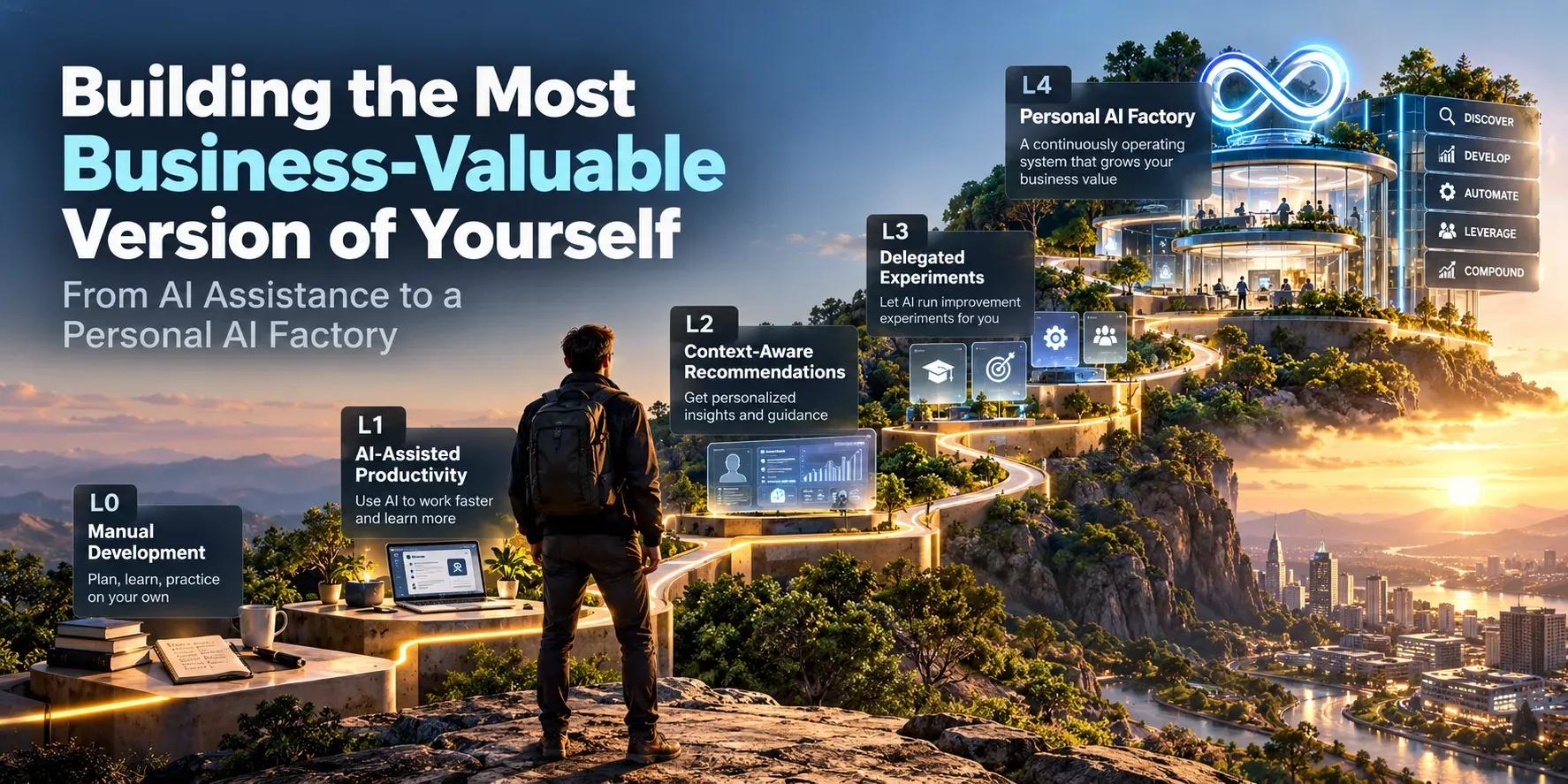
A sketch rather than a proposal: what happens to the factory idea when you point it at one person’s development instead of a product.
In Beyond Software Factories I looked at systems that run whole cycles on their own. They spot an opportunity, try something, read the evidence and pick the next thing to investigate. Those examples were organizational: engineering, science, product discovery, research.
Since then I keep turning the same shape over at the smallest scale I can think of. One person, and the business value that person is able to create.
There is no product here and no finished framework. There are a few distinctions that keep showing up when I think about it, and some pictures that help me hold them.
Two different things to automate
Most of us started using AI by speeding up the work we already do. An engineer writes code faster, a manager drafts feedback faster, a product leader summarizes customer interviews faster.
That is useful, and it is also not the same as creating more value. If implementation becomes cheap, an engineer’s best contribution may drift toward deciding what deserves to be built, designing a reliable delivery system, or noticing that a feature should not exist at all. A manager might save hours on status reports, while the bigger win was finding the bottleneck that made the reports necessary.
So I see two separate things you could automate:
The second column is the one I find interesting.
A rough ladder
To think about it I borrow the idea of automation levels. The five below are my own working labels, not an industry standard. What separates them is not how many agents are running. It is which steps of the loop can move forward without waiting for the person to start them.
| Step | L0Manual | L1Assisted | L2Integrated | L3Delegated | L4Governed |
|---|---|---|---|---|---|
| Set the objective | You do it | You do it | You do it | You do it | You do it |
| Notice what matters | You do it | You do it | AI runs it within limits | AI runs it within limits | AI runs it within limits |
| Form hypotheses | You do it | AI helps when asked | AI prepares, you decide | AI runs it within limits | AI runs it within limits |
| Choose what to try | You do it | You do it | AI prepares, you decide | AI prepares, you decide | AI runs it within limits |
| Run the experiment | You do it | AI helps when asked | AI helps when asked | AI runs it within limits | AI runs it within limits |
| Judge the evidence | You do it | AI helps when asked | AI prepares, you decide | AI runs it within limits | AI runs it within limits |
| Update the picture | You do it | AI helps when asked | AI prepares, you decide | AI prepares, you decide | AI runs it within limits |
- You do it
- AI helps when asked
- AI prepares, you decide
- AI runs it within limits
L0, manual. You notice gaps through experience, feedback, annual reviews and mentors. You choose what to learn, find resources, practice, and later reflect on whether it paid off. This is how most professional development has worked, and it can work well; the loop is just sporadic and runs entirely on your attention.
L1, assisted. AI makes each activity better: it explains a subject, critiques a document, rehearses a difficult meeting with you. The catch is that you still have to know what to ask. Someone who has not noticed that their real limit is strategic communication may never ask for help with it. L1 improves execution inside the person’s existing picture of themselves.
L2, integrated. The system keeps a living professional context: responsibilities, ambitions, strengths, outcomes, recurring problems, what the organization is trying to achieve. It runs a weekly or monthly review against that context and suggests where attention should go. A typical note might read:
Over the past month, you invested substantial time in operational escalations. Several recurring patterns could be converted into a durable automated capability. Doing so could free capacity for cross-organizational work.
It is still advice. What changed is that it connects observations across time instead of depending on you to remember everything.
L3, delegated. Now it executes, inside a boundary. For an engineering leader working on strategic decisions, it might gather authorized information on business objectives, find gaps in a proposal, write the opposing argument and prepare a decision brief for the next leadership review. Or it automates a repetitive workflow, measures the time actually saved, compares that with the original hypothesis and suggests a second experiment. It does not change your commitments, send sensitive messages or make career decisions on its own. Those still wait for you. The difference is that large parts of the cycle no longer need manual orchestration.
L4, governed. Several bounded loops run together. One follows changes in your domain and business environment. One tests skill-building opportunities. One automates suitable work to create leverage. One evaluates evidence and challenges assumptions. One allocates limited attention across all of them. Instead of a fixed six-month development plan, you get a continuously updated portfolio of hypotheses about how you could create more value. It might run between workdays or over weekends, though constant activity is not the point. Reliable improvement per unit of time, attention and cost is.
The top row of the grid is the one I would not move. At every level the person stays the architect: defining what matters, controlling access, setting constraints, choosing consequential paths, and now and then questioning the objective the whole thing is optimizing.
Autonomy has a shape
The levels are a simplification. A real system will be quite autonomous at research and preparation while still needing permission to act. I find it easier to picture it as a shape across several dimensions than as one number.
- Where a sensible system might sit
- Maximum autonomy everywhere (not the target)
- Context
- Understands history, goals and constraints
- Discovery
- Finds worthwhile directions on its own
- Execution
- Does useful work within boundaries
- Verification
- Tests whether its findings hold
- Feedback
- Learns from outcomes, not repeated advice
- Authority
- Decisions it may make without approval
- Impact
- Evidence of more contribution, not activity
The gap I care most about in that picture is between capability and authority. A system may be able to draft a message to your manager without being allowed to send it. It may spot a promising career move without any mandate to pursue it.
So the outer ring is not where I would aim. The target is the largest part of personal development that can run autonomously and responsibly, and that will look lopsided.
Automation and value are separate axes
Picture two professionals. One has a setup that drafts emails, summarizes meetings, organizes notes and produces dozens of reports. The other has a far simpler system that keeps helping them find high-value business problems, push back on poor investments and build reusable capabilities.
The first has more automation. The second probably creates more value.
HigherAutomationLower
- An efficient factory for low-value activity
- A governed factoryProducing compounding, evidence-backed capability
- Helpful but mostly tactical assistance
- High-leverage human decisions supported by AI
LowerBusiness-value impactHigher
The top-right cell is not the destination just because everything there is autonomous. A high-value, human-led decision supported by modest automation can beat a fully autonomous loop aimed at the wrong thing. My shorthand for it: automate where it creates leverage, keep human attention where it creates judgment.
What it would need to know
Every factory runs on context. For a person, that would be a living and carefully governed model of capabilities and experience, accomplishments and attributable outcomes, repeated strengths and limitations, goals and personal boundaries, how time actually gets spent, relevant business and market changes, and the experiments tried so far with what they showed.
That is not a résumé or a performance-review archive. A résumé records what happened. This would exist to help decide what to try next.
The part I would be most careful with is keeping three kinds of statement apart.
Least certain
- Interpretation: "an ineffective communicator"Not established by a few data points
- Hypothesis: communication may be limiting impactWorth testing through feedback and real business outcomes
- Fact: a few presentations were abstractWhat was actually observed
Most certain
A wrong model of a person would make an exceptionally efficient machine for improving the wrong thing.
The loop
The cycle is the same one the organizational factories run.
Objective: create more value next
- 01 · ObserveConnect observations across time
- 02 · Generate hypothesesHypotheses about how to create more value
- 03 · PrioritizeAllocate limited attention
- 04 · ExecuteExecute a bounded experiment
- 05 · EvaluateEvaluate evidence
- 06 · LearnUpdate the context and choose the next experiment
Back to step 01
Here is how I imagine one pass for an engineering manager who wants impact beyond a single team. The objective is better cross-organizational outcomes. The observation is that a lot of effort goes into tactical coordination while strategic cross-team initiatives move slowly. A plausible hypothesis is that the bigger gain lies in reusable execution capabilities and clearer executive-level decision framing, not another technical course.
So the experiment pairs two things: one operational workflow with a clear recurring cost, automated against a baseline, and one leadership discussion where better framing could produce a real decision, prepared with alternatives and tradeoffs. The evaluation looks at whether operational effort actually dropped, whether the decision got clearer and moved, and what happened to quality, trust and the load on other people. Whatever comes out updates the context and points at the next experiment.
The levels only change who drives that pass. At L1 the person starts every step. At L2 the system connects the observations and recommends the experiment. At L3 it does the authorized preparation and measurement. At L4 it runs several passes like this at once and reshuffles priorities as evidence comes in.
In every version, the output that matters is better evidence that the person can now create more value. A longer list of completed training is not it.
Sometimes the improvement is to stop doing the work
Development plans usually ask how to get better at tasks. A factory like this would also ask whether the tasks belong in the job at all.
This is where personal factories meet software, analytics, research and product-discovery factories. Professional value increasingly includes the capabilities you build and operate, not only the work you do yourself.
There is a catch on the right-hand side. Delegating well takes stronger judgment about scope, verification, risk and when to intervene. Automation does not make those skills irrelevant; it makes them central.
It would have to disagree with you
A development system that agrees with its owner reinforces whatever they already believe, and might make them faster at exactly the work they should drop.
The version I would trust keeps a few uncomfortable hypotheses on the table: that time is going to familiar problems rather than valuable ones, that current expertise is becoming less differentiated, that visible output is crowding out durable impact, that an important responsibility is being avoided for lack of confidence or experience, and that a different skill, relationship, decision process or autonomous capability would unlock more than another productivity shortcut.
Those are things to investigate, not verdicts. Independent critique, reliable evidence and the ability to say we do not know matter more as the automation level rises. Without trustworthy feedback a factory becomes more active and more confident without making its owner any better.
Who decides what value means
This is the hardest part for me. “Most business-valuable version of yourself” is not a complete objective. It does not say value to whom, over what time horizon, or at what personal cost.
- An employer may value
- Short-term output
- A person may value
- Growth, Autonomy, Stability, Meaningful work, Readiness for a new role
- Where they overlap
- Sustainable, chosen capacity for meaningful value
An employer may weight short-term output. A person may weight growth, autonomy, stability, meaningful work or readiness for a different role. The two overlap without being the same, so I would want the factory to look at several kinds of evidence instead of one score:
- Business impact: measurable customer, financial, technical or operational results
- Decision quality: better tradeoffs, less uncertainty, fewer costly reversals
- Leverage: reusable capabilities and effective delegation
- Adaptability: contributing in new domains and changing conditions
- Organizational contribution: trust, coordination, developing others
- Sustainability: whether the gains are achievable without unacceptable personal cost
There are things it clearly should not do: reward visibility over substance, optimize someone toward burnout, or quietly turn private development notes into surveillance. The person would control their goals and sensitive context. An employer-provided version would need explicit data boundaries, access rules, retention policies, and a hard separation between private coaching and formal evaluation.
The aim I have in mind is a sustainable, chosen capacity to create meaningful value, which is a different thing from extracting the most out of someone.
Where managers and mentors fit
If a system can track progress, suggest experiments, find gaps and coach continuously, people managers are left with what I suspect are the most human parts of the job.
The more gets automated, the more it matters to keep track of what is measurable and what needs genuine human understanding.
How small the first version could be
None of this needs a multi-agent platform to explore. The smallest version I can picture is a personal context file and a recurring review: a compact, user-controlled record of goals, decisions, results, lessons and open hypotheses, read once a week against what the business needs, ending in one proposed experiment.
Later there might be one low-risk workflow handed over, such as preparing research, reviewing authorized documents or collecting operational evidence, with defined verification and approval gates. Authority would grow only as evidence shows the system is accurate, economical and safe. A successful demo is not the same thing as reliable autonomy.
- L0Manual development
- L1AI assistance
- L2Context-aware recommendations
- L3Delegated experiments
- L4Governed continuous improvement
The milestone that would interest me is not L4. It is the first time the system points at a worthwhile improvement I would otherwise have missed, and helps check that it actually matters.
A career that runs like a loop
Careers have been organized around discrete milestones: education, experience, promotion, retraining, the next role. If AI shifts what organizations value faster than those milestones move, the working question drifts from how to get faster at the current job toward what to learn, change, build, delegate or stop doing next.
In Beyond Software Factories I wondered what capability we could build today that would keep generating progress even when nobody is actively working on it. This is the personal version of that thought: a factory aimed at one’s own growth, automating enough of the discovery, preparation, experimentation and feedback around it that more human attention is left for the parts that need it.