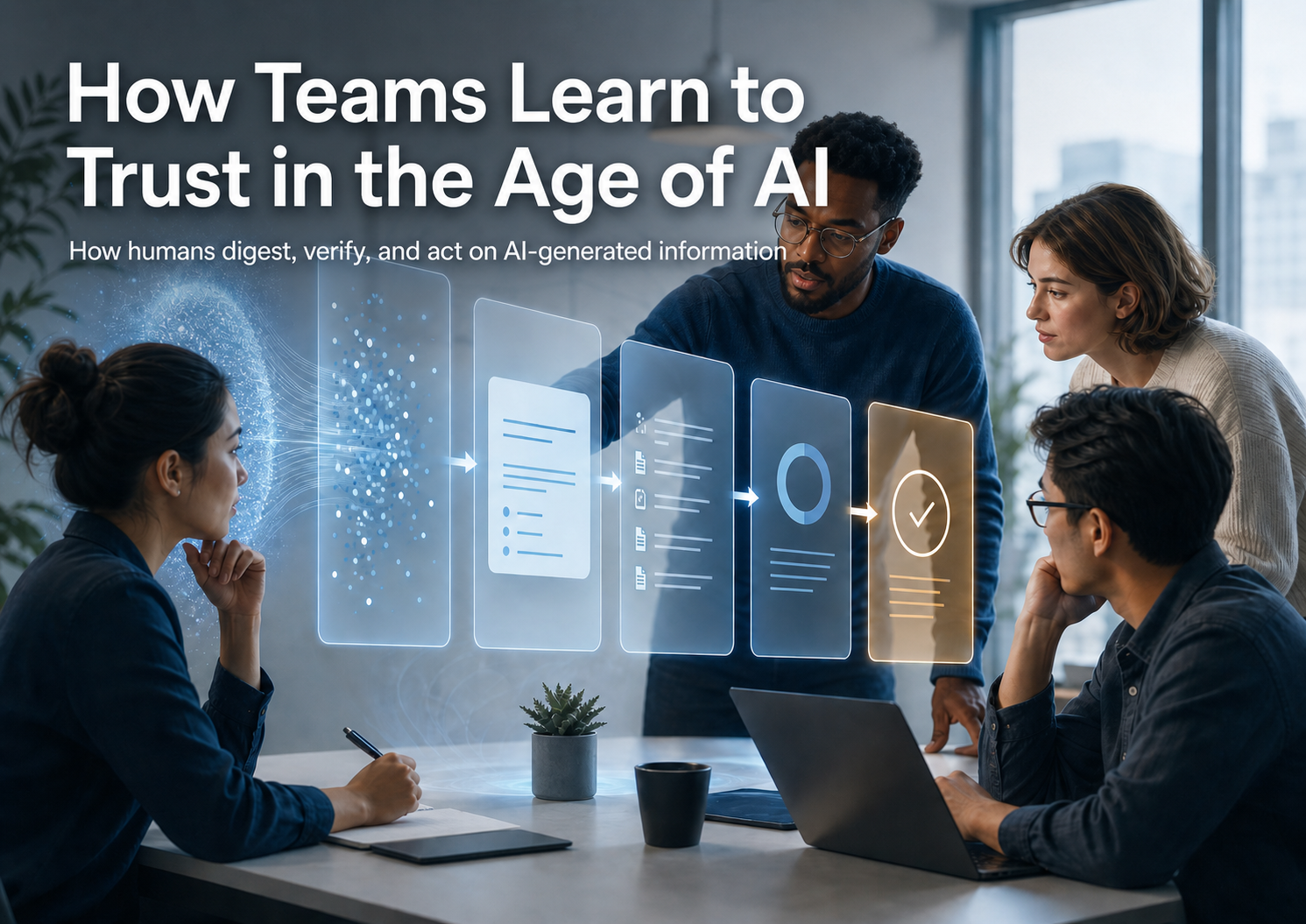
AI has made it dramatically easier to produce information. A summary can be generated in seconds, a proposal drafted in minutes, a technical design expanded, challenged, rewritten, and converted into tickets before the coffee gets cold.
That sounds like progress. And it is. But it also creates a strange new problem: the bottleneck moves from creating information to digesting information.
In the pre-AI workplace, information was expensive enough that humans naturally filtered it. Someone had to write the document, prepare the deck, summarize the meeting. The friction was annoying, but it acted as a brake. AI removes the brake. Now the team can generate more plans, more options, more analysis, more “alignment artifacts,” and more plausible arguments than anyone can reasonably process.
The question is no longer “can we create enough information?” It is “can humans still understand, trust, and act on the right information?”
This is not a future problem. Microsoft and LinkedIn’s 2025 Work Trend Index reports 75% of global knowledge workers using generative AI at work, with most leaders saying it is a pivotal year to rethink their AI strategy even as that strategy lags adoption. AI use is already inside the building. The missing layer is not access — it is operating discipline.
The New Failure Mode: Infinite Plausibility
AI outputs often look complete before they are actually reliable. They are fluent, structured, calm, and speak the language of competence — useful, but dangerous. A messy human draft usually exposes its weaknesses; you can see the gaps, the hesitation, the missing parts. An AI-generated artifact hides its uncertainty behind polished formatting.
I’d call this infinite plausibility. The team is not dealing with obviously bad information. It is dealing with too much information that sounds reasonable enough to deserve attention. Bad information is easy to reject. Plausible information consumes judgment. And judgment is the thing AI does not make cheaper.
This connects directly to the shift in The Future of Software Careers After AI Becomes Native: AI compresses execution, but humans still own deciding. The problem is that deciding now happens inside a much larger cloud of generated options, summaries, recommendations, and counterarguments. AI does not only increase output. It increases the amount of plausible information humans must evaluate.
Humans Do Not Scale Like Documents
A team can now generate ten design options instead of two — but the human brain did not receive the same upgrade. People still have limited attention, working memory, emotional energy, and ability to compare complex alternatives.
That matters because AI is not just adding information to the team. It is influencing the team’s attention. A bad summary changes what people notice. A confident recommendation anchors the conversation. A generated document can become the thing people organize around.
Microsoft Research studied this directly in a paper on generative AI and critical thinking, surveying 319 knowledge workers with 936 first-hand examples of GenAI use at work. The useful warning is not “AI makes people stupid” — that would be too simplistic. It is subtler: reducing effort is useful, but reducing the wrong kind of effort can weaken the human review loop.
This is why “just use AI and review the output” is not a serious team practice. Reviewing is work. Verification is work. Disagreeing with a polished artifact is work. AI reduces one kind of effort and silently transfers another.
Trust Is Not a Feeling. It Is an Operating Model.
A lot of AI adoption conversations use “trust” too casually. People say “we need employees to trust AI” — but blind trust is not the goal, and neither is distrust. The goal is calibrated trust: people should know when AI is probably useful, when it is risky, when it needs verification, and when it should not be used at all.
A 2026 experimental study of cognitive forcing functions in AI-assisted writing confirmed an earlier pattern: people over-rely on AI recommendations and simple explanations are not enough to fix it. What helps are interaction patterns that require active engagement — for example, asking the user to identify the assumptions in an AI-generated plan before accepting it. The “Assumption” condition most effectively reduced overreliance without raising cognitive load.
The most trustworthy process may not feel the most magical:
| Magical AI workflow | Trustworthy AI workflow |
|---|---|
| “Here is the answer.” | “Here is the answer, what it depends on, what might be wrong, and where a human must decide.” |
Less impressive in a demo. Much more useful in a company.
The Team Problem: Everyone Has Their Own AI Reality
Before AI, teams already struggled with alignment. Now each person may arrive with their own AI-generated version of reality.
| Person | AI-Assisted Context They May Bring |
|---|---|
| Engineer | Generated technical plan or code critique |
| Product Manager | AI-summarized customer themes |
| Engineering Manager | AI-assisted delivery risk analysis |
| Director | AI-generated operating model or roadmap |
| Staff Engineer | AI-generated architecture alternatives |
| Designer | AI-generated user journey or research synthesis |
On the surface, everyone appears to be discussing the same topic — but each person is operating from a different private context bundle. This is where AI quietly damages trust. Not because the tool is evil — because the reasoning path becomes private. A human says “I think we should do X,” but behind that sentence may be thirty minutes of private prompting, generated assumptions, rewritten options, and AI-ranked tradeoffs nobody else has seen. Fine for early thinking. Not fine for shared decisions.
Teams need a way to separate private AI use from shared AI-assisted reasoning.
| Type of AI Use | Should It Be Shared? | Why |
|---|---|---|
| Private brainstorming | Usually no | Helps individual thinking |
| Draft polishing | Sometimes | Depends on decision importance |
| Decision recommendation | Yes | Team needs reasoning path |
| Technical analysis | Yes | Assumptions must be inspectable |
| Customer, legal, or security interpretation | Yes, with verification | High cost of being wrong |
| Performance or people-related summary | Yes, carefully | Trust collapses if people feel secretly analyzed |
This is the missing practice in many AI rollouts.
Companies give people tools, but not norms for when AI-assisted reasoning becomes part of the shared record.
Layered Digestion
The answer is not “shorter summaries” — a short wrong summary is worse than a long messy source. The better pattern is layered digestion.
Layer 1 — The Claim. One sentence. Not a summary, not background, not throat-clearing. “We should migrate this service because operational risk is now higher than migration risk.” Without a claim, people swim through information before they know what they are evaluating.
Layer 2 — The Reasoning. Not every token. Just the main path: “We believe X because of A, B, and C. We rejected Y because of D. The biggest uncertainty is E.” Humans do not need to see everything — they need to see enough to know whether the conclusion was earned.
Layer 3 — The Evidence. Link to the underlying sources: logs, traces, PRs, incidents, customer tickets, design docs, experiment results, code references, decision records. AI-generated synthesis without evidence is vibes with formatting. And teams cannot run on vibes forever, even in vibe engineering.
Layer 4 — The Confidence Level. Not fake precision like “87% confident.” More useful:
| Confidence | Meaning |
|---|---|
| High | Supported by direct evidence and low ambiguity |
| Medium | Likely, but depends on assumptions |
| Low | Useful hypothesis, not decision-ready |
| Unknown | Needs human or expert review |
This trains the team to treat AI output as a decision aid, not an oracle.
Layer 5 — The Human Decision. Name what humans must decide. “The team needs to decide whether to accept slower delivery in exchange for lower operational risk.” That sentence is the handoff. AI can frame, synthesize, challenge, and generate alternatives. The team must still decide.
The Format Problem
The tempting belief is that the solution to AI overload is better summaries. But summaries are only one format — and not enough on their own. A short summary can be wrong. A beautiful diagram can hide uncertainty. A table can make weak options look equally comparable. A dashboard can show movement without explaining meaning. A long memo can preserve nuance while losing the reader.
The best format is not a single format. It is a layered representation that matches how humans absorb information: orientation before detail, claim before evidence, decision before full context, confidence before commitment, links to sources when the stakes are high.
For AI-heavy teams, a simple default works: Claim. Decision. Evidence. Tradeoffs. Confidence. Next action. This format does not merely communicate information — it protects judgment. The team should not have to read five pages to learn what is being asked, trust a polished recommendation without seeing evidence, or guess whether the output is a summary, a hypothesis, or a decision. The format should make those things visible.
The 1-3-7 Format
A practical version: the 1-3-7 format — one claim, three reasons, seven details. Exact numbers are less important than the discipline. The claim forces clarity, three reasons force prioritization, seven details prevent the summary from becoming empty.
Example:
## 1 Claim

We should delay the migration by one sprint because the operational risk is higher than the delivery risk.

## 3 Reasons

1. The rollback path is not tested.
2. Two customer-facing dependencies still have unclear ownership.
3. The current incident rate is already elevated.

## 7 Details

1. Rollback test failed in staging on April 28.
2. Service A still depends on the old schema.
3. Customer B has a contractual launch date.
4. On-call load increased 22% over the last two weeks.
5. Option 1: ship now with mitigation.
6. Option 2: delay one sprint and reduce risk.
7. Recommendation: delay one sprint, retest rollback, and review on Friday.
This matters with AI because AI can generate infinite supporting material. The human job is not to read all of it — it is to inspect whether the main claim is credible, the reasoning sound, and the next action justified.
Different Formats Do Different Jobs
A healthy AI-adopting team should treat information like a product interface. The same underlying reality may need several views depending on the user and the decision.
| Format | Best For | Weakness |
|---|---|---|
| One-sentence claim | Fast orientation | Too compressed alone |
| Executive summary | Quick context | Can hide uncertainty |
| Memo | Reasoning and alignment | Too slow for scanning |
| Table | Comparison and tradeoffs | Can oversimplify nuance |
| Diagram | Systems, flows, dependencies | Can look cleaner than reality |
| Timeline | Incidents, decisions, history | Weak for tradeoffs |
| FAQ | Adoption, rollout, objections | Can become shallow |
| Dashboard | Metrics and trends | Weak at explaining why |
| Decision record | Accountability | Often written too late |
| Source-linked brief | Trust and verification | Takes discipline |
The mistake is forcing one format to do everything. A diagram is great for structure, terrible for nuance. A table is great for comparison, bad for narrative. A memo is great for reasoning, bad for quick absorption. A dashboard is great for monitoring, bad for explaining causality. The better pattern is progressive disclosure: headline → claim → recommendation → evidence → full reasoning → source material.
Different people need different depth. A senior leader may need the decision, risk, confidence, and cost of delay. A staff engineer may need architecture, assumptions, and failure modes. A PM may need customer impact and sequencing. An EM may need ownership, capacity, and unresolved disagreement. An on-call engineer may need exact runbook steps.
This is not “dumbing down.” It is good information design. The best information representation in the AI era is not the prettiest document — it is the smallest reliable interface between evidence and decision.
What About Slides and Video?
Slides and videos are not bad formats — they are just often asked to do the wrong job. Media richness theory is the classic frame: richer media (video, face-to-face) carry tone and social cues for ambiguous topics; leaner media (documents) win when information needs to be searched, reviewed, and preserved. Video helps humans feel context. Documents help humans verify the claim.
| Format | Strength | Weakness |
|---|---|---|
| Slides | Compress a strategy, roadmap, or decision into an absorbable sequence | Can make weak thinking look finished and turn debate into theater |
| Video | Carries nuance, tone, urgency, conviction; builds trust at distance | Hard to skim, quote, update, verify; details disappear into timestamps |
| Docs | Searchable, reviewable, durable, citable | Slow to absorb; easy to skim past important nuance |
This becomes riskier with AI, because a polished deck can now be generated much faster than the reasoning needed to justify it. The healthier pattern: evidence first, reasoning second, slides third. Slides are the communication layer, not the thinking layer. Video usually supports the written artifact, not replaces it.
The best format for important team communication is usually a stack: written brief → visual representation → linked evidence → optional video walkthrough. Written for durability, visual for absorption, sourced for trust, human-presented for nuance. The goal is not to pick between docs, slides, and video — it is to use each for what it is actually good at.
The Ideal Information Package
For important AI-assisted decisions, default to three artifacts (with an optional fourth):
- Decision brief — claim, context, decision needed, recommendation, risks, confidence, next step.
- Visual layer — slide, diagram, table, or timeline that makes the structure absorbable.
- Evidence appendix — links to logs, docs, tickets, code, metrics, customer evidence, prior decisions.
- (Optional) Short human walkthrough — video or live for nuance, tone, and trust.
A Practical Template for AI-Generated Team Artifacts
For teams adopting AI, I would standardize a simple format:
# Recommendation: [Short Title]

## 1. Claim

What is the main point?

## 2. Decision Needed

What exactly needs to be decided, by whom, and by when?

## 3. Context

What does someone need to know before evaluating this?

## 4. Evidence

Links to logs, tickets, customer data, experiments, docs, code, research, or examples.

## 5. Options Considered

| Option | Pros | Cons | Risk | Effort |
| ------ | ---- | ---- | ---- | ------ |

## 6. Recommendation

What should we do and why?

## 7. Confidence

High / Medium / Low / Unknown.

Explain why.

## 8. What Might Be Wrong

Assumptions, unknowns, weak spots, missing evidence.

## 9. Next Step

The smallest concrete action after this.
This may look almost too simple.
That is the point.
AI adoption does not fail only because models hallucinate. It fails because teams do not have repeatable ways to inspect, challenge, and absorb AI-generated information.
The template creates a shared digestion protocol.
Collective Metacognition
There is a useful research phrase for part of this: metacognition — thinking about thinking. In the AI context, it means noticing how you are using the model, when you are relying on it, and when you need to verify it. Microsoft Research has argued that GenAI creates new metacognitive demands for users: people are not only writing prompts but evaluating outputs, monitoring their own confidence, and adjusting their workflow around a system that may be helpful, incomplete, or wrong.
A person needs metacognition. A team needs collective metacognition — shared habits for asking: how was this produced, what are we trusting, what did AI infer, what did a human verify, what evidence supports this, what uncertainty remains, what decision is actually being made?
This may become one of the core AI-era team skills. Not prompting. Not tool usage. Those matter, but they are not enough. The deeper skill is preserving shared judgment while every person has access to a private synthetic thinking partner.
The Role of the Engineering Manager Changes Again
In classic teams, EMs helped with prioritization, delivery, people growth, and cross-functional alignment. In AI-heavy teams, they also become stewards of information hygiene — not by becoming documentation police, but by:
- noticing when the team is drowning in AI-generated artifacts
- asking for claims before details
- requiring evidence for high-impact recommendations
- separating summaries from decisions
- making sure quiet disagreement has space
- protecting humans from “AI said so” pressure
- ensuring generated information becomes shared context, not private leverage
This connects to engineering management evolution in agentic engineering: the manager’s job shifts from “Am I seeing everything?” to “Am I interpreting the right patterns?” Interpretation becomes more important than observation. A manager does not need to personally verify every AI output — they need to design the team norms that make verification possible.
The Role of the Software Engineer Changes Too
For engineers, “use AI” is quickly becoming table stakes. The stronger skill is knowing how to interrogate AI-generated technical information. A good AI-native engineer asks: what assumptions did this answer make, does the code actually match the architecture, what edge cases were skipped, what invariant could this violate, what source of truth confirms this, what would I need to see before trusting this in production?
The future engineer looks less like a typist and more like a systems author, reviewer, and editor. The value moves from producing the first draft to knowing whether the draft deserves to exist.
AI Slop Is Really Social Slop
“AI slop” is usually described as low-quality generated content. Inside teams, the deeper risk is social: meetings where everyone read a different summary, decisions based on polished-but-weak analysis, confidence without shared understanding, performance theater of more documents and less clarity.
Microsoft’s 2026 research on AI “workslop” makes this point directly — low-quality AI work undermines performance, erodes trust between colleagues, and damages reputations. It also reports that 60% of employees skip accuracy checks when using AI, which is exactly the behavior that turns one person’s shortcut into another person’s cleanup work.
This connects directly to What About Teams?: teams are not merely units of task execution. They are systems of context, trust, resilience, and shared meaning. AI can strengthen that system. It can also fragment it. The trust problem is not only between human and machine. It is between human and human, after machines enter the workflow.
Practical Team Rules for Trustworthy AI Adoption
Here are the practices I would actually introduce on a team.
1. Label AI-Assisted Work When It Influences a Decision
Not every AI-polished Slack message needs a disclaimer.
But if AI helped shape a recommendation, technical direction, customer interpretation, performance summary, or risk assessment, say so.
Simple phrasing is enough:
I used AI to summarize the incident notes and identify possible contributing factors. I verified the timeline against the logs, but the root cause interpretation still needs team review.
That builds trust.
Not because AI use is suspicious, but because hidden reasoning paths are dangerous.
2. Require Sources for High-Impact Claims
The more important the decision, the more visible the evidence should be.
For low-risk brainstorming, AI can roam freely.
For production, customer, legal, financial, security, or people-impacting decisions, AI output should point back to sources.
No source, no decision.
3. Separate “Summary” From “Recommendation”
A summary says:
Here is what happened.
A recommendation says:
Here is what we should do.
AI can help with both, but teams should not confuse them.
A summary can be checked against evidence.
A recommendation requires judgment.
That distinction should be explicit.
4. Use AI to Generate Counterarguments
One of the best uses of AI is not answering.
It is challenging.
Before committing to a plan, ask AI:
- What is the strongest argument against this?
- What assumption is most fragile?
- Where would this fail at 10x scale?
- What would a skeptical staff engineer say?
- What would a customer hate about this?
- What are we pretending is known?
This helps teams avoid using AI only as a confidence amplifier.
5. Create Shared AI Digestion Rituals
For example:
- weekly “AI learnings” discussion
- review one AI-assisted artifact and improve it together
- share prompts that worked
- share prompts that misled people
- compare AI summary against source material
- maintain a team-level “trust patterns” doc
This turns AI adoption from private tool usage into team capability.
6. Protect Space for Human Slow Thinking
This may be the least fashionable practice.
AI makes everything faster, but not every decision should be fast.
Some problems need latency:
- architecture direction
- team design
- hiring decisions
- performance feedback
- incident interpretation
- product strategy
- ethical tradeoffs
Fast drafts are useful.
Fast commitments are dangerous.
This connects directly to the theme of The Pace: AI destabilizes the old sense of reasonable output. Without new boundaries, the team can confuse acceleration with progress.
What Companies Usually Get Wrong
Many AI adoption programs start with tools, then training, then governance. Reasonable, but incomplete. The missing layer is team cognition — how the team knows what it knows, how it decides what to trust, how it preserves shared context, how it prevents generated noise from becoming organizational reality.
Research has a name for part of this: transactive memory systems. Teams do not function because everyone knows everything — they function because people develop a shared sense of who knows what, where knowledge lives, and how to coordinate around distributed expertise. AI complicates that system: it adds a synthetic contributor to the knowledge flow, but one whose reasoning path may be private, inconsistent, or hard to inspect.
The adoption question is not only “which AI tools should we use?” — it is also “how does our team think together now that everyone has a synthetic thinking partner?” Much harder. Much more important.
A Simple Maturity Model
One way to map where a team sits on AI information maturity:

| Stage | Behavior | Trust Pattern |
|---|---|---|
| 1. Private AI | Everyone uses AI individually | Hidden context, uneven quality |
| 2. Output Boost | Team produces more artifacts | More speed, more noise |
| 3. Shared Templates | AI outputs follow common structure | Easier review and comparison |
| 4. Evidence-Linked AI | Claims connect to sources | Trust becomes inspectable |
| 5. Multi-Format Digestion | Written, visual, source, and human layers are intentionally combined | Better absorption |
| 6. Collective Metacognition | The team has shared habits for inspecting AI-assisted work | Better judgment |
| 7. Team Cognition | AI improves how the team thinks together | Better decisions, not just faster output |
Most teams are somewhere between stages 1 and 2. They have tools, enthusiasm, and output. They do not yet have digestion.
The Real Goal: Better Shared Judgment, Not More Information
The best AI-adopting teams will not be the ones generating the most content. They will be the ones with the clearest judgment loops — the ones who know:
- when to use AI for expansion and when for compression
- when an answer is good enough for exploration and when it needs evidence
- when a summary helps alignment and when it hides disagreement
- when slides help people absorb and when they cover up weak reasoning
- when video builds trust and when it becomes an unsearchable substitute for a decision record
- when speed is useful and when speed is just anxiety wearing a productivity costume
This is why teams still matter. In What About Teams?, the argument was that teams are not just boxes on an org chart — they are trust, context, and resilience systems. AI does not remove that need. It makes it sharper. When information becomes infinite, trust becomes infrastructure.
Final Thought
AI gives every person a private analyst, writer, researcher, critic, and brainstorming partner. Powerful — but companies do not run on private intelligence alone. They run on shared understanding.
The next stage of AI adoption is not better prompting, better models, or better integrations. It is better digestion — practices that help humans ask: what is the claim, why should we believe it, what evidence supports it, what might be wrong, what format helps us absorb it, who decides?
That sounds slower than simply accepting the AI-generated answer. It is probably the only way to move fast without slowly losing the ability to think together.