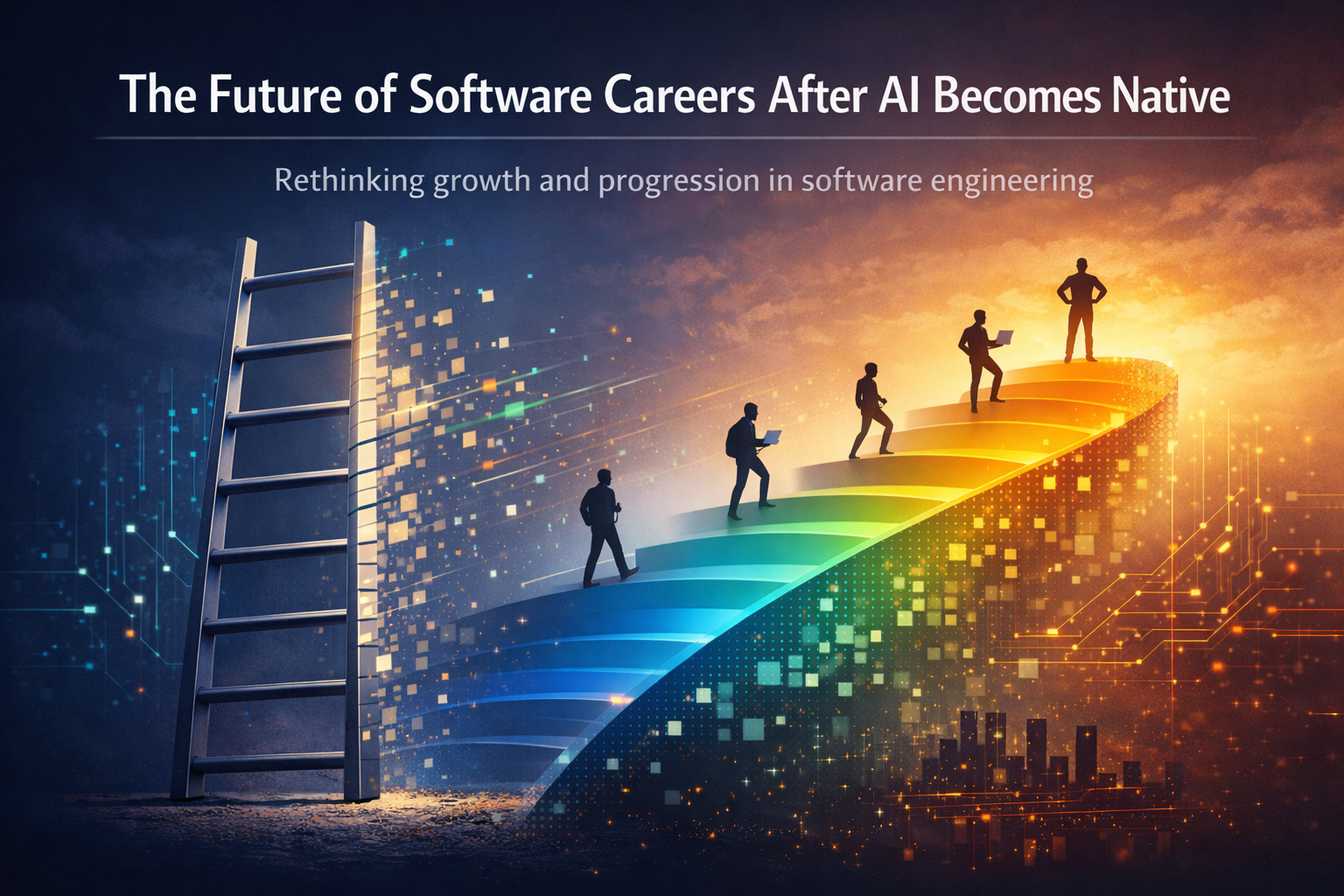
Rethinking growth and progression in software engineering
Introduction
Recently, a few of my direct reports asked me about career growth.
Normally, this is a straightforward conversation. The company has clear guidelines, the industry has familiar ladders, and the advice is well rehearsed.
This time, it didn’t feel that simple.
Corporate frameworks haven’t meaningfully changed yet, and in my opinion the industry hasn’t fully recalibrated either. AI is moving fast, but the guidance we give people about careers still sounds largely the same. Repeating the classic answers didn’t feel entirely sincere.
I try to build teams on trust, and part of that is not pretending to have certainty where I don’t. So instead of defaulting to the usual ladder-based explanations, I started thinking more carefully about what career growth actually means once AI is fully integrated into how we build software.
This post is the result of that thinking — and of brainstorming it through with AI.
The Structural Shift: From Execution to Judgment
For decades, software careers were differentiated by what you produced:
- Code
- Models
- Specs
- Roadmaps
- Queries
- Tickets
AI dramatically lowers the cost of producing all of that.
What remains scarce — and therefore valuable — is:
- Decision quality
- Context
- Taste
- Accountability
- The ability to operate under uncertainty
AI compresses doing. Humans expand deciding.
How Core Roles Are Evolving
Software Engineer: From Coder to Systems Author
What fades
- Boilerplate and scaffolding
- Mechanical refactors
- CRUD-heavy feature work
- Translating tickets into code
What grows
- System design and constraints
- Interfaces, contracts, and invariants
- Reviewing and correcting AI-generated code
- Debugging emergent, non-obvious failures
- Defining “good enough” versus “overbuilt”
Strong engineers type less and think more. They increasingly resemble architects and editors rather than pure implementers.
Machine Learning Engineer: From Model Builder to Intelligence Operator
What fades
- Training everything from scratch by default
- Manual feature engineering for commodity problems
- Custom pipelines where managed solutions suffice
What grows
- Model selection and orchestration
- Evaluation, alignment, and drift detection
- Data quality and feedback loops
- Cost, latency, and accuracy tradeoffs
- Safe integration of foundation models
The work shifts from how to build models to when and how to trust systems.
Engineering Manager: From Delivery to Leverage
What fades
- Status chasing
- Velocity as a proxy for value
- Headcount as the primary scaling lever
What grows
- Bottleneck identification and removal
- AI leverage per engineer
- Decision quality over output volume
- Technical and organizational risk ownership
- Designing small, high-impact teams
Managers increasingly design systems — human and AI — rather than manage throughput.
Product Manager: From Backlog Owner to Narrative Architect
What fades
- Exhaustive acceptance criteria
- Backlog grooming for implementation detail
- Over-specifying obvious flows
What grows
- Problem framing
- User mental models
- Strategic sequencing
- Value discovery
- Narrative clarity
PMs focus less on what gets built and more on why something should exist at all.
Is There Still a Career Ladder?
Yes — but it is no longer the dominant mental model.
AI breaks a long-standing assumption:
More experience plus more output leads to promotion.
Execution is cheaper now. Time-in-role is a weaker signal of growth than it used to be.
What replaces the ladder looks more like a responsibility gradient.
The New Promotion Currency: Blast Radius
In an AI-native environment, career progression converges on a single question:
What breaks if this person makes the wrong call?
Growth increasingly tracks decision impact, not artifact volume.
| Dimension | Early | Mid | Senior / Staff | Principal / Leadership |
|---|---|---|---|---|
| Scope | Tasks | Features | Systems | Strategy & org design |
| Ambiguity | Low | Medium | High | Extreme |
| AI Usage | Consumer | Power user | Orchestrator | System designer |
| Failure Cost | Local | Team | Organization | Company-level |
| Growth Signal | Can execute | Can own | Can decide | Can shape direction |
Advancing means absorbing more ambiguity, more irreversible decisions, and more risk without full control.
What It Takes to Grow (Across Roles)
1. Optimize for Decision Density, Not Output
AI already maximizes output.
Career growth comes from:
- Making fewer, better decisions
- Stopping weak ideas early
- Knowing when not to build
- Preventing failures others don’t yet see
Senior people are often paid to reduce mistakes, not produce more artifacts.
2. Own Problems That Don’t Fit Cleanly in Tickets
Promotion tends to follow people who:
- Pick up messy, poorly defined problems
- Operate without full authority
- Align across functions
- Create clarity where none exists
AI excels at clean, well-defined work. Humans advance by handling the edges.
3. Shift from “How” to “Why” and “What If”
AI increasingly dominates the how.
Growth comes from asking:
- Why are we doing this at all?
- What happens if this scales tenfold?
- Where does this fail — technically, ethically, or socially?
- What if we are wrong?
The higher you go, the more your job is to reason in counterfactuals.
4. Develop Taste
Taste shows up as:
- Knowing when something is over-engineered
- Recognizing when a model is correct but not useful
- Choosing simplicity over impressive complexity
- Saying “this feels wrong” — and being right often enough
AI has no taste. Taste increasingly differentiates senior contributors.
Creativity and Outside-the-Box Thinking in an AI-Native World
AI can generate ideas endlessly. That does not make creativity obsolete — it changes where it lives.
In an AI-native environment, creativity shifts from idea generation to idea selection, framing, and recombination.
AI expands the solution space. Humans decide:
- Which problems are worth solving
- Which constraints are real versus inherited
- Which direction is coherent over time
- Which options should be ignored entirely
Creative impact increasingly looks like:
- Reframing the problem instead of optimizing the given one
- Challenging defaults and assumptions
- Combining ideas from unrelated domains
- Choosing a simpler path when complexity is expected
This form of creativity is often quiet at first — and obvious only in hindsight.
AI can help explore possibilities. It cannot decide which ones deserve commitment.
How Career Paths Are Fragmenting
Expect more non-linear movement:
- Staff engineers who never manage people
- Managers rotating back into IC roles
- PMs moving into AI system design
- MLEs focusing on governance and risk
- Leaders stepping “down” in title but “up” in leverage
Lateral and diagonal moves carry less stigma as learning velocity becomes more important than continuity.
The New Plateau Risk
The biggest career risk is no longer failing to learn how to code.
It is becoming excellent at work AI has already commoditized.
Warning signs include:
- Primarily translating requirements
- Optimizing process without questioning purpose
- Losing most of your value when AI is removed
AI-native careers reward people whose impact persists even when execution becomes cheap.
A Better Mental Model Than a Ladder
A more accurate framing is a responsibility gradient, not a staircase.
You grow by:
- Absorbing ambiguity
- Making decisions with incomplete information
- Owning outcomes you do not fully control
- Exercising judgment under pressure
The people who grow fastest are often already operating one level above their formal role — quietly and imperfectly.
Final Thought
AI does not eliminate software careers.
It eliminates:
- Unclear thinking
- Mechanical execution
- Low-context decision-making
The future of software careers is not smaller.
It is sharper:
- Fewer people
- More leverage
- Higher expectations
- Real accountability
AI flattens execution. Careers still grow — but only where humans decide.