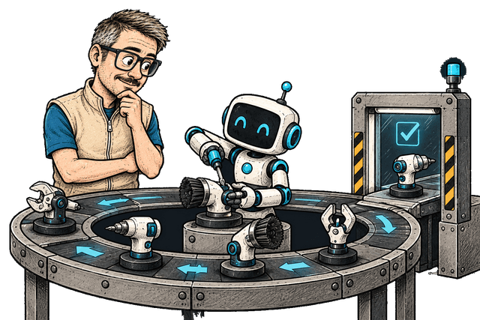
Agentic development begins with assigned work. A human defines a task, and an agent plans, implements, tests, and presents a result.
An autonomous software-development lifecycle controls more of the loop. It can receive a signal, interpret whether engineering work is required, prepare and execute a bounded response, validate it, observe the result, and decide what evidence should change the next cycle.
A self-learning pipeline adds one requirement: corrections and outcomes must produce durable changes to the delivery system.
Three levels of execution
| Level | Trigger | System scope | Learning |
|---|---|---|---|
| Agentic execution | Human-assigned task | Implementation and verification | Usually local to the session |
| Autonomous SDLC | Signal or governed request | Multiple lifecycle stages | Operational feedback returns to the loop |
| Self-learning pipeline | Signal plus retained history | Lifecycle and its execution strategy | The surrounding system is revised |
This distinction prevents autonomy from being reduced to longer coding sessions. The central question is not how much code the agent can write. It is how intent, evidence, authority, and learning move through the system.
Working components already exist
Anthropic’s long-running agent harness uses progress files, Git history, incremental work, and clean handoffs to preserve execution across context windows. Its parallel C compiler experiment combined 16 agents, nearly 2,000 sessions, shared tests, and incremental commits around a measurable target.
Anthropic’s agent-evaluation guidance explains how capability evaluations can become regression suites and emphasizes that the evaluated unit is the model plus its harness. Its sandboxing work shows how enforced filesystem and network boundaries can reduce repetitive approvals while limiting authority.
OpenAI’s harness-engineering account describes repository-local knowledge, execution plans, structural tests, custom linters, and the conversion of review feedback into documentation or executable rules. This is a concrete form of repository learning.
Google DeepMind’s AlphaEvolve demonstrates repeated generation, evaluation, retention, selection, and mutation in domains with strong automated scoring. CodeMender applies a bounded autonomous loop to vulnerability repair, combining specialized analysis and automated validation before human-reviewed submission.
OpenClaw demonstrates a persistent control-plane pattern with a Gateway, channels, sessions, skills, and per-agent memory. Its own security documentation also makes the boundary clear: persistence and tool access require sandboxing, narrow workspace access, and explicit tool policy.
These examples establish important components. They do not establish a complete autonomous organizational lifecycle.
Newer components make this distinction more concrete. OpenAI’s Agents API announcement describes a managed harness and environments for persistent execution. Anthropic’s Managed Agents architecture separates sessions, orchestration, and execution infrastructure. OpenAI’s Symphony orchestration specification connects tracked work to agent execution. A team may adopt these capabilities rather than build every layer itself; it still has to supply the task contract, authority, and outcome criteria.
Anthropic’s measurement of agent autonomy also distinguishes observed deployment behavior from model capability. Its tool-call classifications have limited visibility into real-world effects. Longer unattended runs should not be treated as evidence of safe autonomy for a different task class.
The closed engineering loop
Observe
  -> Interpret
  -> Prioritize
  -> Plan
  -> Implement
  -> Verify
  -> Release
  -> Measure
  -> Learn
Observe collects telemetry, incidents, customer feedback, security findings, dependency events, and explicit requests.
Interpret connects those signals to architecture, ownership, operational history, and previous decisions.
Prioritize applies organizational intent, risk, urgency, expected value, and accountable authority.
Plan defines context, boundaries, evidence, rollout, permissions, and stop conditions.
Implement assigns isolated agents or agent teams to bounded work.
Verify combines deterministic checks, security analysis, model-based evaluation, and human judgment.
Release applies progressive delivery and explicit approval boundaries.
Measure compares intended outcomes with actual product and operational behavior.
Learn changes the inputs to later cycles.
The loop is not complete when code merges. It is complete when the organization has incorporated what the result revealed.
Learning happens around the model
Self-learning does not need to mean continuous foundation-model training.
The delivery system can learn through:
- stronger specifications;
- new regression evaluations;
- better model or agent routing;
- revised repository instructions;
- promoted architectural rules;
- new deterministic checks;
- corrected ownership and escalation paths;
- reduced permissions after unsafe behavior;
- improved decomposition and planning heuristics.
This connects the chapter directly to Hierarchical Context. Learning should be retained at the narrowest scope where it is valid.
A service-specific test belongs in the service repository. A shared API rule may belong in team or organization context. A company-wide release policy belongs at the governing level. Evidence should support every promotion upward.
One undifferentiated memory store creates noise and allows local accidents to become global folklore.
Recursive Self-Improvement and Organizational Change distinguishes repairing an output, improving this workflow, and improving the machinery that produces future improvements. It also explains why those technical loops do not automatically transform the company operating them.
Five learning layers
Learning can mean removing orchestration. In Harness design for long-running application development, Anthropic describes dropping scaffolding as model capability improved, including sprint structure and, for suitable tasks, separate evaluator overhead. Re-test each component after upgrades. Keep a control because it addresses an observed failure or authority requirement, not because an earlier model needed it.
Execution learning
Which models, tools, prompts, and workflows reliably solve a task category?
Repository learning
Which architectural conventions, dependencies, failure classes, and validation requirements characterize this system?
Product learning
Did the change produce the intended customer or business outcome?
Organizational learning
Which ownership, communication, and decision boundaries repeatedly caused delay or rework?
Governance learning
Where did the system request too much authority, miss risk, create review burden, or require human correction?
Governance learning matters because a useful pipeline must be able to learn that it should automate less.
These layers run on different timescales, and one does not settle another. A successful deployment shows that a change reached production, not that the customer needed it. A useful feature does not show that the delivery process behind it was economical; people may have spent days quietly repairing the automation that produced it. Report the layers separately so that progress in one is not read as evidence for another.
Outcome feedback, not activity feedback
A self-learning system cannot optimize for commits, pull requests, generated tests, token throughput, or agent utilization. Those measures describe internal motion.
The pipeline needs evidence such as:
- defect escapes and regressions;
- incident frequency and severity;
- rollback and recovery behavior;
- security findings;
- customer adoption and behavior;
- latency, availability, and cost;
- human review effort;
- maintenance burden;
- architectural complexity;
- recurrence of the same failure class.
Weak outcomes make weak learning. If a pipeline receives only activity measures, it becomes highly effective at producing activity.
Bound the work the system starts itself
Once the loop can observe signals without a human assignment, it can also fill its own queue. Every repository offers another refactoring, another test, another investigation that opens five more. A system that discovers work faster than it settles it becomes busy in exactly the way the previous section describes.
The following constraints are a proposal rather than established practice. Each self-initiated item should trace to an approved objective or an explicit operational responsibility; an item that traces to neither does not enter the queue. Exploration stays separate from commitment: the agent may record a possibility within its permissions, but turning it into a team obligation is a prioritization decision with an owner. “No intervention” is a valid result of Prioritize, and the system should be able to report it. Self-initiated work also draws on the same review capacity as requested work. If four patches arrive each day and reviewers can responsibly assess two, a patch nobody asked for competes for those two reviews, and the admission limit in Evaluation and Release Evidence applies to it as well.
The improvement loop needs outcome feedback of its own. Track how often proposals are accepted, how much rework autonomous tasks required, and whether the people who own the affected systems can still explain how those systems work. A loop that improves the code while eroding that understanding has optimized the wrong outcome. The Team That Never Stops Improving sketches these constraints as one part of a speculative team design.
Autonomy is earned by task class
| Level | Permitted authority |
|---|---|
| Observe | Gather evidence and propose work |
| Prepare | Produce plans, patches, and verification evidence |
| Execute safely | Merge or release reversible, low-risk changes within policy |
| Operate conditionally | Respond to production conditions within defined limits |
| Adapt | Modify bounded workflow configuration and routing |
| Governed improvement | Propose policy, evaluation, or permission changes for independent approval |
Reliability belongs to a pipeline in a specific context. A strong record with documentation updates does not authorize autonomous database migration.
Separation of planes
A self-learning AI SDLC benefits from explicit architectural separation:
- Signal: telemetry, incidents, feedback, dependencies, and roadmap inputs.
- Context and memory: hierarchical guidance, architecture, decisions, and operating history.
- Goal and policy: intent, constraints, permissions, risk, and approval boundaries.
- Orchestration: persistent supervisors and specialized agents.
- Execution: worktrees, environments, CI, delivery, and observability.
- Evaluation: tests, security analysis, model graders, human judgment, and outcome comparison.
- Learning: memory updates, routing, evaluation creation, and knowledge promotion.
- Governance: identity, authorization, provenance, audit, cost, rollback, and escalation.
The learning plane should not have unrestricted authority over governance. A system must not weaken its controls merely because doing so improves an internal score.
Where human authority remains
The closed loop increases the importance of explicit authority.
People remain accountable for determining which outcomes matter, resolving conflicting priorities, accepting consequential risk, changing governing policy, and deciding whether the evidence measures the right thing.
A loop fed only by signals from the current product will improve that product. It will not ask what product should exist, and a queue of customer requests inherits the constraints those customers already know. Choosing which possibilities to investigate before any signal points to them remains a human responsibility. Discovery in What Is the AI SDLC? and option value in Engineering Economics describe how to keep that choice testable.
Deterministic systems authorize conditions they can prove. Agents interpret, propose, and execute within bounds. Accountable humans authorize organizational tradeoffs.
The objective is not maximum independence from people. It is a reliable path from observed need to verified improvement, with learning retained for the next cycle.
A practical starting point
Begin with one bounded work category that has strong signals, repeatable verification, reversible changes, and a known owner.
Examples include dependency remediation, flaky-test correction, documentation synchronization, security hardening, or narrow performance optimization.
For that category:
- define the initiating signal;
- define authoritative context;
- classify permitted actions;
- specify deterministic evidence;
- preserve a human approval boundary;
- observe production outcomes;
- turn corrections into context or checks;
- review whether authority should expand, remain stable, or contract.
Run the category in shadow mode before any authority moves. The agent receives the same signals and prepares a plan, patch, and evidence, while the existing human process stays authoritative and nothing the agent produces ships. Compare decisions, not code. Two correct patches can differ line by line, so a code diff mostly measures style. The useful question is whether the agent would have accepted, rejected, escalated, or stopped where the reviewer did.
When the agent would have released something a reviewer rejected, classify the reason: missing context, a weak check, an ambiguous request, or a decision that was never the agent’s to make. Those disagreements show what to improve first, and the shadow period supplies a baseline for the later promotion decision. Path to the Dark Factory follows one fictional reporting team from that baseline to an unattended path for a single class of work.
This converts autonomy from a demonstration into an operated capability.
Operate one loop before extending it
The fictional Northstar case can seed a preparation-only loop. A sandbox regression signal opens a bounded investigation. The coordinator deduplicates repeated signals, binds the task to accepted context, and admits it only when review capacity is available. Execution produces a patch and evidence; a named owner still decides what can be released.
Each run needs an identity, task identifier, expiry, and action budget. Retrying a failed orchestration step must not create duplicate issues, deployments, or external side effects. Cancellation stops new actions and leaves an inspectable state; it cannot undo actions already committed. Recovery belongs to the domain contract.
Code rollback is not data recovery. Reverting a deployment restores an executable; it does not restore records already written in a new shape, a notification already sent, or a charge already made. Before a change rolls out without a person in the release path, list its actual side effects, not the ones its task class usually has, and check each against the recovery plan. A fix that changes only rendered output fits a code rollback. A fix that also rewrites stored records does not, however small the diff. When the side effects exceed what recovery can undo, the correct automated action is to halt with the patch and evidence prepared and request a decision. Eligibility for unattended rollout is decided per change, by its consequences.
Persist enough state to resume: last verified revision, outstanding decision, checks actually executed, and temporary permissions. Treat a progress summary as a claim to verify, not authority to skip checks.
Memory can regress too
Suppose the agent proposes a broad instruction after one race: “Always wrap retries in a local transaction.” That is unsafe generalization when external effects cross the transaction boundary. Keep the observation local and require a scope review before promoting it.
Version retained instructions and record which evaluations justified each change. Test proposed memory against known tasks, counterexamples, and permission boundaries. A reviewer approves promotion separately from the patch that produced the lesson. If later behavior degrades, roll back the instruction revision and investigate which runs consumed it.
Do not train the organization to hide failures. Preserve denied actions and failed attempts in access-controlled evidence. Reward an accurate stop when context is insufficient, rather than making completion rate the sole objective.
A promotion decision with a reverse gear
Use the ledger in Evaluation and Release Evidence. State the exact task class, workflow version, observed attempts, required interventions, accepted limitations, and recovery rehearsal. The owner can keep preparation-only authority even when every sampled task succeeds, if the consequence exceeds what that evidence can support.
Contract authority immediately after an unauthorized action, an unexplained serious regression, or loss of a required control. Re-evaluate after material model, harness, tool, or policy changes. A system earns authority for a bounded configuration, not for being called autonomous.
The September 2026 revision retains the distinction between component demonstrations and a governed end-to-end capability. The cited experiments are dated evidence, not a claim that the complete organizational loop has been validated. Revisit this chapter alongside the source article as the evidence changes.