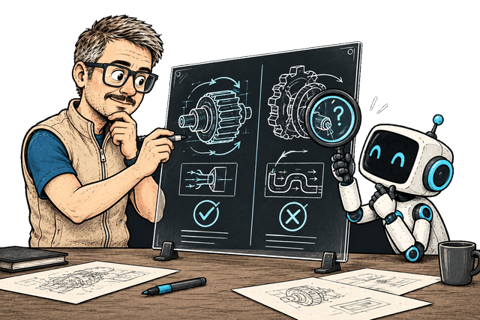
Work artifacts usually preserve conclusions. Apprenticeship depends on something else: seeing how an experienced person notices risk, rejects an attractive option, changes direction, and decides that evidence is sufficient.
Expose the decision path
A useful reasoning trace does not narrate every keystroke. It captures the observations that changed the plan, alternatives considered, assumptions tested, and signals that led to a decision.
The aim is legibility, not performance. A polished explanation written after success often removes the uncertainty that made the work educational.
Use lightweight formats
Engineers can add short reasoning notes to a design, record a narrated debugging session, annotate a pull request with rejected approaches, or publish a brief decision walkthrough after an incident. The format should fit the work and be searchable afterward.
Teams should avoid turning the practice into mandatory surveillance or a transcript of private cognition.
Invite questions, not imitation
Visible reasoning is one example of judgment in context, not a universal recipe. Learners should be encouraged to challenge assumptions and compare alternative approaches. Mentors can explain which parts were principles and which were situational choices.
This distinction prevents expertise from hardening into unexplained ritual.
Protect psychological safety
People will hide uncertainty if reasoning artifacts are used to score confidence or punish exploration. Leaders must separate learning material from performance theater and allow sensitive details to be redacted.
A healthy practice normalizes changing one’s mind when evidence changes.
A trace worth keeping
In this fictional excerpt from Northstar, Priya reviews the first retry implementation:
The sequential test passes. I am not yet satisfied because the code reads before it claims the key. I want to see what happens if two workers both read “missing.”
I expected the database constraint to reject the second worker. The test shows two orders, so I misunderstood where the uniqueness boundary was placed. The constraint protects the result row after order creation, not the whole effect.
I would move the claim and order creation into one transaction, then test a crash on both sides of commit. I am still assuming all side effects live in this database. If that assumption changes, this design needs another review.
The value is the changed hypothesis and its boundary. A transcript of every tool call would make those moments harder to find.
Let the learner disagree first
Pause the walkthrough before showing the failure. Ask the learner to predict which state can persist and propose a discriminating test. Then compare their reasoning with the observation. A different valid test is a useful contribution, not a failure to imitate the expert.
After the correction, change one assumption: suppose order creation also calls an external provider. Ask what no longer follows from the transaction argument. This tests transfer rather than recall of the original patch.
The mentor should admit uncertainty in the artifact. Retrospectively editing the trace to make the correct answer look inevitable removes much of its educational value.
A capture agreement
Before recording, agree who can see the material, what is excluded, how to redact it, and when it expires. Use synthetic inputs when customer information is irrelevant to the reasoning. A participant can decline recording and still contribute to the review.
Keep the educational trace separate from performance evaluation. An artifact designed to expose mistakes will stop being honest if those mistakes become a ranking feed. The manager should explain that boundary in concrete terms and honor deletion requests within the agreed retention policy.
AI can help organize the recording, but the participant checks the summary. A summary that removes the uncertainty or invents an explanation is not an accurate account of the decision.
A short practice session
Choose one uncertain decision from this week’s work. Capture the observation, competing explanations, test, changed belief, and remaining assumption in a page or a short walkthrough. Invite one colleague to find an alternative interpretation.
Only send the curated result to Learning Streams if it contains a lesson worth retrieving later. The practice should improve thinking before it increases the size of an archive.