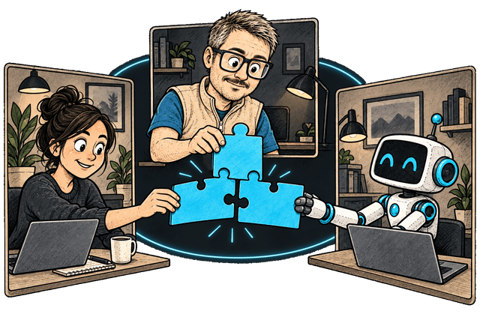
Culture does not require everyone to share a calendar. It does require repeated signals about what the organization values, how people treat one another, and which behavior earns trust.
Make norms observable
Values become useful when they appear in decisions and routines. Teams should define expectations for response, disagreement, ownership, documentation, escalation, and focus time.
Leaders must model the norms. A written async policy has little force if urgent private messages remain the real path to influence.
Build trust through reliability
In asynchronous work, trust grows when people provide complete context, meet commitments, acknowledge dependencies, and surface risk early. Silence should not require guesswork because the protocol makes state visible.
This is operational trust, and it supports interpersonal trust rather than replacing it.
Preserve human connection
Not every interaction should be transactional. Coaching, conflict repair, creative exploration, celebration, and informal conversation benefit from richer human presence.
Intentional synchronous time is compatible with async-by-default work. The distinction is whether the interaction requires shared presence.
Keep agents inside the culture
Agent instructions, review standards, and escalation rules encode organizational norms into execution. If they reward speed while leaders speak about quality, the executable culture wins.
Teams should inspect agent behavior as another expression of their operating values.
Read the exception path to find the real norm
Imagine Northstar says that all decisions should be recorded, but influential people routinely get work approved in private messages. The formal protocol becomes extra work for people without access. The culture is the exception path everyone learns to use.
The fictional retry case offers a smaller test. Luis objects to the client semantics. Does the team record and resolve the objection, or describe him as blocking progress because the agent already produced a patch? The answer teaches more than a statement about psychological safety.
Make disagreement possible without demanding performance
Give people ways to contribute before a decision: a written comment, a short conversation, or an assisted summary they can correct. Writing fluency, language, time zone, disability, and available focus time affect participation. Async should make room for different modes of contribution, not reward only the fastest polished writer.
Record material objections and how they were handled. The decision owner can choose an option despite disagreement, but should explain the authority and tradeoff. Consensus is not always necessary; legibility is.
An AI summary must not smooth away dissent to produce a tidy account. Ask the people whose position it represents to correct important summaries before they become governing context.
Inspect what earns recognition
| Stated value | Contradictory reward | Better evidence to recognize |
|---|---|---|
| Quality | Most patches opened | Reliable changes and useful defect prevention. |
| Learning | Always sounding certain | Corrected assumptions and shared reasoning. |
| Collaboration | Personal heroics | Durable interfaces and shared credit. |
| Sustainable work | Instant replies at all hours | Dependable response within agreed expectations. |
These are proposed review prompts, not a universal compensation framework. Apply them with the people affected and look for local consequences.
Notice when capacity becomes the baseline
Faster tools change what a team can produce, and the change rarely stays a choice for long. “We can do more” becomes “we should do more.” Yesterday’s unusual output becomes today’s baseline, and the next expectation arrives before anyone has registered the last result. People keep moving while fewer of them feel they have finished anything.
Ask whether the team decided to raise its pace or simply absorbed the new capacity. Leaders shape much of that answer through what they plan, praise, and ask about next.
Treat celebration as a practice rather than an occasional event. Before the next item starts, give completed work some attention: ask the person to explain the part they are proud of, and name the specific contribution. Someone made a difficult migration safe. Someone argued that a feature should not be built, and the product was better for it. Recognition that shows someone understood the work carries more weight than a generic congratulations, and it makes visible the contributions that counting artifacts misses.
Keep some time uninstrumented
Coaching, relationship repair, and informal connection need room outside permanent records. Agree what becomes organizational memory and what stays private. More searchable conversation is not automatically a better culture.
For a practical review, select a recent disagreement. Ask participants privately whether they could raise it, whether their position survived summarization, and whether the outcome changed how safe they feel to object next time. Report themes without exposing confidential accounts. Change one behavior leaders control before adding another values document.