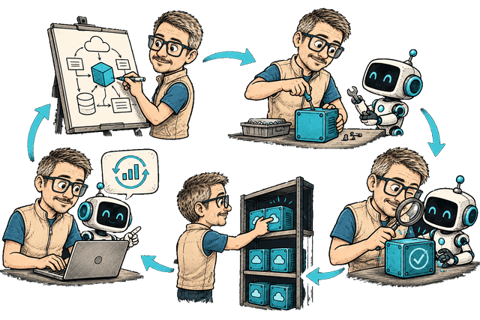
Software development has always combined human intent with technical execution.
Someone identifies a problem. A team decides what should change. Engineers translate that decision into software. The software is tested, deployed, operated, and eventually revised or replaced.
AI does not eliminate this lifecycle.
It changes how work moves through it.
The AI Software Development Lifecycle, or AI SDLC, is the operating model through which humans and AI systems jointly define, build, validate, deliver, operate, and improve software.
It is not simply traditional software development with an AI coding assistant added to the implementation phase. It is a redesign of the delivery system around a new fact:
That distinction matters.
Using AI to generate code is a tool choice. Building an AI SDLC is an organizational capability.
From AI-assisted coding to AI-assisted delivery
The first widely adopted use of generative AI in software engineering was code assistance.
An engineer could ask for a function, generate a test, explain an unfamiliar class, or autocomplete an implementation. The interaction happened inside the existing development process. The engineer still gathered the requirements, explored the repository, made the design decisions, coordinated with other teams, reviewed the result, and managed the release.
AI accelerated one activity inside the lifecycle.
The AI SDLC extends AI participation across the lifecycle:
- discovering and clarifying requirements
- inspecting existing systems
- retrieving relevant organizational context
- proposing implementation plans
- generating and modifying code
- producing tests and documentation
- reviewing changes
- checking policies and architectural constraints
- preparing deployments
- analyzing operational behavior
- capturing what the organization learned
The important change is not that AI appears in more tools. It is that AI becomes part of the execution layer through which engineering work moves.
A coding assistant waits for an engineer to ask a question.
An AI-enabled delivery system can receive a specification, resolve the relevant context, prepare a plan, implement a change, validate portions of its work, and produce evidence for human review.
The unit of acceleration therefore expands from typing code to moving an engineering change through the system.
The lifecycle remains
The phrase “AI SDLC” can sound as though a new lifecycle is replacing the old one. That is not what is happening.
Software still has to move through the same fundamental concerns:
- A need must be understood.
- A change must be defined.
- A solution must be designed.
- Software must be implemented.
- Its behavior must be validated.
- It must be released safely.
- Its operation must be observed.
- The resulting knowledge must inform future work.
These concerns do not disappear when AI becomes more capable. In many cases, they become more important because execution can happen faster and at greater scale.
What changes is the distribution of work within each stage.
In a traditional SDLC, people perform most of both the reasoning and the execution. Tools automate narrow, deterministic operations such as compilation, testing, deployment, and monitoring.
In the AI SDLC, people continue to establish intent and accountability, while AI systems can perform a broader range of interpretive and generative work.
The lifecycle remains.
Its execution model changes.
A working definition
The AI SDLC can be defined through five characteristics.
1. AI is a first-class participant
AI is not treated as an occasional productivity feature. It participates in repeatable, governed workflows.
Its inputs are defined. Its permitted actions are bounded. Its outputs enter established review and validation paths. Its activity can be inspected, reproduced, and evaluated.
This does not mean that AI operates independently everywhere. It means the delivery system has been intentionally designed for both human and machine participants.
2. Intent becomes executable
Traditional requirements are usually written to align people.
In the AI SDLC, specifications also guide machine execution. Requirements, constraints, acceptance criteria, interfaces, policies, and validation instructions become inputs to the development system itself.
This raises the standard for how work is defined.
A vague ticket given to a human engineer creates conversation.
A vague ticket given to an agent creates output.
The ability to execute ambiguity quickly is not an advantage. It is a risk.
For that reason, specification quality becomes one of the central engineering disciplines of the AI SDLC.
3. Context becomes infrastructure
An AI system cannot reliably perform engineering work from a ticket alone.
It may need to understand:
- the product objective
- organizational policies
- architectural standards
- ownership boundaries
- previous decisions
- service dependencies
- repository conventions
- operational history
- deployment requirements
- security and compliance constraints
Human engineers acquire much of this context through experience, conversations, documentation, code exploration, and organizational memory.
AI systems need that context to be discoverable and addressable.
The AI SDLC therefore depends on more than model capability. It depends on context architecture: how knowledge is stored, scoped, owned, inherited, versioned, and supplied to the work.
Source code remains important. Source context becomes equally important.
This is where Hierarchical Context becomes part of the delivery model rather than a documentation preference.
4. Validation becomes a primary bottleneck
When implementation is expensive, organizations optimize the production of software.
When implementation becomes cheaper, the constraint moves toward determining whether the generated change is correct, appropriate, secure, maintainable, and aligned with intent.
This makes validation broader than code review.
A mature AI SDLC may combine:
- compilation and deterministic tests
- static analysis
- security scanning
- policy checks
- architecture checks
- dependency analysis
- generated test evaluation
- runtime verification
- comparison against acceptance criteria
- targeted human judgment
The goal is not to remove humans from review. It is to use human attention where judgment carries the most value.
People should not repeatedly perform checks that reliable automated systems can perform. Passing those checks remains evidence within their scope. Deterministic checks enforce defined conditions; they do not choose the organizational tradeoffs behind those conditions.
5. Learning returns to the system
Every completed change produces more than code.
It can produce new architectural knowledge, operational evidence, corrected assumptions, reusable prompts, improved tests, clearer specifications, revised policies, and better understanding of the system.
Traditional organizations often leave this knowledge distributed across pull requests, conversations, incident documents, and individual memory.
The AI SDLC treats captured learning as part of delivery.
The lifecycle is not complete when code reaches production. It is complete when the organization has also incorporated what the work revealed.
This creates a feedback loop:
Intent
  ->
Context
  ->
Plan
  ->
Execution
  ->
Validation
  ->
Delivery
  ->
Observation
  ->
Organizational learning
  loops back to Intent
The output of one cycle improves the inputs available to the next.
The human and AI boundary
The AI SDLC is sometimes described as a path toward replacing engineers. That framing hides the more useful question.
The question is not whether a task is performed by a human or by AI.
The question is what kind of authority the task requires.
AI systems are increasingly capable of:
- retrieving information
- analyzing repositories
- identifying patterns
- generating alternatives
- implementing bounded changes
- producing tests
- checking consistency
- summarizing evidence
- monitoring defined conditions
Those capabilities make AI a powerful execution and analysis layer.
They do not automatically give it organizational authority.
Humans remain responsible for:
- deciding which problems matter
- defining acceptable outcomes
- resolving competing priorities
- approving consequential tradeoffs
- determining acceptable risk
- assigning ownership
- authorizing production impact
- accepting accountability for results
The exact boundary varies with the risk of the change.
A documentation correction may require minimal supervision. A payment-system migration, security-policy change, or destructive data operation requires stronger controls and explicit approval.
The AI SDLC is therefore not one fixed automation level. It is a governed system in which autonomy is matched to risk.
What changes in each stage
The easiest way to understand the AI SDLC is to compare how work moves through the lifecycle.
Discovery
Traditional discovery relies heavily on meetings, interviews, analytics, support reports, and manual research.
In the AI SDLC, AI can help assemble evidence, group recurring problems, inspect prior decisions, identify affected systems, and expose contradictions.
Humans still determine which problem deserves investment.
The request queue is one source of problems, not the only one. Requests reflect the products and constraints customers already know. Direction can also come from a technical capability that has become practical, domain insight that challenges an accepted assumption, strategic conviction, or a difficulty engineers keep meeting inside the system. A proposed direction is easier to test when it states the outcome it would enable, why that could matter, the assumptions that must hold, and the evidence that would cause the team to revise it. That keeps conviction separate from certainty. The Software Factory Needs Vision and a Way to Learn develops the argument.
Definition
Traditional requirements often describe the desired feature while leaving implementation assumptions implicit.
AI-enabled execution requires clearer intent, constraints, interfaces, acceptance criteria, and validation rules.
The specification becomes both an agreement and an operational input. This connects directly to the idea of Async by Default: communication becomes a durable protocol for moving intent between people, teams, and agents.
Planning
Planning moves away from decomposing work only into coding tasks.
It increasingly identifies:
- the context required
- the decisions that remain open
- the systems that may be affected
- the risks that need human review
- the evidence required for completion
- the boundaries within which agents may operate
The plan describes not just what to build, but how trustworthy execution will be established.
Implementation
AI can inspect the repository, propose a plan, modify code, create tests, update documentation, and prepare a reviewable change.
The engineer’s work shifts toward directing the change, resolving ambiguity, evaluating design choices, and investigating unexpected behavior.
Writing code remains part of engineering. It is no longer the only primary form of engineering execution.
Review
Review expands from reading lines of code to evaluating the complete change.
Reviewers need evidence that:
- the implementation matches the specification
- relevant constraints were applied
- affected interfaces were identified
- tests cover the intended behavior
- generated output does not introduce unsupported assumptions
- operational and migration risks have been addressed
The quality of the evidence becomes as important as the volume of output.
Delivery
Release workflows can use AI to prepare change summaries, identify rollout dependencies, draft migration steps, analyze deployment signals, and support rollback decisions.
Actual release authority remains governed by risk, policy, and ownership.
Operations
AI can assist with alert analysis, log investigation, incident correlation, runbook execution, and the production of incident timelines.
The operational system becomes another source of context for future development.
Learning
The final stage updates the organization’s reusable knowledge.
A completed change may revise a runbook, strengthen an architectural rule, improve a test harness, document a new failure mode, or correct previously incomplete context.
Without this step, the organization may generate software faster while repeatedly rediscovering the same information.
Scope and limits
A coding assistant rollout is one input to this operating model. Neither a vendor toolchain nor maximum automation defines the lifecycle. The goal is reliable delivery, with authority matched to consequence. Some work should remain manual or pause for an unresolved decision.
Iterative delivery and feedback remain useful. From Agile to AI-Native Development examines the mechanics; The AI-Executable Ticket defines the task contract; Evaluation and Release Evidence explains verification.
Follow One Change Through the System to see those mechanisms interact, including a failed attempt.
Three levels of adoption
Organizations frequently describe themselves as AI-enabled while operating at different levels of maturity.
Level 1: AI-assisted work
Individuals use AI inside the traditional lifecycle.
They generate code, tests, documentation, or explanations, but the surrounding workflow remains largely unchanged.
The productivity gain is personal and often difficult to reproduce across the organization.
Level 2: AI-integrated workflows
Teams introduce shared practices for specifications, agent execution, automated checks, review evidence, and approved tool use.
AI becomes part of repeatable engineering workflows rather than an individual technique.
The organization begins to redesign portions of the lifecycle.
Level 3: AI-native delivery
The lifecycle is designed around human and machine participants from the beginning.
Context is structured for retrieval. Specifications are executable. Work is routed based on ownership and risk. Validation is layered. Authority is explicit. Operational learning returns to organizational memory.
At this level, the organization is no longer using AI inside the old delivery system.
It has built a delivery system for AI-enabled engineering.
Why this is an organizational change
The visible artifact of software engineering is code, so it is natural to measure AI’s effect through code generation.
But software delivery depends on a much larger system:
- product decisions
- architecture
- communication
- knowledge management
- ownership
- review
- testing
- security
- deployment
- operations
- leadership
- learning
Accelerating implementation exposes weaknesses in all of them.
A team that can produce a change in twenty minutes but waits three days for context has not achieved twenty-minute delivery.
A team that generates ten times more code without increasing its ability to validate changes has increased review pressure, not necessarily value.
A team that delegates implementation to agents but keeps critical knowledge inside meetings and personal memory has created an execution layer that cannot reliably understand its environment.
This is why AI SDLC adoption cannot be owned only by a developer-tools group.
It requires changes to engineering management, technical leadership, platform capabilities, organizational knowledge, governance, and team interaction.
AI changes software development most significantly when the system around implementation changes with it.
The new engineering equation
The traditional engineering constraint was often expressed through implementation capacity:
Traditional constraint:

Ideas -> Available engineers -> Software
The following is a conceptual heuristic, not a measured equation or a quantitative prediction. It emphasizes interacting prerequisites:
AI SDLC constraint:

Intent
x Context quality
x Validation capacity
x Organizational judgment
= Reliable delivery
Execution capacity still matters, but it is no longer sufficient.
If intent is unclear, AI accelerates the wrong work.
If context is incomplete, AI makes unsupported assumptions.
If validation is weak, AI increases output faster than confidence.
If authority is unclear, automation creates organizational risk.
The value of the AI SDLC comes from improving the full equation, not maximizing one term.
A practical test
An organization has begun building an AI SDLC when it can answer these questions clearly:
- What inputs does an AI system receive before it begins work?
- Which sources of context are authoritative?
- How is intent expressed precisely enough for execution?
- What actions may an agent perform without approval?
- Which decisions require accountable human authority?
- What deterministic checks must pass?
- What evidence accompanies a generated change?
- How are affected teams and systems identified?
- How is production behavior connected back to the original intent?
- Where does the resulting knowledge live after the work is complete?
When the answers depend on whichever engineer happens to be using the tool, the organization has AI-assisted coding.
When the answers are part of the delivery system, the organization is developing an AI SDLC.
The foundation for an AI-native organization
The AI SDLC is the delivery core of an AI-native engineering organization.
It connects the other systems discussed throughout this book:
- Communication determines how intent and change move between people, teams, and agents.
- Knowledge supplies the context needed for trustworthy execution.
- Learning develops the judgment that cannot be reduced to generated output.
- Leadership designs the boundaries, incentives, and operating mechanisms.
- Execution coordinates humans, agents, and deterministic tools.
- Organizational design determines whether local improvements become durable institutional capability.
None of these dimensions is secondary to the lifecycle.
Together, they are the lifecycle.
The AI SDLC is therefore not primarily a method for producing more code. It is a system for converting human intent into reliable software through coordinated human and machine work, while continuously improving the organization that performs it.
That is the central idea from which the rest of this book follows.