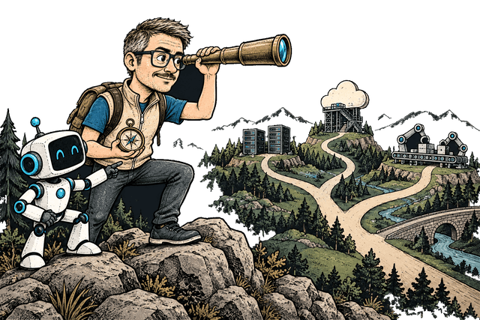
The useful question is no longer “can AI write code?” It can. The more interesting question is what the next few model generations change, and what those changes mean for how work is defined, delegated, executed, reviewed, and trusted.
This chapter develops conditional planning assumptions rather than predicting a product roadmap. The assumption is simply this: if frontier models keep improving and their harnesses improve around them, the biggest impact may not be “more code faster.” It may be a redesign of how work is defined and trusted.
It is the harness, not just the model
A coding agent is not a model floating in space. It is a model inside a harness: repo access, tools, context retrieval, memory, permissions, orchestration, validation, and feedback loops. The harness determines whether the model becomes a useful teammate, a risky intern, or a very expensive autocomplete.
This is also why “larger context window” is not the same as “smarter.” A bigger window is only useful if the harness retrieves the right evidence, marks what is authoritative, and ignores what is stale. Otherwise the model gets a bigger haystack and may confidently use the wrong needle.
From assistant to delegated work system
The important trend is not a version number. It is the steady movement from assistant to agent to delegated work system, and at each stage the human bottleneck moves up a level.
| Stage | System behavior | Human bottleneck |
|---|---|---|
| Autocomplete | Suggests fragments | Implementation speed |
| Pair programmer | Helps with functions and tests | Prompting and review |
| Coding agent | Works across files and tools | Task framing and validation |
| Project agent | Owns tickets or feature slices | Specs, architecture, risk control |
| Multi-agent system | Specialized agents collaborate | Governance and value judgment |
These stages are a vocabulary for assessing a workflow, not a dated ranking of available products. Leaders should evaluate the task boundary their own system can reliably handle. As work units grow, a ticket stops being a tracking artifact and becomes an executable contract, the same shift the The AI SDLC is built around.
The new bottleneck is value definition
The biggest mistake is assuming better models mostly improve throughput. If execution gets cheaper, value definition becomes more important, not less. When implementation is expensive, weak ideas die naturally because they are too costly to build. When implementation is cheap, weak ideas survive longer as features, settings, dashboards, and technical debt.
The better metric is not time-to-code or time-to-PR. It is time-to-trusted-output: how long it takes to get from intent to a result humans trust enough to ship. Stronger systems may improve that not by producing faster first drafts, but by producing fewer bad ones.
Responsibilities to preserve
Organizations should retain accountable ownership of priorities, customer commitments, and risk acceptance even when agents help reason about them. That is a governance recommendation, not a prediction that these cognitive tasks will remain beyond AI capability. A vague strategy gives powerful agents too little basis for choosing useful work.
OpenAI’s September 2026 research-acceleration report describes broader delegation while retaining human direction and substantial intervention on complex tasks. It also cautions that more code and experiments do not directly measure overall research progress. This is a dated internal observation, not a permanent capability boundary.
Nor does better system design guarantee that existing roles survive. Anthropic’s economic scenario explorer includes futures with displacement and uneven gains for knowledge workers. Those are conditional model outputs, not forecasts to adopt as fact. A leadership plan should test staffing, retraining, and benefit-sharing assumptions alongside its delivery model.
The organizations that benefit most will not be the ones with the most AI tools. They will be the ones that redesign work around human intent and machine execution: better inputs, clearer boundaries, stronger feedback. Those capabilities compound across every model generation. The next model will not save weak process. It will make leadership more visible, and probably more expensive to fake.
Three scenarios to prepare for
Rather than organizing a strategy around an undated claim about the current frontier, consider three conditional scenarios. These are planning hypotheses, not probabilities or predictions.
| Scenario | What to observe locally | Sensible response |
|---|---|---|
| Better models, similar supervision burden | First drafts improve but review and rework remain costly | Invest in evidence and task selection before expanding autonomy. |
| Reliable bounded delegation | Repeated success on an evaluated task class with manageable intervention | Expand that class gradually with revocation triggers. |
| More output, weaker system outcomes | Queues, complexity, or escaped defects grow | Reduce admission, narrow scope, and repair the constraint. |
The same company may experience all three in different repositories. A vendor capability announcement does not settle which scenario applies to a payment migration or an internal documentation update.
For a more specific treatment of feedback-driven capability, read Recursive Self-Improvement and Organizational Change. It separates current AI-assisted improvement from autonomous successor development, and follows the consequences through delivery and company transformation.
Questions still open
How much retained context improves a task before maintenance and contradiction overwhelm its benefit? When does parallel execution earn its integration cost? Which learning activities develop judgment when routine implementation is delegated? How reliably can organizations measure outcomes without rewarding proxies?
A further question concerns what counts as the source. Suppose a business rule were stored in a form written for machines, with source code, a permissions matrix, and policy prose rendered as views of one model. The Coding Language of the Future Might Not Be for Humans sketches that idea as a hypothesis; no one has implemented or benchmarked it. Two conditions remain unproven. First, a view must be faithful enough to sign: a security lead who certifies the matrix has to be certifying what runs, not a persuasive account of it. Second, an edit made in a human view has to return to the model with its meaning intact, or stay visible as an open question when it cannot. Earlier round-trip tools failed by rejecting or losing edits they could not express. A language model moves that failure: it will express nearly any edit, confidently and sometimes wrongly. Branches could also merge cleanly as text while disagreeing in behavior or policy. Until a tool demonstrates both conditions, source code stays the source.
The book proposes mechanisms for investigating these questions. It does not claim they have been resolved by a single model generation or by this operating model.
Keep a small assumption register. Record the claim, task boundary, evidence, owner, and next review trigger. Retire assumptions when observed results contradict them. If stronger models repeatedly fail to reduce total accepted-change cost in a workflow, change the investment decision instead of explaining away every result.