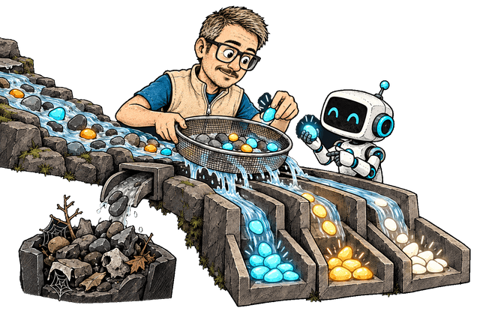
An engineer explains why a retry test needs concurrent requests. The reviewers understand, the patch lands, and the explanation remains in a pull-request thread. A month later another engineer makes the same mistake. A learning stream gives that observation a destination and a route into later work.
Capture close to the event
The best raw material appears during debugging, review, incidents, design, and customer discovery. Capture should be lightweight enough to happen there: a short note, annotated change, recorded walkthrough, or structured lesson.
The raw artifact does not need to be timeless. It needs enough context for later curation.
Curate for reuse
Not every observation deserves policy status. A curator or owning team should remove duplication, connect related evidence, identify scope, and decide whether a lesson belongs in a runbook, standard, example, or training path.
Curation converts a stream of activity into an organizational asset.
Deliver learning in the workflow
A searchable archive is insufficient if engineers must remember to visit it. Relevant lessons should appear in onboarding, repository guidance, design templates, incident preparation, and agent context.
The point of a learning stream is changed behavior at the moment of work.
Close the feedback loop
Consumers should be able to correct, supersede, or rate the usefulness of guidance. Usage and failure signals show which material is trusted and which has decayed.
A learning system that only accepts new content becomes an attic. A healthy stream removes and revises as actively as it adds.
From a failed check to a useful lesson
The fictional Northstar case produces a concurrency failure. Its raw trace is long and specific. The curator extracts a smaller lesson: a sequential replay test cannot establish concurrent safety. The lesson links to EVAL-42, its source revision, and the scope in which the conclusion was observed.
That lesson takes three forms. A repository check prevents recurrence. A short annotated example supports onboarding. A review prompt asks whether a new retry design has concurrent and crash evidence. Those are different consumers; they do not need identical text.
| Stage | Owner action | Exit evidence |
|---|---|---|
| Capture | Preserve failure and context | Reproduction tied to a revision. |
| Curate | Remove sensitive detail and establish scope | Reviewed lesson with owner and limitations. |
| Deliver | Put the lesson where the relevant decision happens | Link from the task or review path. |
| Apply | Use it in a later task | A changed test, plan, or decision. |
| Reassess | Check validity and usefulness | Keep, revise, supersede, or delete. |
View count is evidence of exposure, not understanding. A later engineer identifying the same race under a different surface is stronger evidence of transfer.
Give the stream a deletion path
Every retained artifact needs a purpose and an owner. Raw recordings may deserve shorter retention than a sanitized lesson. An expired policy example should stop appearing as current guidance. A participant’s access restrictions must survive transcription and summarization.
Do not automatically retain every conversation. Select designated learning sessions and useful work artifacts with participant agreement. Otherwise the organization creates a surveillance system and calls it education.
Budget curation. If nobody can review ten new lessons this week, capture fewer or maintain a clearly unreviewed queue with restricted use. An agent should not consume unreviewed observations as governing policy.
Keep this distinct from organizational change
A learning stream makes a lesson discoverable and usable. Continuous Learning asks whether shared practices actually changed across teams. A curated example may be excellent while the organization still rewards behavior that ignores it.
For a first trial, retain one lesson and name one future context where it should appear. Revisit that context with a colleague who was not present at the original event. Record whether the lesson changed their action and what they still had to ask. Improve the delivery path before increasing capture volume.