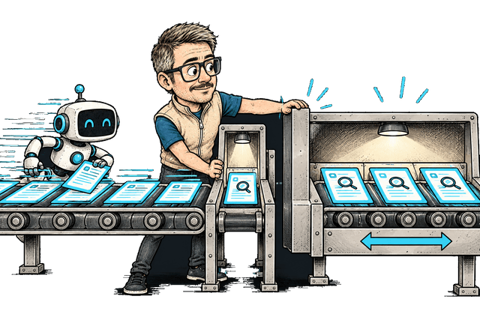
AI changes software engineering before it changes the organization chart. The first visible effect is faster implementation. The more important effect is that constraints move. Work that once took days can be attempted in hours, while clarification, review, coordination, and operational confidence still move at human speed.
Implementation is only one cost
Software delivery includes discovery, decisions, context retrieval, design, implementation, validation, release, and learning. AI can reduce effort in several of these activities, but it does not remove them. A faster implementation phase exposes delays elsewhere. If a change waits two days for an ownership decision, generating it in twenty minutes does not create twenty-minute delivery.
This is why local productivity measurements are incomplete. They can show that an engineer finished a coding task faster while missing whether the organization delivered a reliable outcome sooner.
The feedback loop becomes tighter
Lower-cost implementation makes smaller experiments practical. Teams can compare alternatives, add tests, inspect unfamiliar code, and revise a change with less mechanical effort. The advantage comes from receiving useful evidence sooner, not from maximizing generated output.
A tighter loop also creates more opportunities to make the wrong change quickly. Clear intent and observable acceptance criteria become load-bearing because they determine whether fast feedback teaches the team anything.
Leverage shifts toward judgment
When routine production becomes easier, scarce judgment has more reach. A clear architectural decision can guide many agent-assisted changes. A vague standard can create inconsistency at the same scale. Senior engineers therefore create leverage by making reasoning, constraints, and examples reusable.
The same principle applies to product and operational judgment. AI can assemble options and evidence. Accountable people still decide which problem matters, which tradeoff is acceptable, and which risk the organization will own.
The surrounding system has to keep up
Repositories, review workflows, team boundaries, and governance were designed around a particular cost profile. AI does not invalidate them. It changes the load placed on them. A review process designed for a few large changes may struggle with many smaller ones. Knowledge held in meetings becomes harder to supply consistently to agents.
The practical response is system design: improve specifications, make context addressable, automate deterministic checks, define authority, and capture learning. That is the foundation of the AI SDLC.
Follow the elapsed time
Consider a hypothetical change that spends four hours in implementation, two hours in review, and three working days waiting for an interface decision. Cutting implementation to one hour saves three hours. It does not remove the three days. Those invented numbers illustrate a measurement boundary, not a claim about typical teams.
In Northstar, the important early work is deciding what a retry means. Writing the handler before that decision can create rework in both client and server. Faster code may shorten the wrong part of the path.
Make a timeline for one recent change. Separate active work from waiting, and distinguish elapsed time from labor cost. A day of waiting may consume little engineering labor while still delaying customer value. A concentrated hour of review may be expensive labor and still be the best investment in the system.
The counterexample matters
Implementation does not become cheap everywhere. A novel algorithm, a poorly understood legacy subsystem, a constrained device, or an environment with weak tests may still require difficult technical work. A task can also cost more with an agent once orientation, correction, and verification are counted.
The book’s thesis is conditional: when the cost or speed of execution changes materially, inspect the surrounding constraints before scaling execution. It is not a claim that every engineering organization has already crossed that threshold.
Nor does every constraint end in user adoption. Adoption is a possible constraint, not a universal one, and the work mix decides the path to value. A new workflow may need training before anyone benefits. A latency improvement, a security fix, a cost reduction, or the retirement of recurring operational work can reach value without users learning anything new. When feature adoption saturates, capacity can move to that kind of work. The Maximum Velocity of a Team develops the point.
The same caution applies to organizational knowledge. Better context cannot rescue an incoherent product decision. Nor should a two-person team build a hierarchy of repositories merely because a large organization benefits from explicit scope and ownership.
Establish a baseline you can challenge
Choose a small, recurring task category. Record the outcome, active effort, waiting, review effort, rework, and defects that surface within an agreed observation window. Compare agent-assisted work with similar work under the existing process. Keep the selection criteria visible: assigning only easy tasks to the agent makes the comparison misleading.
Write down what would reverse the investment decision. For example: if accepted changes cost more after review, or quality deteriorates, narrow the task class and investigate before buying more capacity. Engineering Economics develops the calculation. The useful result of this exercise can be a decision to leave a workflow alone.