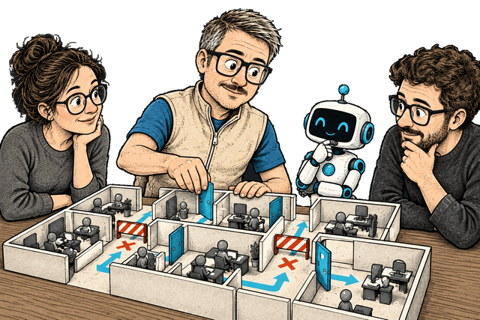
Follow a new engineer trying to release their first change. They need a service owner, an accepted specification, the right permissions, and someone who can explain a failed check. Each handoff is part of the environment the organization provides. Treating that environment as a product means investigating where this person’s work stalls and owning the repair.
Design the whole experience
Team topology, incentives, knowledge systems, tools, leadership behavior, and communication protocols interact. Improving one surface while ignoring the others often moves friction rather than removing it.
The organization needs an explicit operating model that explains how these elements support its purpose.
Create feedback from work
The strongest signals come from delivery and operations: recurring waits, ownership confusion, incidents, rework, onboarding questions, and decisions repeatedly escalated. These are product feedback about the organizational environment.
Leaders should collect them without converting every complaint into a new process.
Evolve through bounded changes
Organizational redesign is safer when changes have a hypothesis, owner, affected users, adoption support, and review point. Teams can learn from a pilot before expanding a mechanism.
The language of experimentation does not remove accountability. People experience organizational changes directly.
Maintain coherence
Local optimization can fragment the organization into incompatible tools, terms, and policies. Shared principles and interfaces provide coherence while allowing teams to adapt locally.
Shared capability is one way to buy coherence, and it has a price. An enabling platform investment that lets several teams deliver without coordinating every release can create more capacity than speeding up a team that is already independent. The same platform becomes a new queue if every small change needs its owners. Evaluate it against the dependencies it removes and the obligations it creates. Where sharing costs more than it saves, limited duplication is acceptable. The Maximum Velocity of a Company treats this as a portfolio choice.
The aim is not uniformity. It is predictable collaboration across boundaries.
Decide what belongs to the product
This chapter is the canonical definition of Organization as a Product: the working environment is a designed system with users, constraints, interfaces, and feedback. Operating the Improvement Backlog explains the management practice. Keeping that distinction prevents the same argument appearing twice under almost identical titles.
The product includes how people discover ownership, propose a change, receive a decision, get help, learn, and recover from mistakes. It also includes incentives. A written quality policy and a promotion process that rewards only visible throughput are two conflicting parts of the same product.
Employees are participants with agency, not components to optimize. Organizational experiments affect workload, opportunity, trust, and power. Their experience is part of the outcome, not an implementation inconvenience.
Follow one boundary across the whole system
In the fictional Northstar case, safe retries depend on a shared definition between Checkout and Orders. A tooling change alone cannot settle that definition. A team restructure alone cannot test it. A review policy alone cannot supply missing implementation context.
The organizational intervention connects an owner, a decision record, a communication contract, and a verification path. It is small enough to try on one change and broad enough to expose the interactions that matter.
If it helps Orders while creating unowned work for Checkout, the product has not improved as a whole. Ask both sides before declaring success.
Avoid turning the metaphor into a mandate
Organizations differ from software products: people interpret rules, negotiate legitimacy, and change their behavior in response to measurement. A process cannot be rolled back as though the trust it damaged never existed.
Use the product lens to improve discovery, stewardship, and feedback. Do not use it to justify constant restructuring or to treat every human disagreement as a defect. Sometimes disagreement is the mechanism that prevents a bad decision.
For a tiny team, one shared owner map and a few explicit decisions may be sufficient. Add structure when observed coordination costs justify its maintenance, not because the eight dimensions imply eight departments.
A test of the model
Choose one journey, such as a new engineer making a first production change. Ask the person to trace where they found context, requested authority, received feedback, and learned what to do next. Record friction at the boundaries rather than assessing each tool in isolation.
Select one change that improves that journey and name the people who may bear its cost. If you cannot identify them, the proposal is not ready for an organizational experiment.