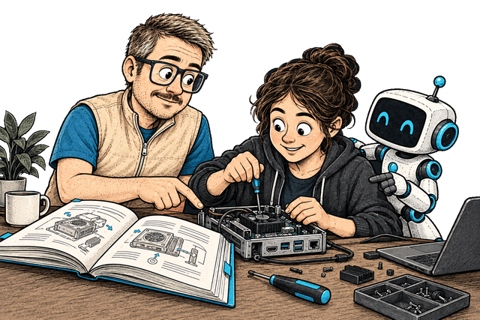
Imagine an organization where every architectural decision is documented, every design discussion captured, every pull request explained, and an AI can answer any question about any service. On paper, the best knowledge-sharing system ever built. Now imagine a new engineer joining it. Six months later they are productive, but they are not growing as fast as someone who started ten years ago.
That is a hypothetical failure, not an observed comparison between generations of engineers. Information is not the same thing as learning. If AI makes knowledge cheaper, organizations need to become more deliberate about the thing knowledge does not automatically produce: judgment.
Anthropic’s coding-skills experiment gives a narrower reason to test understanding directly: it found lower immediate quiz scores in the assisted group. It does not establish that AI tutoring cannot teach judgment. The mentorship chapter examines that experiment alongside more positive self-reported learning evidence.
The apprenticeship we did not know we had
Much engineering learning happens through apprenticeship, even when a team does not call it that. A junior overhears two staff engineers debating an API. Someone catches half a whiteboard discussion. A senior mutters “this cache makes me nervous,” and another replies “me too, we tried something similar three years ago.” None of it was intended as training. All of it trained everyone listening.
Educational researchers have language for this. Lave and Wenger’s work on situated learning described learning as participation in a community of practice, not the transfer of facts. We do not learn architecture by memorizing documents. We learn it by watching people reason through trade-offs, constraints, incidents, and organizational scars.
Documentation captures decisions; learning comes from reasoning
AI-assisted workflows can make documentation easier to produce, although its quality still needs review. Documentation can preserve uncertainty, but teams often record the conclusion more carefully than the reasoning. When an engineer writes “we chose Redis over DynamoDB for latency reasons,” the reader learns the decision. What they do not see is the hour before that sentence existed: “I almost chose DynamoDB,” “I was worried about operational complexity,” “I remembered an incident from another company,” “I realized latency was not actually our bottleneck.”
Two different learning systems
AI can support explanations, practice, and exploration. Human mentors bring responsibility for a particular learner in a particular organization. The useful distinction is how we design those supports, not a permanent division of cognitive abilities.
| AI-supported practice | Accountable mentorship |
|---|---|
| Explain a concept in several ways | Notice the learner’s recurring misunderstandings |
| Generate exercises and counterexamples | Select work with appropriate consequences |
| Explore possible tradeoffs | Challenge reasoning against local experience |
| Provide feedback for further checking | Observe transfer and adjust responsibility |
These supports can overlap. The organizational mistake is to provide a tool and assume that someone is therefore responsible for the learner. Assign that responsibility and evaluate whether the learner develops transferable judgment.
Make execution async, make judgment observable
The companion argument in Async by Default is that execution belongs in durable artifacts, not meetings. That is right. But learning follows a different optimization function. Observing expert reasoning can complement reading conclusions and practicing independently. If we eliminate every synchronous interaction in pursuit of efficiency, we accidentally remove one of the strongest learning mechanisms engineering ever had.
The answer is not to bring back status meetings. It is to change what synchronous time is for.
| Use async for | Protect human time for |
|---|---|
| Status | Sense-making |
| Decisions already made | Decisions still forming |
| Clear requests | Ambiguous trade-offs |
| Routine review | Judgment calibration |
| Action tracking | Mentorship and relationship building |
The operating principle: make execution asynchronous, but make judgment observable.
Thinking out loud
The practice that makes judgment observable is Thinking Out Loud: deliberately capturing reasoning, not just the final answer. Not architecture theater. Real thinking, of the form “this implementation feels elegant, but I have seen similar systems become operational nightmares,” or “my intuition says something is off; let us figure out why.” None of these are decisions. They are windows into how experienced engineers build intuition, and that intuition is often more valuable than the final design.
This is not a new idea in AI clothing. The cognitive apprenticeship literature emphasizes making expert thinking visible through modeling, articulation, and reflection, teaching the craft behind expert performance rather than handing over the final answer.
Learning streams
We already record demos. Why not record engineering thinking? Imagine experienced engineers occasionally narrating real work: searching unfamiliar code, exploring logs, changing their minds, taking wrong turns, recognizing patterns. Then AI turns the recording into searchable knowledge. Future engineers can search not just “how was this bug fixed” but “how did Alice figure this out?” This is Learning Streams: expert reasoning as a first-class, searchable artifact.
It needs governance. Not every session should become permanent memory. Record by default only in spaces designed for learning, redact secrets and customer data, let participants mark sections private, and summarize the reasoning pattern rather than every raw sentence. The goal is not surveillance. It is reusable judgment.
The mentorship paradox
Experienced engineers may thrive in highly async environments. New engineers often will not. Experienced engineers know what questions to ask; beginners do not. So the first few years of a career may become more dependent on mentorship than ever, not because information is scarce, but because it is abundant. Someone still has to teach judgment.
Async systems make execution scalable. AI makes knowledge accessible. But careers are still built through observation, mentorship, and shared reasoning. The watercooler may never come back. Apprenticeship should, and this time we can build it on purpose.
Check whether the lesson transfers
The fictional Northstar case gives a practical assessment. Show a learner the sequential retry test before revealing the concurrency failure. Ask which assumption it does not test and how they would challenge it. After the correction, introduce an external side effect and ask what no longer follows from the local transaction argument.
The learner can use AI to explore alternatives. They still need to explain which evidence supports the decision and where they would stop. The mentor is accountable for feedback in this actual working context, including consequences a general-purpose tutor may not see.
This avoids a brittle claim that machines can teach only facts and humans alone can discuss tradeoffs. Both can support explanation and practice. The organizational obligation is to ensure that someone knows the learner, observes their decisions, gives honest feedback, and adjusts responsibility accordingly.
Protect time for this work and make participation accessible. A searchable recording is helpful, but it does not notice that a new colleague is reluctant to ask a question. Mentorship in AI-Native Teams provides a progression of responsibilities, while Thinking Out Loud shows the reasoning artifact itself.